

Main Menu
Let's chat.

Have a Revenue Growth Analytics pain point, a question, or a content suggestion?

Pharmaceutical Pricing Analytics — Governed, Auditable, and Defensible

Pharmaceutical pricing language must stay precise. Revology co-designs governed AI pricing analytics, contract economics, and tier governance systems, with legal review before publication.

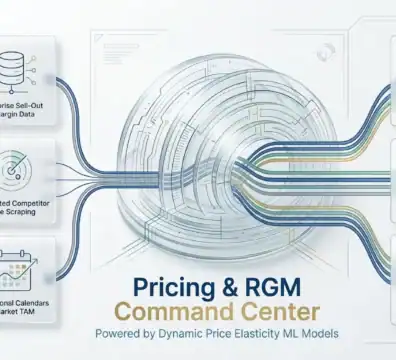
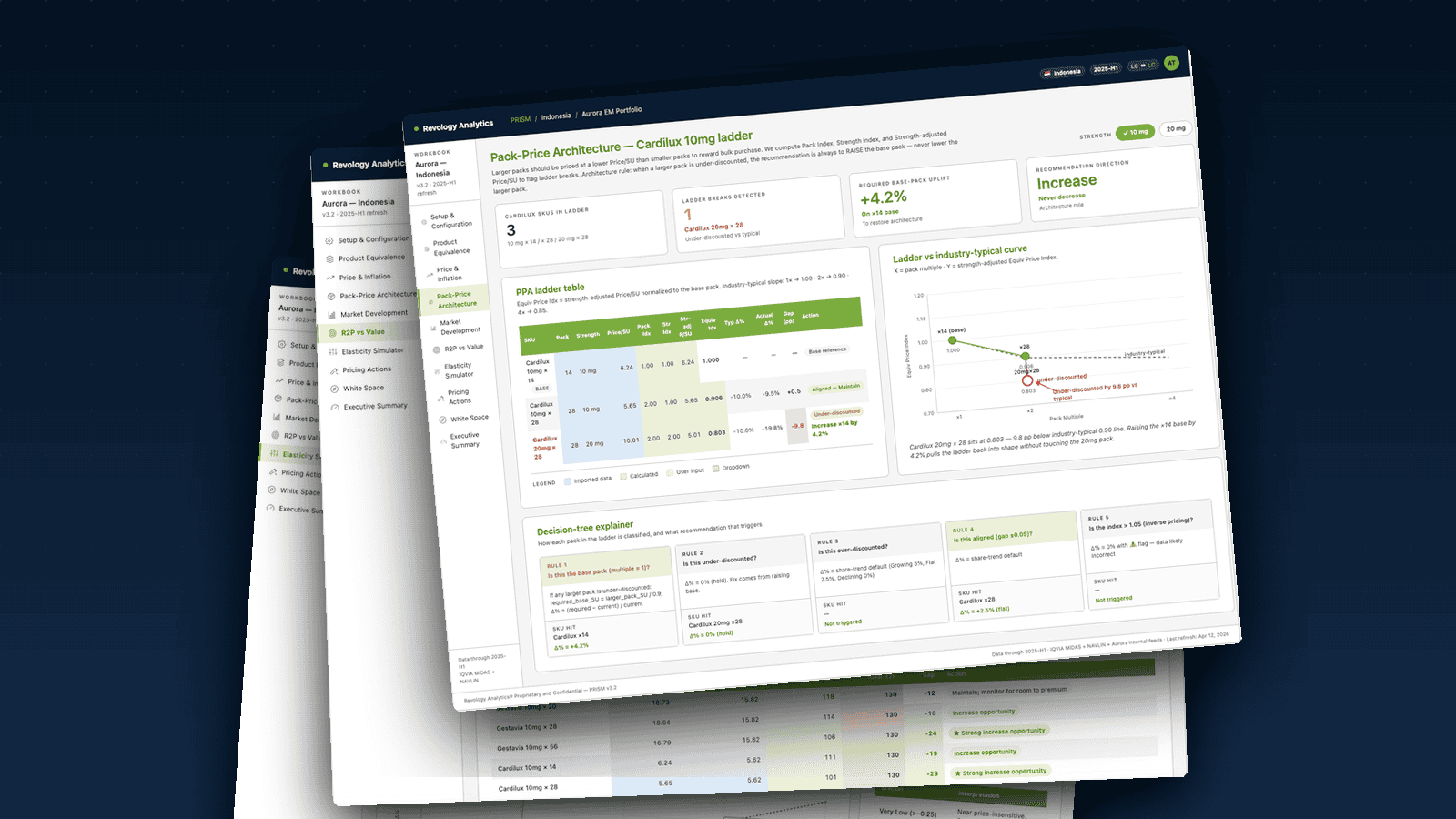
Pharmaceutical pricing pages need precision, and pharma pricing itself needs structure that survives scrutiny. Revology co-designs the analytics and builds the capability inside pharmaceutical commercial teams: an automated Product Equivalence Matrix that maps each product to true competitor equivalents (one recent build reached 95%-plus SKU coverage), causal elasticity models using Double Machine Learning that separate real price sensitivity from promotions, supply swings, and competitor moves, a Competitive Price Index that flags under- and over-priced SKUs, and scenario simulators that project volume, revenue, and gross-profit impact before a price moves — surfacing the Pricing Quick Wins worth acting on first. The work integrates internal sales and cost data with syndicated sources and normalizes to standard units. It is scoped to pricing and revenue decisions, not clinical efficacy or patient outcomes. For mid-market and business-unit teams ($100M–$2B), keep regulated-industry counsel review on final copy wherever reimbursement, access, or outcomes language appears.

Q: How does Revology handle pharmaceutical pricing compliance constraints?

A: We design the AI analytics outputs to be auditable, defensible, and compatible with the client's pricing-compliance review process. Compliance counsel is engaged on the client side.

Q: What use cases fit pharma best?

A: Gross-to-net modeling, payer-mix analysis, wholesaler/pharmacy channel pricing analytics, rebate-accrual integrity, and 340B program analytics.

Accelerating Pricing & Revenue Growth in the Pharmaceutical Sector

Our Approach to Pharma:

Pharmaceutical companies contend with intense branded generic competition, overlapping regulations, and high-stakes pricing decisions. Relying on static spreadsheets or simple benchmarks is no longer enough. Our pharma work focuses on three pillars:

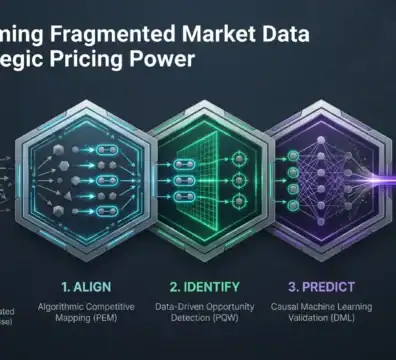
  1. Product Equivalence Matrices (PEM) at Scale
  • Build automated equivalence logic using ingredient, dosage form (including ER/SR), strength, pack size, and therapeutic alignment (e.g., ATC/TA).
  • Normalize prices to a standard therapeutic unit (such as DDD or standard units) so you can compare your price architecture to competitors on a true like-for-like basis.
  • Deliver transparent similarity scores that make it easy for brand, pricing, and market access teams to trust and use the mapping across countries and portfolios.
  1. Causal Elasticity & Demand Modeling
  • Apply advanced machine learning and Double Machine Learning (DML) frameworks to separate true price sensitivity from noise created by promotions, competition, supply constraints, and other confounders.
  • Estimate own- and cross-price elasticities at the right level of granularity (brand/SKU, segment, or channel) to inform pricing strategy in both non-regulated and semi-regulated environments.
  • Translate elasticities into practical guidance: where you can take price up with limited volume risk, where you should defend price, and where targeted reductions can expand access and share.
  1. Pricing Quick Wins & Scenario Simulation
  • Combine PEM outputs and elasticity insights into a Competitive Price Index (CPI) view that highlights underpriced and overpriced SKUs within each market.
  • Build user-friendly simulators that allow country and portfolio teams to test “what-if” price changes and see projected impacts on volume, revenue, and gross profit before any move is executed.
  • Prioritize a pipeline of Pricing Quick Wins (PQWs) that can be implemented quickly while laying the foundation for longer-term revenue growth management capabilities.

Beyond analytics, we emphasize capability building—training your teams to maintain the PEM, refresh models, interpret outputs, and embed pricing analytics into standard business rhythms so value continues to compound after the project ends.

Colorful pharmaceutical capsules and pills for medication and health.

Key Client Deliverables

Multi-Country Product Equivalence Matrix

Rules-based equivalence logic achieving >95% SKU coverage and harmonizing internal product views with IQVIA market data.

Price Elasticity Modeling & PQW Engine

Causal ML-based price elasticity models and a recommendation engine that surfaced SKU-level price opportunities with quantified volume, revenue, and margin tradeoffs.

Capability Building & Governance

Training, documentation, and governance frameworks that embedded PEM maintenance, model refresh cycles, and pricing decision standards into day-to-day operations.

Pricing Simulator & Insights Dashboards

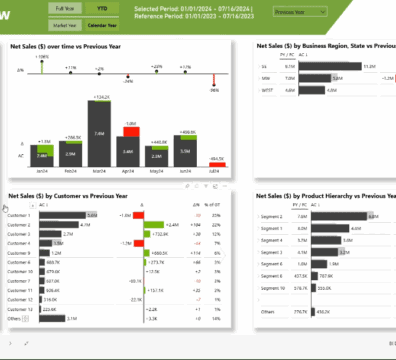
Excel/BI tools that allowed local teams to simulate price moves, evaluate CPI positions, and communicate impact in a common language to finance and leadership.

Case Studies

Featured Whitepapers

Let's chat.

Have a Revenue Growth Analytics pain point, a question, or a content suggestion?

The Hurt Hub@Davidson
210 Delburg St, Davidson, NC 28036, United States
+1 803-701-9243

Get in Touch

We would love to hear from you.

Browse Articles

No more posts to show