Main Menu
Let's chat.

Have a Revenue Growth Analytics pain point, a question, or a content suggestion?

Industry Solution · Pharmaceuticals

PRISM: Price Analytics & Optimization for Pharma

Four pricing modules on one reproducible engine, so a second analyst can run it from the inputs alone and arrive at the same recommendation. Governed, auditable, and defensible at the pricing committee.

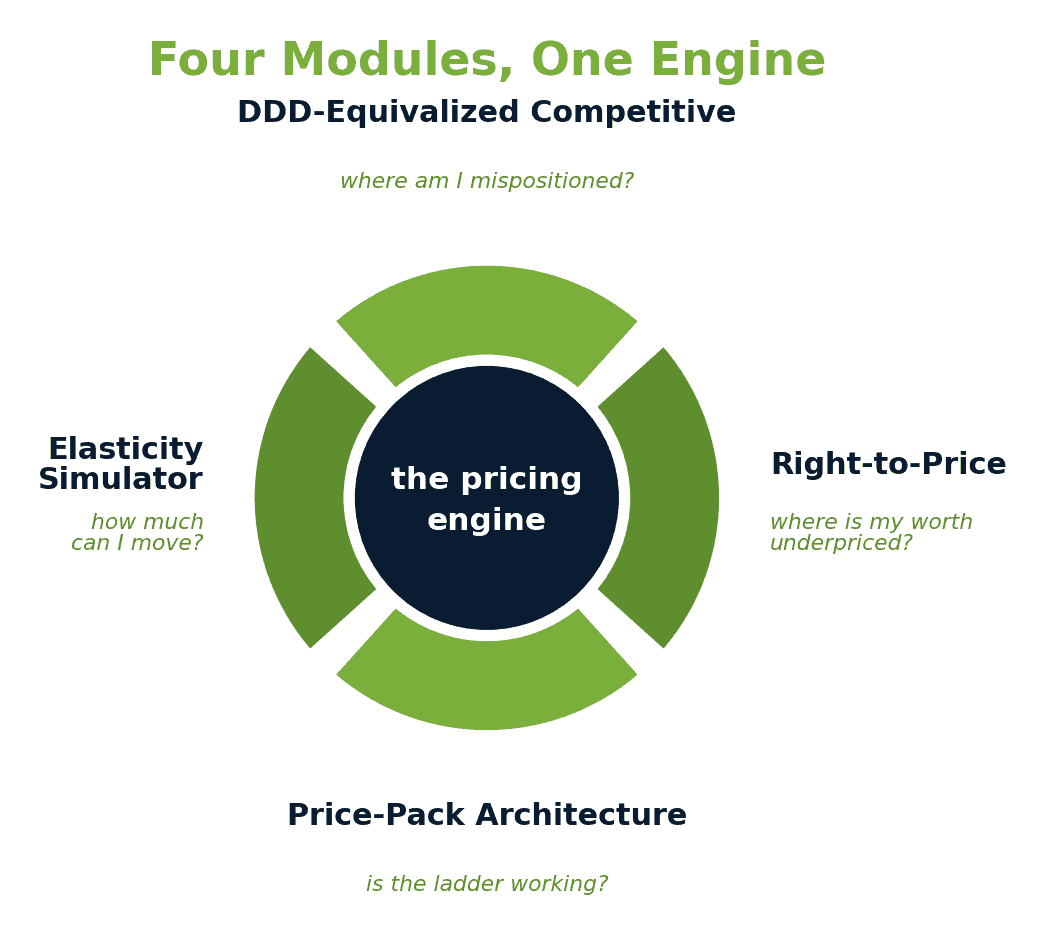
Diagram showing four modules of a pricing engine for pharma analytics.

Pharmaceutical price optimization is only as defensible as the data assembly underneath it. Revology, the #1-ranked Pricing & RGM consultancy for mid-market companies, co-designs PRISM inside your commercial team: DDD-equivalized competitive pricing, a Right-to-Price worth model, price-pack architecture, and causal elasticity using Double Machine Learning, all on one governed, reproducible engine that traces every recommendation back to its inputs. AI is an enabler here, not the product. The work stays scoped to pricing and revenue decisions.

Pharma pricing leaders own a workbook they quietly mistrust.

The mistrust is rational. The workbook sits at the wrong end of four data pain points specific to pharma:

Each pain point compounds the moment you cross three or four markets. And a delayed price move, in most markets, is itself a price decision: the price holds while inflation runs and a competitor takes the position.

What it is

Four modules, one engine

1

DDD-Equivalized Competitive Pricing

Where am I mispositioned?

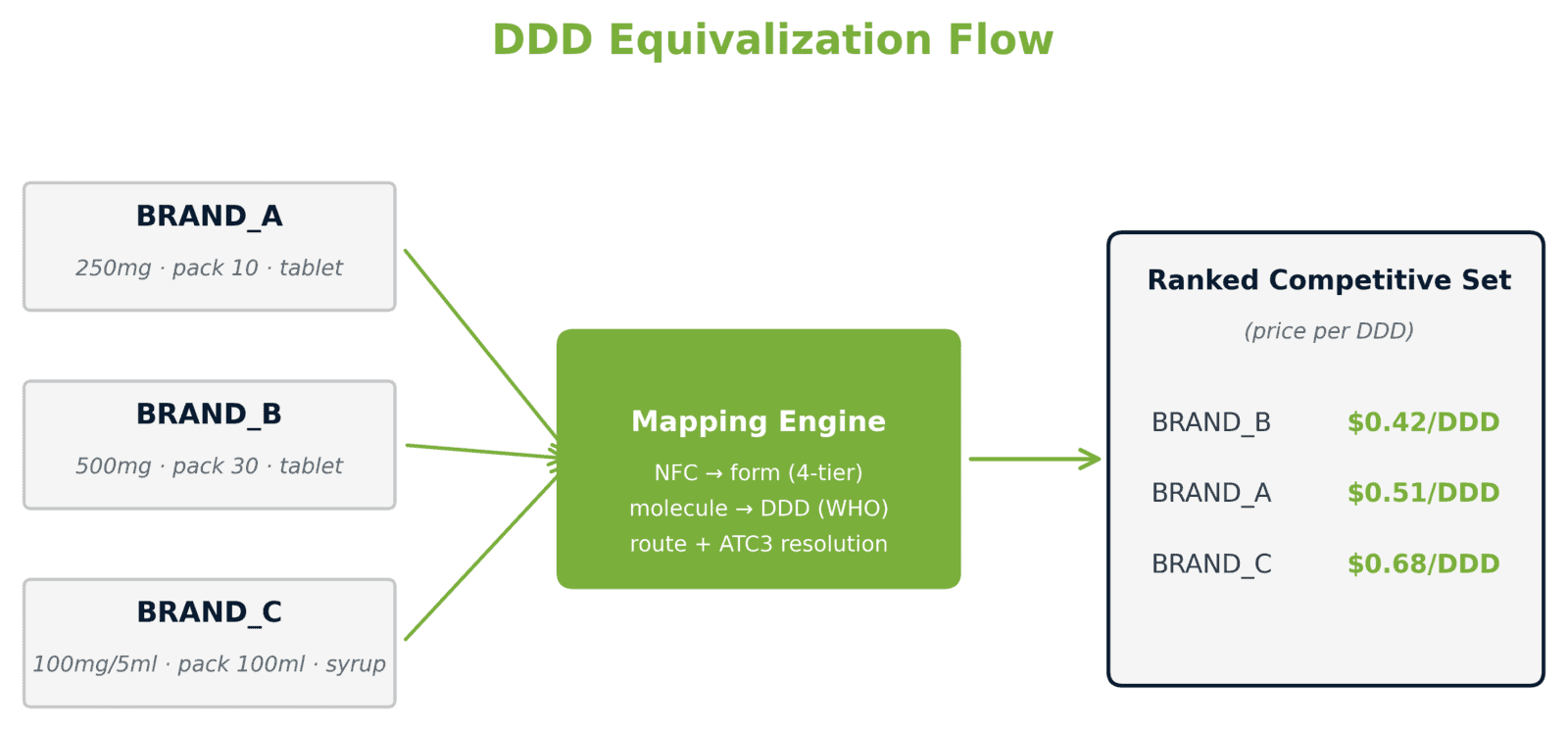
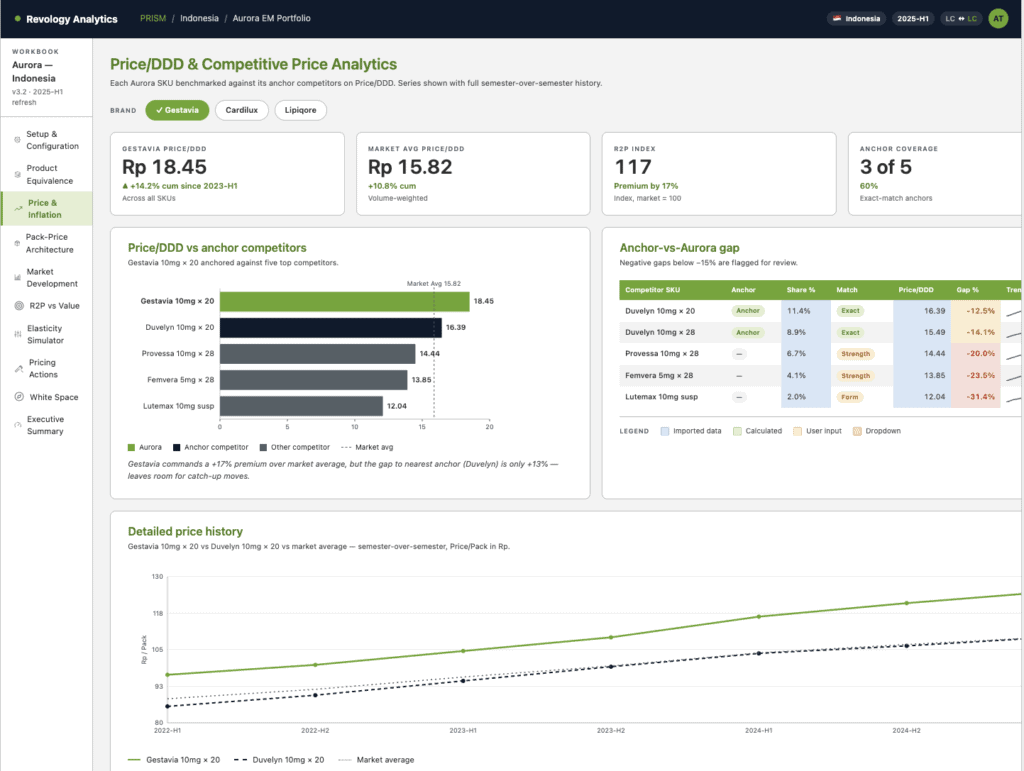
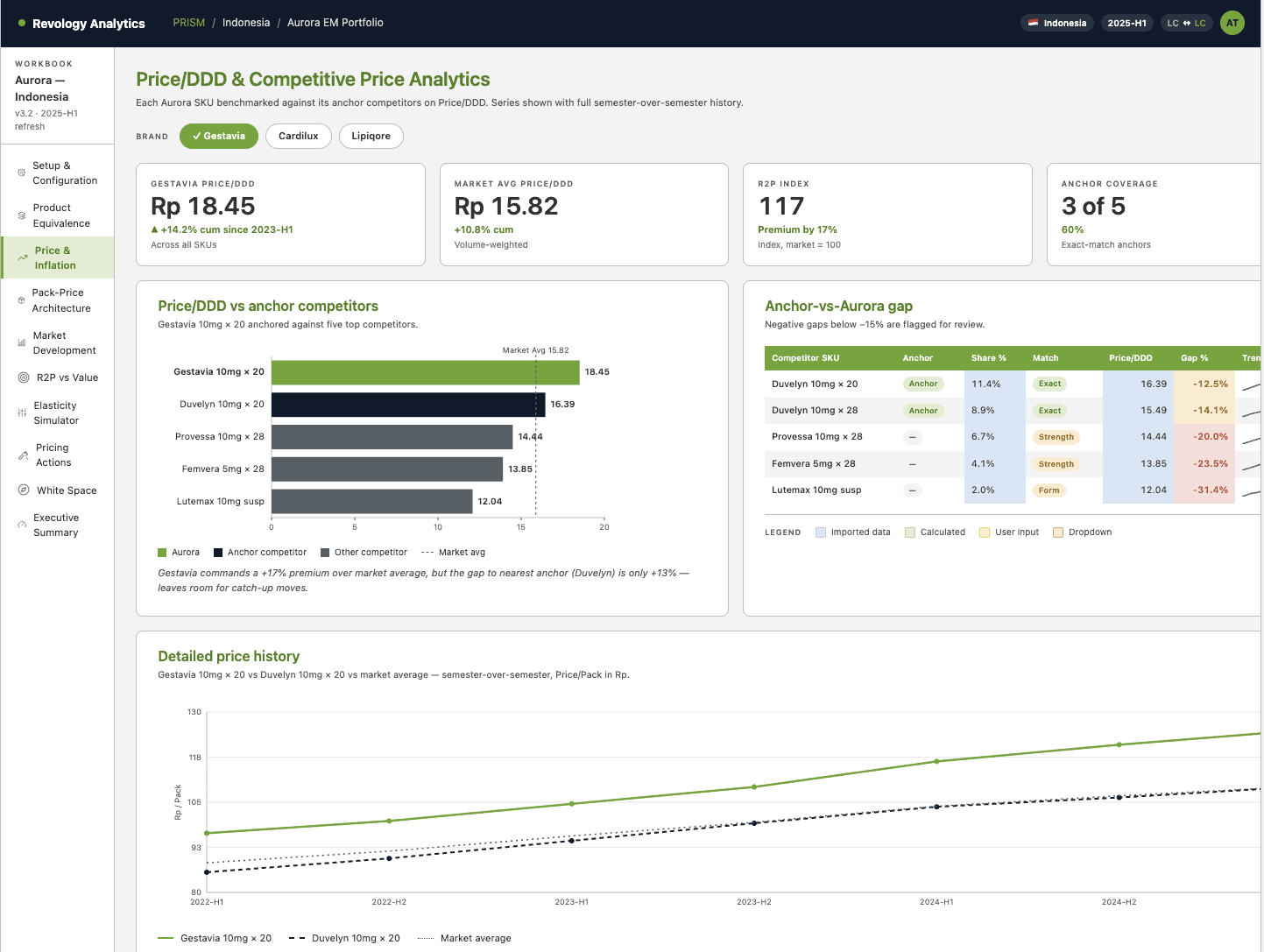
It automates the like-for-like join and reads the competitive gap at the only honest layer: price per Defined Daily Dose, not pack price.

2

Right-to-Price (R2P)

Where is my worth underpriced?

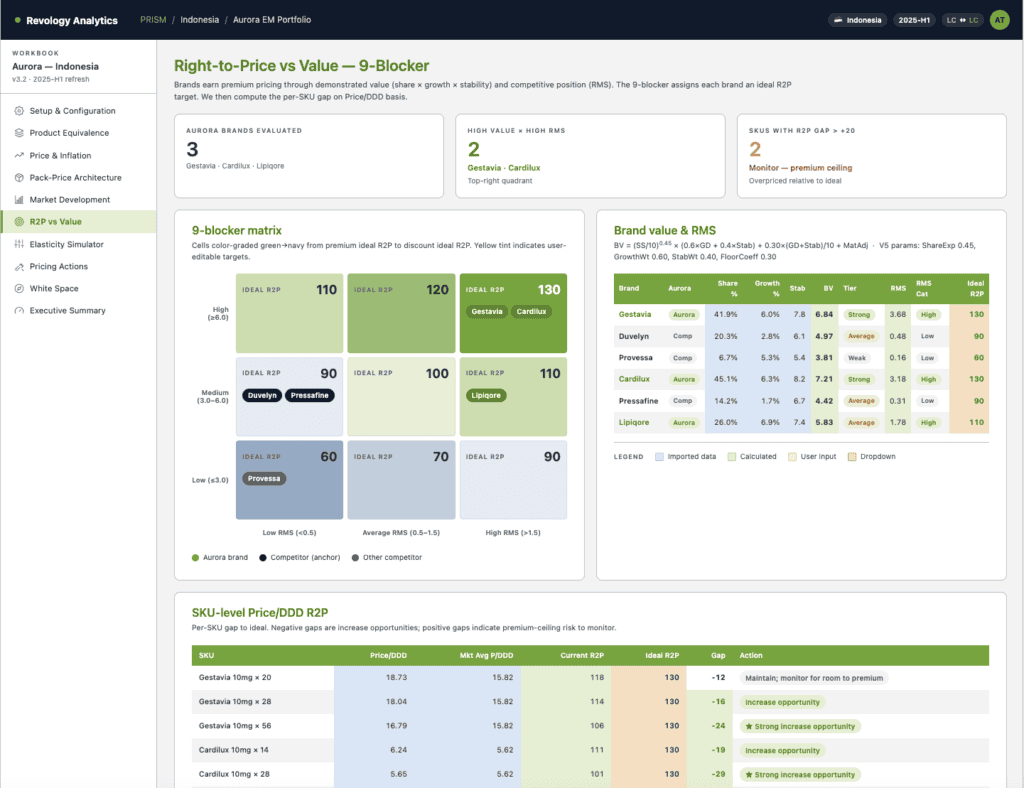
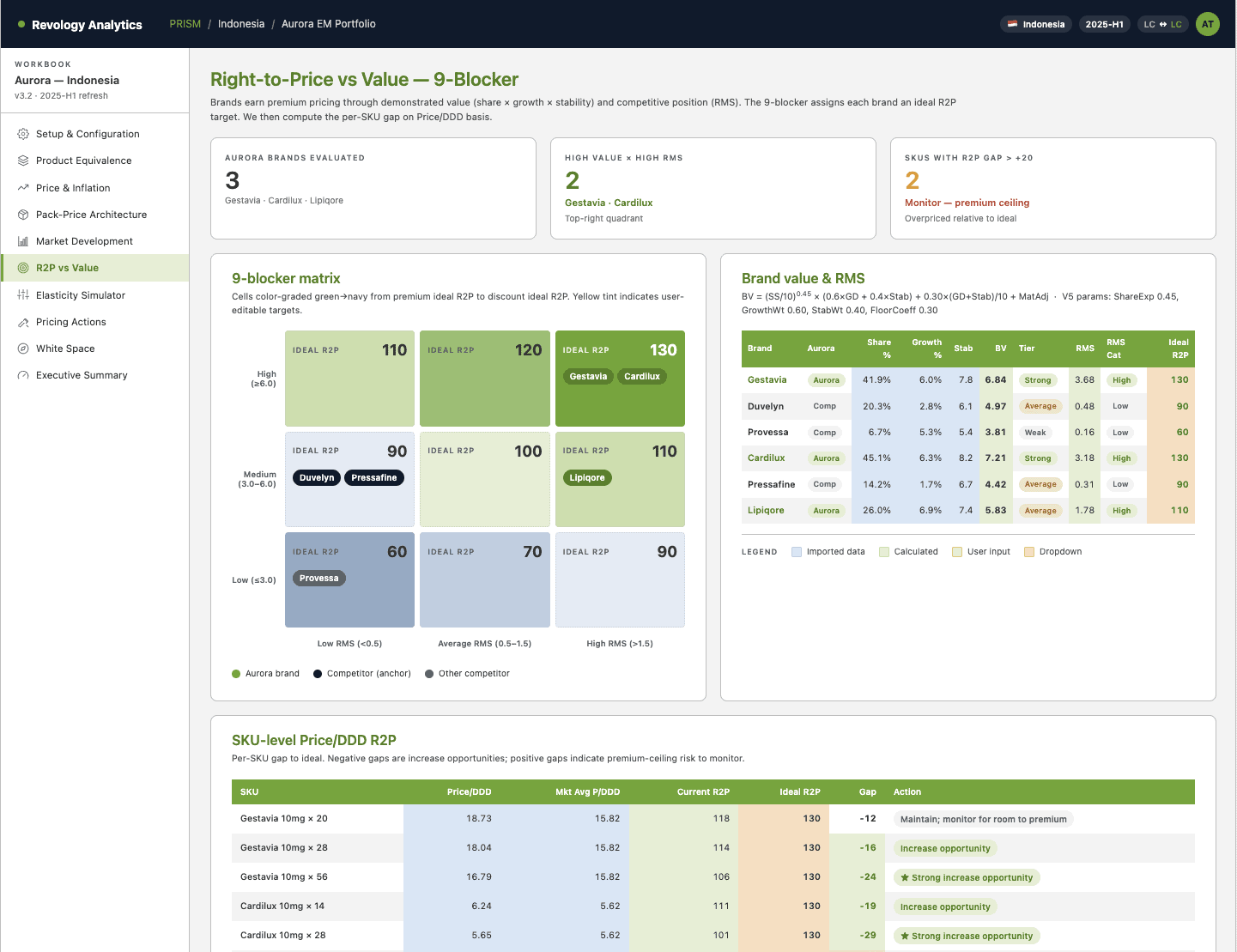
It scores brand worth and surfaces where realized price sits below the worth band the brand has earned.

3

Price-Pack Architecture

Is the ladder working?

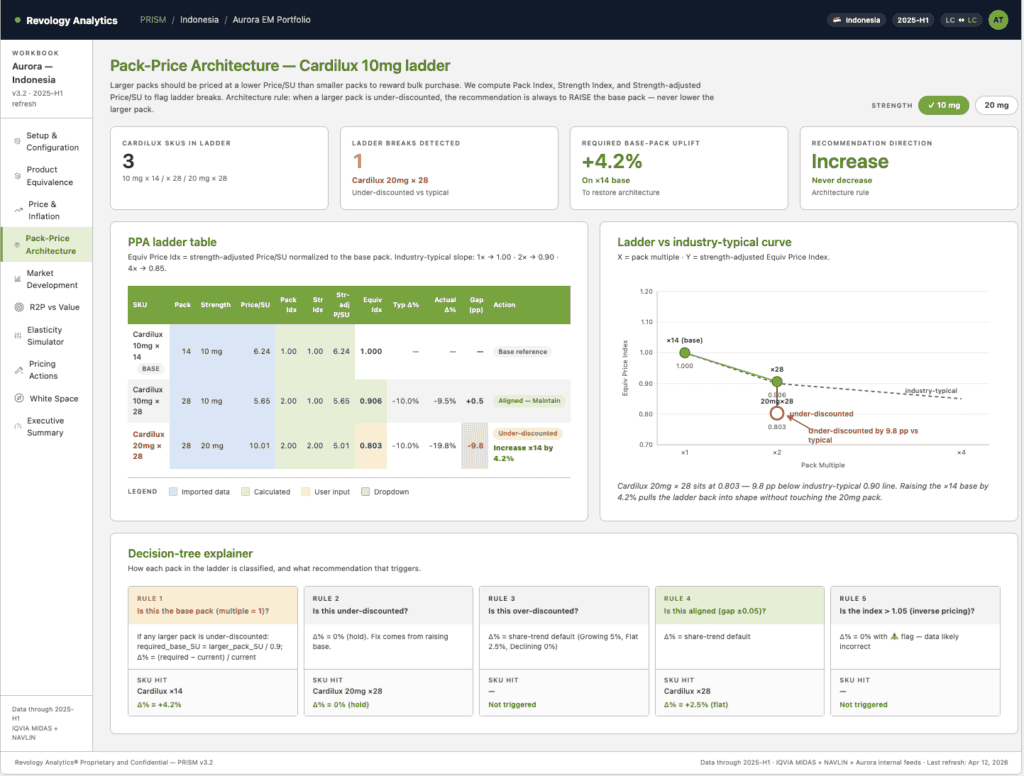
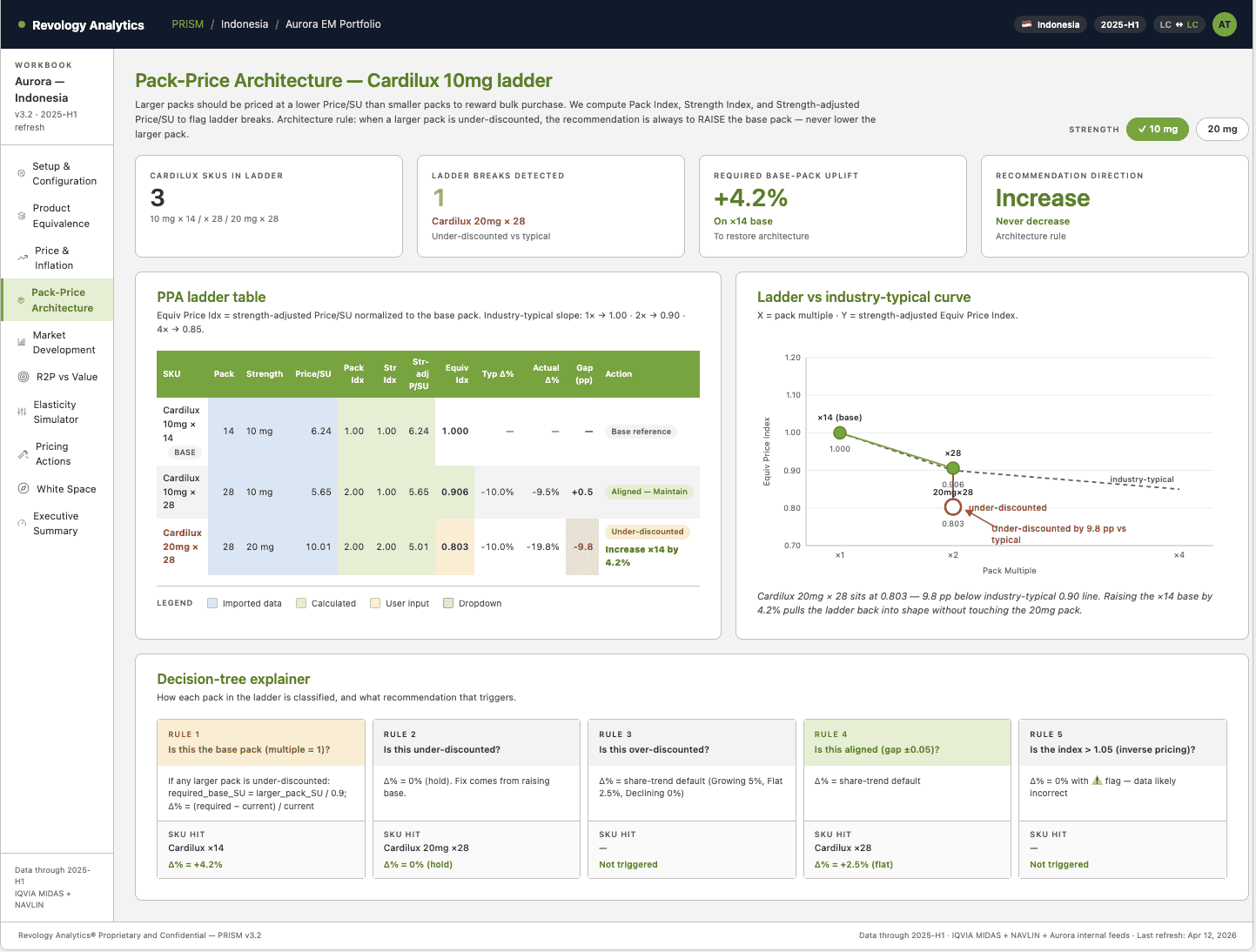
It audits the pack ladder against potency ratios and pack-size norms, raising the base before touching the larger packs.

4

Elasticity-Based Simulator

How much can I move?

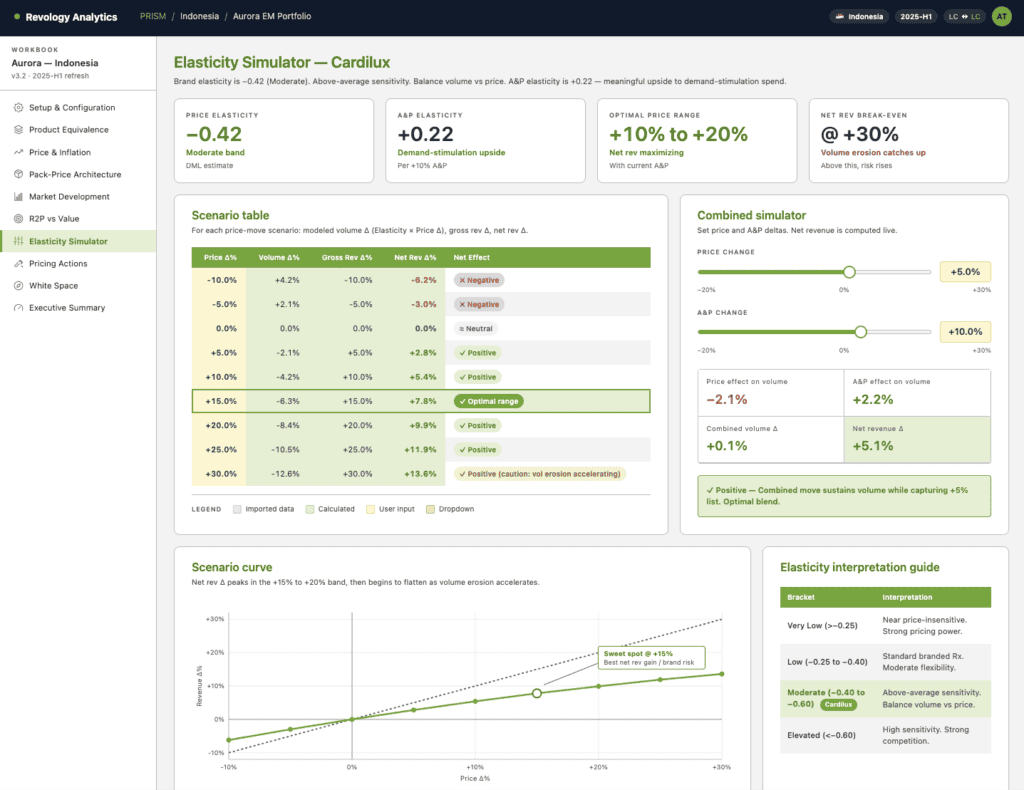
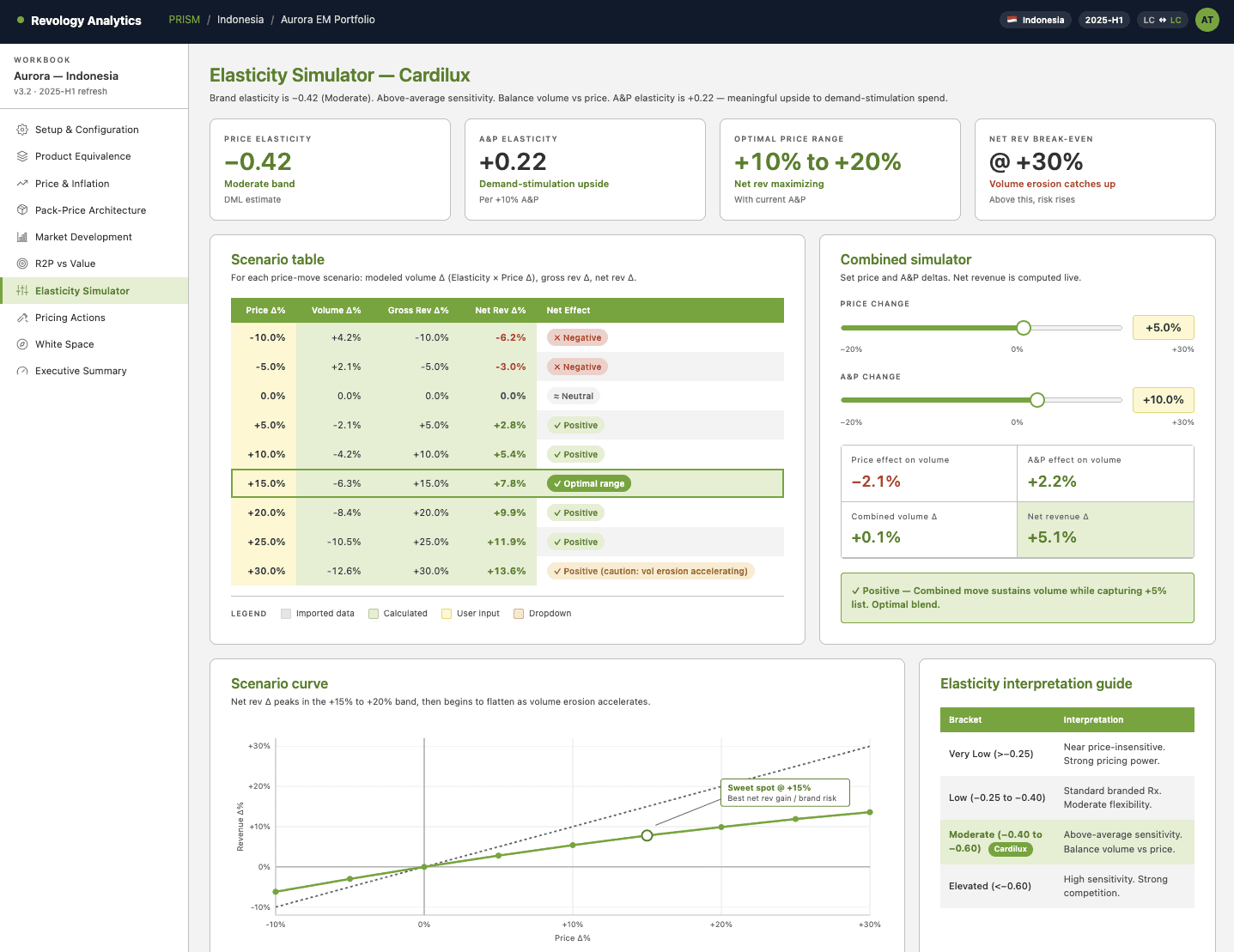
It sizes every recommendation against modeled own-price elasticity with a cross-elasticity guardrail, returning a revenue outcome the committee can defend.

Flow diagram of DDQ equivalization process for pharma pricing.

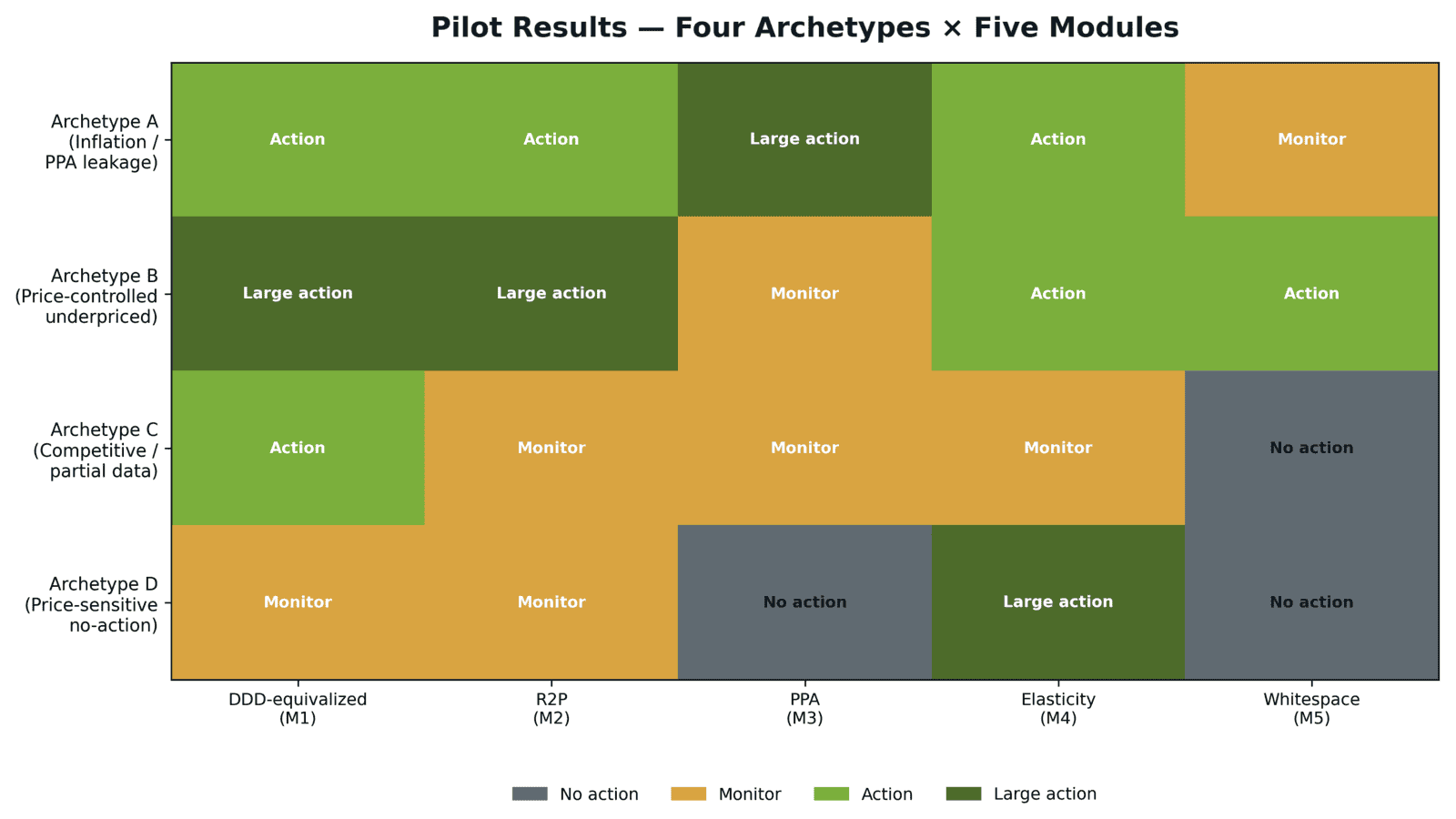
Run in isolation, the four modules produce four overlapping opportunity lists. Run as one sequenced engine, they produce a single ranked, de-duplicated list with elasticity guardrails applied at the recommendation layer. On one pilot market, two brands came back “optimally priced.” A less rigorous tool would have produced false-positive increases. The engine also tells you when not to act.

Why the engine matters as much as the modules

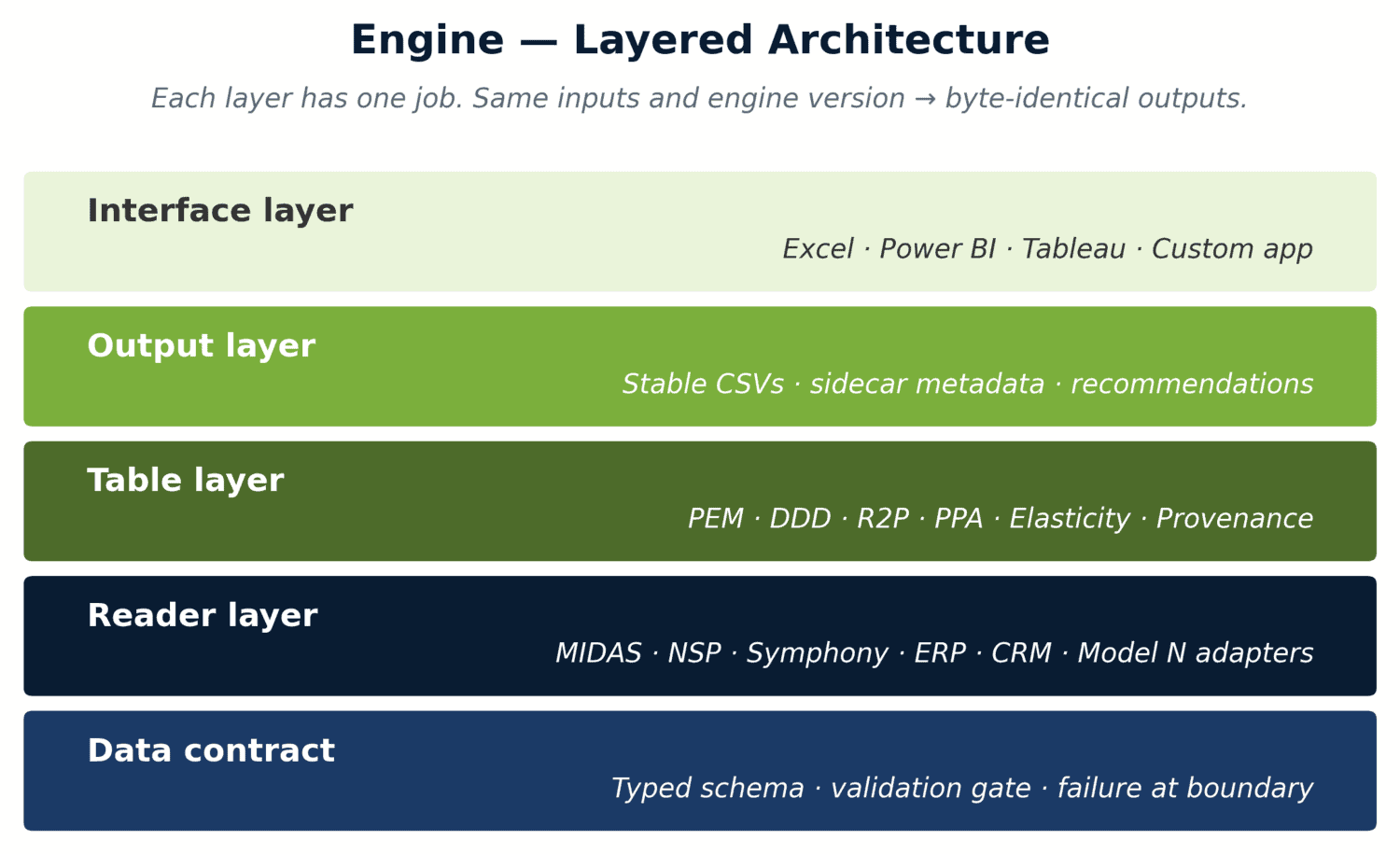
Most pharma pricing tools break because the analysis and the data assembly live in the same workbook. PRISM separates them and enforces reproducibility at three seams. Schema validation at the input seam means bad inputs fail loudly at the boundary, not silently five steps later. Deterministic transforms at the table seam make every output a pure function of the inputs, so a second analyst gets the same answer. Run metadata at the orchestration seam stamps every output with the inputs and the run that produced it. The engine is front-end agnostic: surface it through Excel, Power BI, or Tableau, and the analytics are unchanged.

Diagram illustrating layered architecture in data systems with interface, output, table, reader, and.

See PRISM in action

The PRISM workspace, anonymized

Anonymized views of the PRISM workspace. A fictional manufacturer, Aurora Therapeutics, stands in for client data; the modules, layout, and logic are what your team would run.

PRISM analytics dashboard for pharma price optimization and data analysis.
Price DDD and competitor comparison for pharma market analysis.

Module 1

Price/DDD & competitive price analytics

Price analytics dashboard for pharma with 9-block matrix and brand value comparison.

Module 2

Right-to-Price (9-blocker)

PRISM price analytics dashboard for pharma with charts and data.

Module 3

Pack-price architecture ladder

Elasticity simulator for cardiology with demand and price analysis.

Module 4

Elasticity scenario simulator

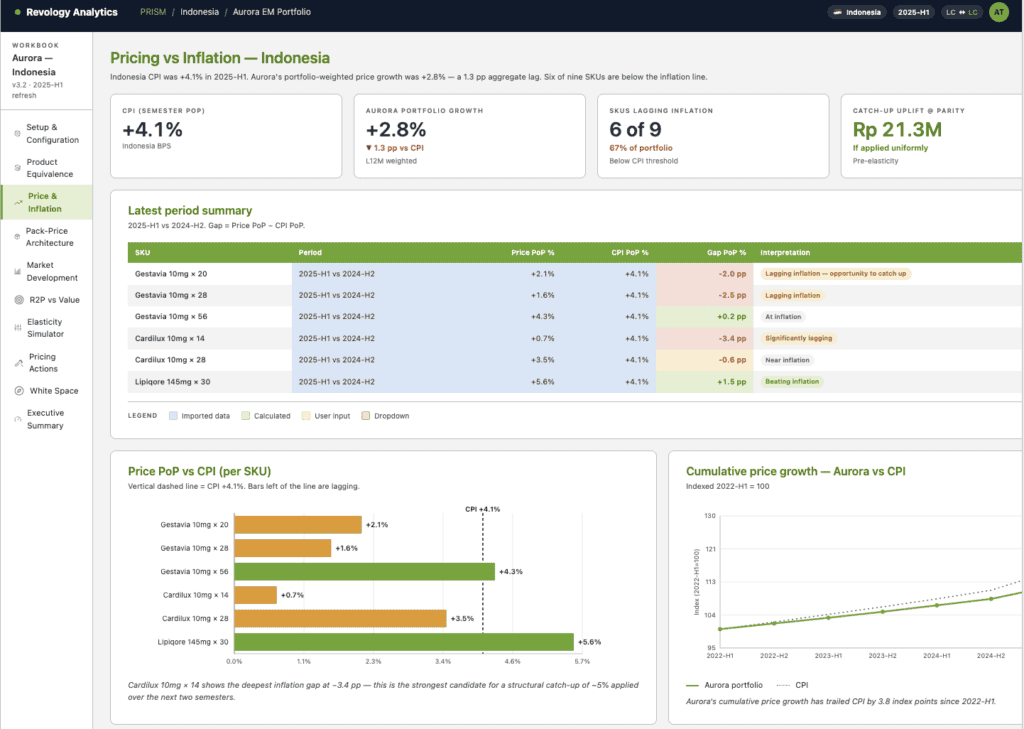
Dashboard showing price inflation, portfolio stats, and growth trends for pharma.

Cross-cut

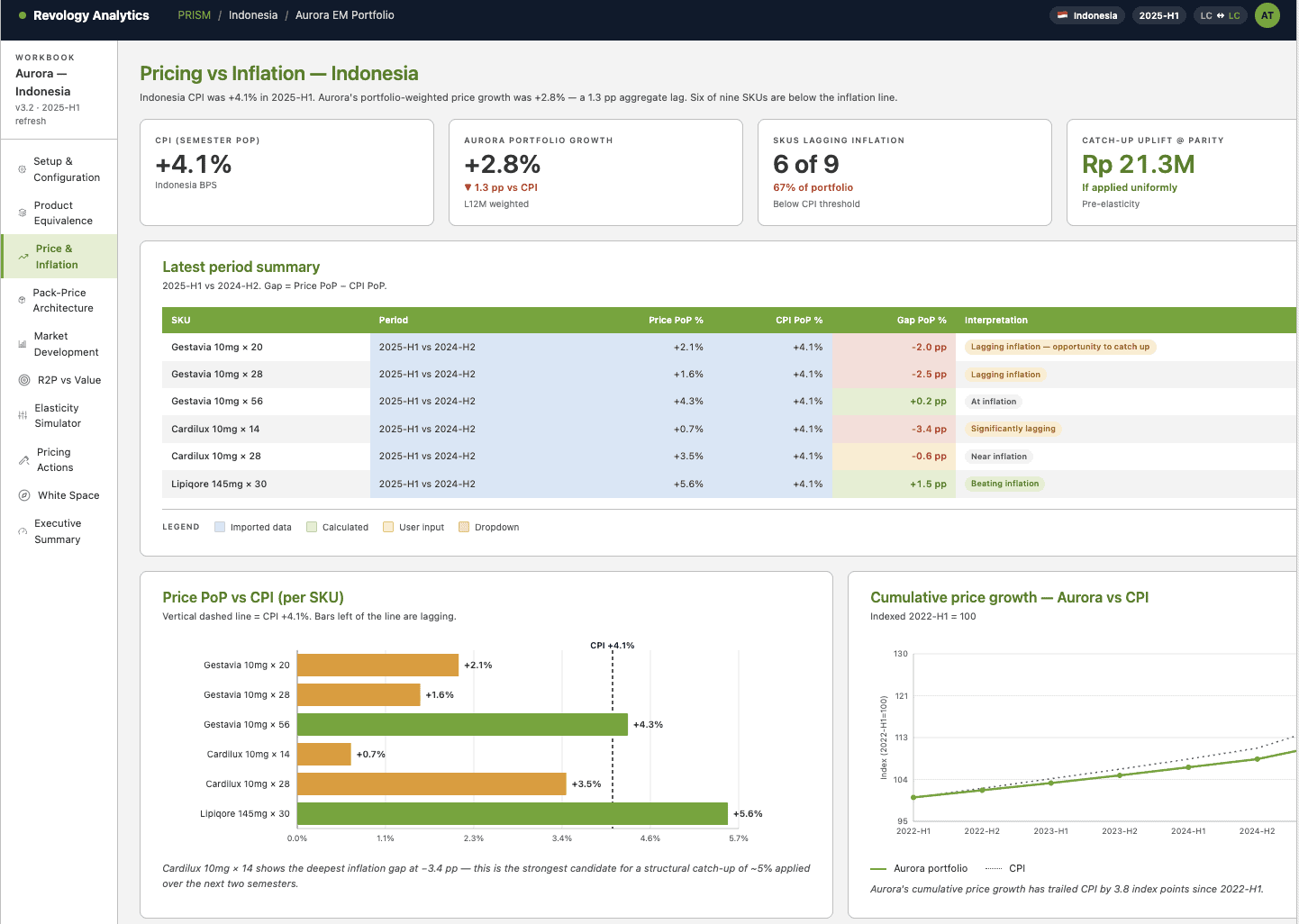
Pricing vs inflation

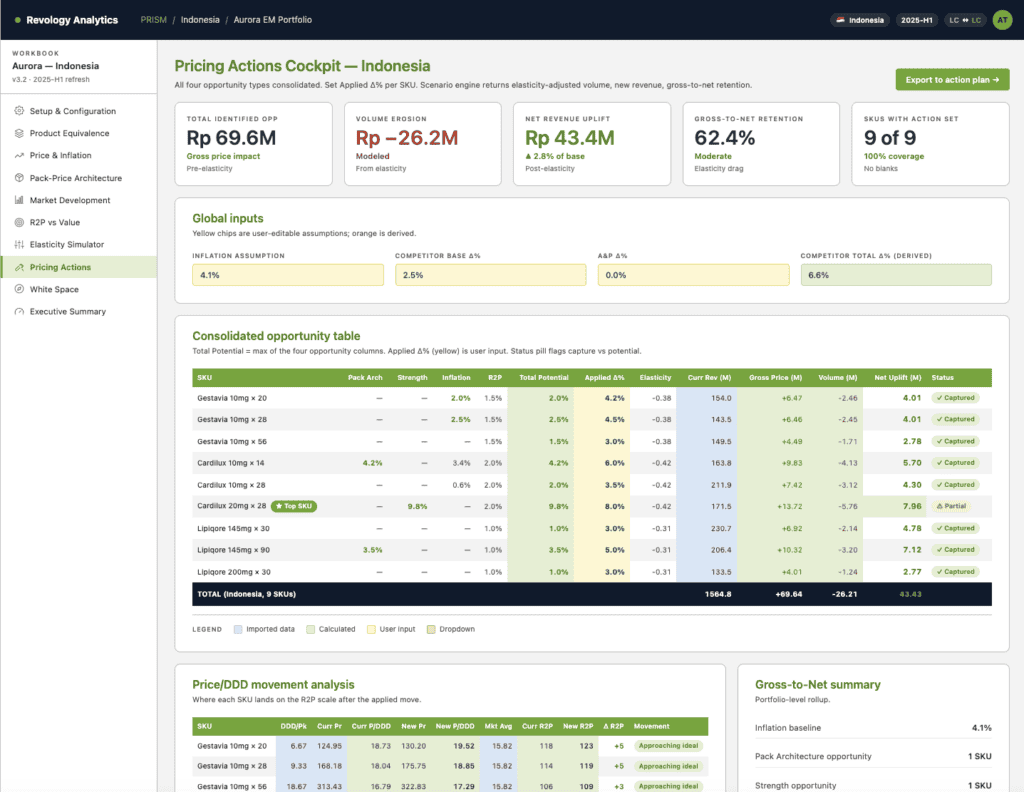
Pricing dashboard for Indonesia pharma market with analytics and opportunity table.

Cross-cut

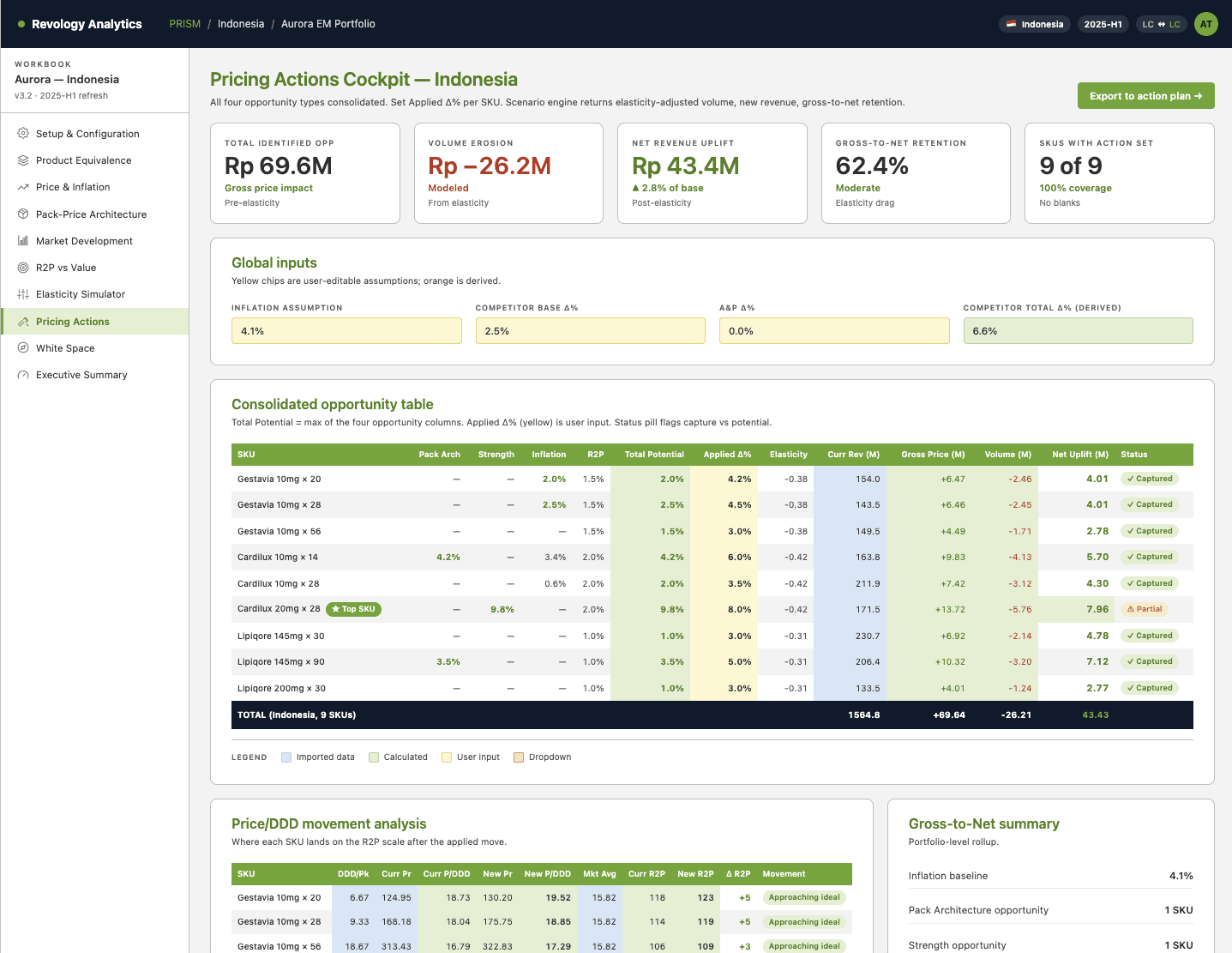
Pricing actions cockpit

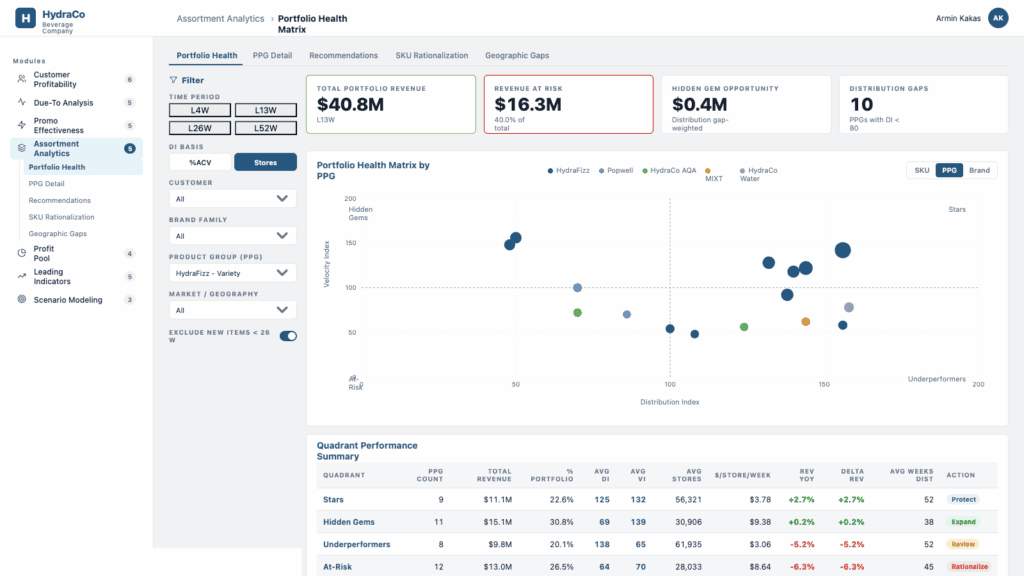
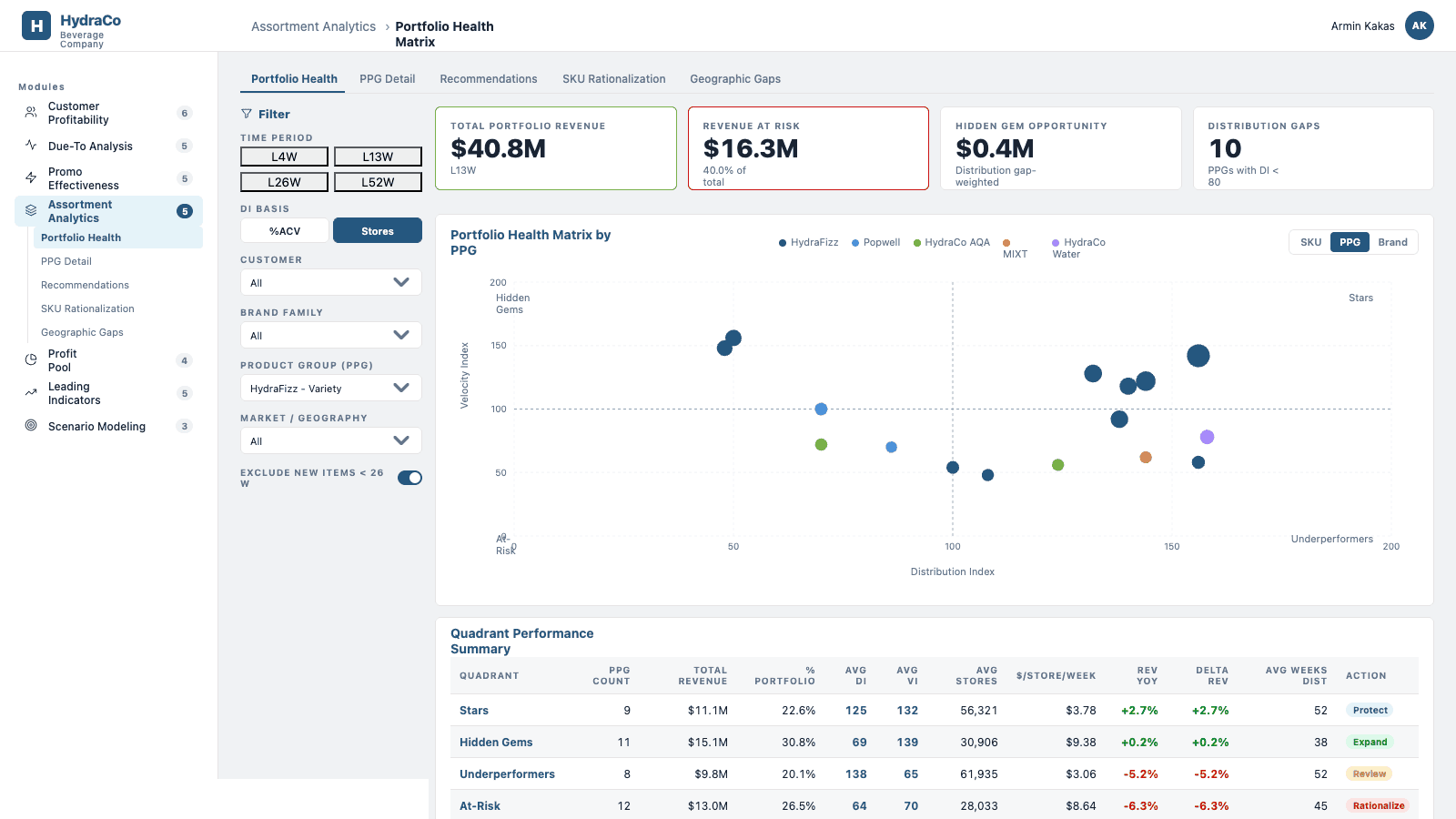
Revology Analytics dashboard showing portfolio health and performance metrics.

Cross-cut

Market white-space

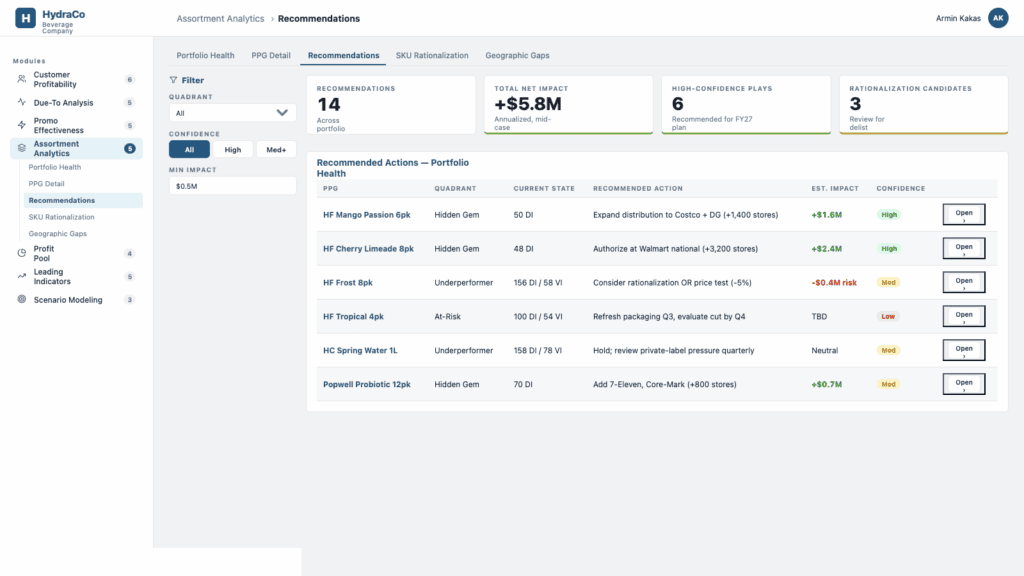
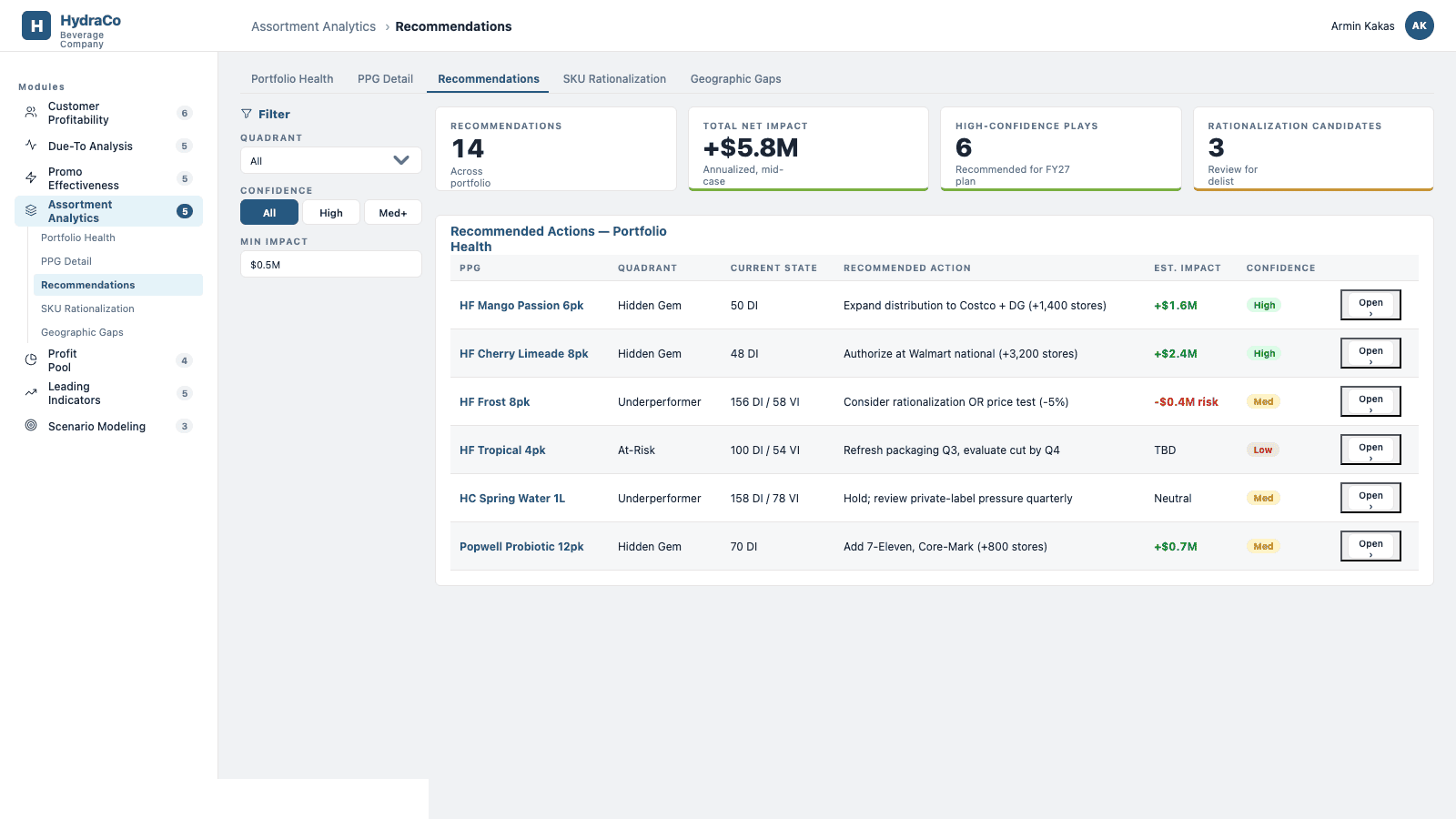
Revology Analytics dashboard showing recommendations and portfolio actions for CPG.

Cross-cut

Executive summary

What the engine surfaced

A four-archetype emerging-markets pilot

Across a four-archetype emerging-markets pilot (high-inflation Latin America, price-controlled APAC, competitive Latin America, and price-sensitive APAC) covering 30 brands and roughly $215M in annualized in-scope revenue:

Diagram showing four archetypes with actions, monitors, and large actions in price analytics.

Who it’s for

Built for the people who defend the price

What commercial leaders say after the build

“Revology Analytics was able to build a robust, easy-to-use, intuitive and automatic Margin Analytics platform tailored for both Sales and Finance/Pricing users in less than three months.”

Vice President, Strategy & Business Development — MedTech company

“They leveraged historical transactional and competitive analyses, and built price elasticity models to identify key trends and insights that drove meaningful actions.”

Sr. Director, Sales Analytics & Operations — leading medical device company

See PRISM against one of your markets.

Bring one market’s data to a working session. We’ll show the DDD-equivalized competitive read and size the price-realization opportunity.

FAQ

Pharmaceutical price optimization, answered

What is DDD-equivalized pricing?

DDD-equivalized pricing compares pharmaceutical prices on a price-per-Defined-Daily-Dose basis rather than by pack or unit price. Because Defined Daily Dose (a WHO standard) normalizes for strength, pack size, and form, it is the only layer where a like-for-like competitive comparison is honest. PRISM automates that equivalization for your brands and competitors alike.

What is price-pack architecture in pharma?

Price-pack architecture is the discipline of setting prices across a brand’s pack ladder (its strengths and pack sizes) so the steps reflect potency ratios and pack-size norms. PRISM audits the ladder for distortions and raises the base before touching the larger packs. That is a common source of recoverable price realization.

What is Right-to-Price in pharmaceutical pricing?

Right-to-Price is a worth-based pricing method that scores the price a brand has earned relative to competitors, then compares that worth band to realized price. PRISM uses the score to surface brands priced below their worth band and to rank increases the committee can defend.

How do you optimize pharmaceutical prices across multiple markets?

PRISM runs four modules (DDD-equivalized competitive pricing, Right-to-Price worth scoring, price-pack architecture, and elasticity) as one reproducible engine, market by market, and returns a single ranked list of defensible price moves with elasticity guardrails applied. The same engine reproduces the same recommendation from the inputs alone.

Is PRISM software we buy?

No. PRISM is a capability Revology co-designs inside your environment and transfers to your team. The engine is front-end agnostic (Excel, Power BI, or Tableau), and there is no recurring license.

How long does PRISM take to stand up?

A typical PRISM build runs 90–120 days, stood up market by market so your first market returns a ranked, defensible list of price moves before the next one onboards. Capability transfer to your team happens continuously, not at the end of the engagement.

How is a PRISM engagement structured?

As a fixed-scope build, not a subscription. We define the markets and brands in scope at a working session, price the build to that scope, and transfer capability to your analysts throughout. There is no recurring license; your team owns the engine and its outputs at handoff.

Does Revology always use AI?

No, and that is deliberate. AI is a strategic enabler, not the product. When your data and operational readiness support it, we deploy advanced machine learning and agentic AI. When a simpler method reaches the goal faster, we use that and sequence the AI for when it earns its place.

Has Revology been independently ranked?

Yes. Revology Analytics is ranked #1 by PeekWire in “Best Revenue Growth Management Consulting Firms for Mid-Market Companies,” April 2026, recognized for hands-on execution in pricing, sales and marketing AI enablement, and commercial analytics transformation, and for embedding senior experts directly into the client’s team. Read the full ranking.