
This guide is designed for pricing, RGM, and commercial leaders at mid-market manufacturers, distributors, and CPG companies. It explains agentic AI pricing, outlines the current capabilities and limitations of autonomous pricing agents, and details the safeguards that distinguish margin gains from margin losses.
Table of Contents
Many teams already use AI for tasks such as summarizing meetings and drafting emails. Looking ahead to 2026, revenue leaders must consider whether software should be permitted to analyze, recommend, and, in some cases, autonomously change prices. Agentic AI in pricing involves autonomous AI agents that monitor markets, simulate pricing scenarios, and recommend or execute price changes within human-defined guardrails. Unlike generative AI, which responds to requests, pricing agents independently plan and execute multi-step tasks. This autonomy makes governance, rather than model selection, the critical factor in determining whether agentic AI pricing improves or harms margins.
The adoption curve is steep. McKinsey’s B2B pricing research finds that 65 to 85 percent of pricing organizations expect to adopt generative or agentic AI in pricing within one to three years, up from roughly 10 to 30 percent today. Gartner projects that task-specific AI agents will be embedded in 40 percent of enterprise applications by the end of 2026, up from under 5 percent in 2025.
A significant failure rate in enterprise software is relevant here and will be addressed later. Before proceeding, please note: this guide focuses on AI agents managing your pricing, not on pricing AI products themselves. It outlines effective practices, common pitfalls, and a phased approach that delivers value to revenue teams while minimizing risk.
| Definition. Agentic AI pricing: the use of autonomous, goal-directed AI agents (software that plans tasks, calls tools and data systems, and takes pricing actions with limited human intervention) to support revenue growth management (RGM) work such as competitive monitoring, scenario simulation, promotion analysis, and guarded price execution. |
Key Takeaways
- Agentic AI pricing agents plan and execute multi-step pricing work, beyond answering questions on request.
- Monitoring and scenario simulation are production-ready today; autonomous price execution still needs tight bounds.
- Guardrails and decision rights, more than model choice, separate margin gains from margin accidents.
- Gartner expects over 40% of agentic AI projects to be canceled by the end of 2027, mostly due to governance gaps.
- A crawl-walk-run roadmap delivers value in weeks while autonomy stays earned, bounded, and measured.
What Is Agentic AI in Pricing?
At its core, agentic AI pricing addresses the division of labor in pricing processes. Traditional pricing software performs calculations, analysts interpret results, and managers make decisions. An agent streamlines this process by selecting data, conducting analyses, drafting recommendations, and, if permitted, implementing price changes directly into your ERP, e-commerce, or CPQ systems.
A practical distinction is clear: if software requires human input at every step, it is a tool. If it independently plans and completes multi-step pricing tasks with predefined checkpoints, it is an agent. This shift transfers risk from errors that humans might catch during analysis to actions that may go unnoticed until financial results are reviewed.
Agentic AI vs. Generative AI vs. Machine Learning Pricing Models
The three layers of an agentic AI pricing stack do different jobs, and mature pricing organizations run all three:
- Machine learning pricing models estimate relationships such as price elasticity of demand, promotion lift, and cross-effects. Methods like Double Machine Learning (DoubleML) produce unbiased elasticity estimates that control for seasonality and competitor moves. Our double machine-learning price-elasticity framework covers this layer in depth.
- Generative AI produces content and analysis on request: summarize this contract’s pricing terms, explain why April’s margin dipped, and draft the price-increase letter. It responds; it does not initiate.
- Agentic AI strings tasks together toward a goal: watch these 400 SKUs, flag competitor moves beyond 3 percent, simulate response options against the elasticity model, and queue recommendations for Monday’s pricing council.
The stack matters because agents inherit the quality of the layers beneath them. Agentic AI pricing built on a weak elasticity model automates guesswork at machine speed.
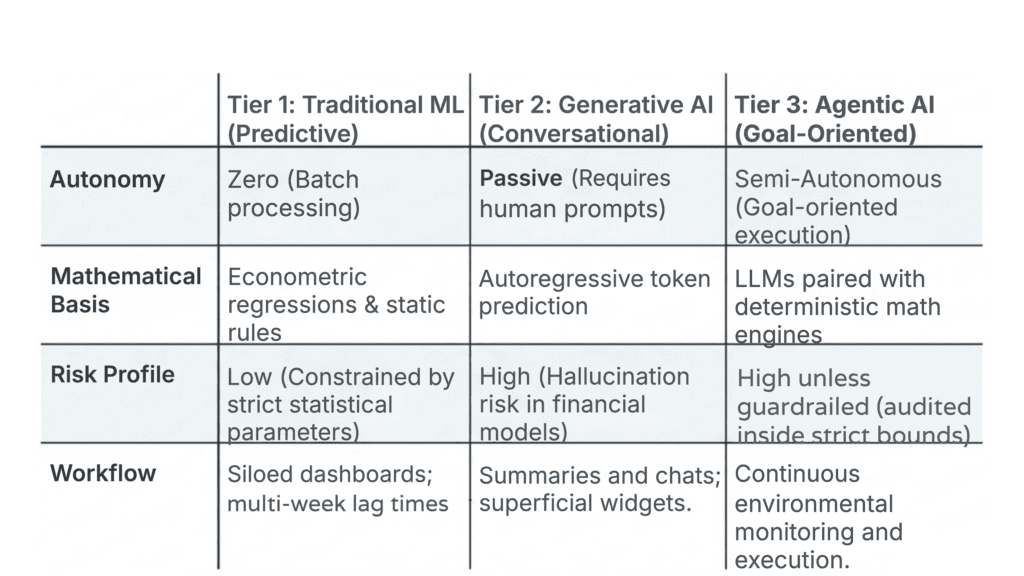
Framework diagram comparing machine learning, generative AI, and agentic AI pricing layers across autonomy and risk
Agentic AI Pricing vs. Dynamic Pricing: What’s Different?
Dynamic pricing adjusts prices based on predefined rules and demand signals; airlines and ride-share are textbook cases, and our dynamic pricing case studies show what disciplined versions look like in retail and distribution. A dynamic pricing engine executes the rules it was given. An agentic AI pricing system can write new plays: notice an unfamiliar pattern, investigate causes, and propose a response nobody scripted. That flexibility is the appeal and the hazard. Rules fail predictably. Agents fail creatively.
One Term, Two Meanings: Agents That Price vs. Pricing AI Agents
Search results for agentic AI pricing are split into two conversations. Most published content addresses “how should vendors price their AI agent products”: per-seat, usage, or outcome-based models. This article covers the other meaning, AI agents doing pricing and RGM work for revenue teams. The monetization debate still matters to you as a buyer because agent vendors’ usage-based pricing is exactly why cost discipline shows up later in this guide. For everyone else: this is about agents working on your prices, not the price tag on agents.
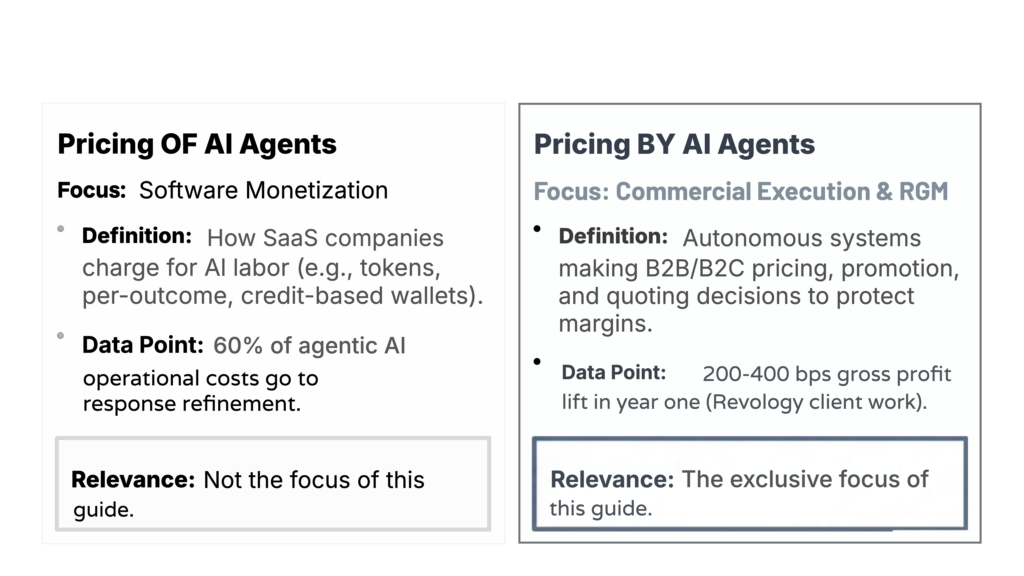
Two meanings of agentic AI pricing: pricing of AI agent products versus AI agents doing pricing and RGM work
Why Agentic AI Pricing Matters for Revenue Teams in 2026
The stakes argument starts with a number we publish every year. According to Revology’s research of 2,000 global companies, a 1% improvement in price realization produces a 6–7% lift in operating profit. Excluding highly regulated industries, this figure is in the 10–11% range (Pricing Still Packs a Punch, Revology Analytics, June 2025).
Pricing remains the highest-leverage line on the P&L, and McKinsey has long estimated that up to 30 percent of pricing decisions fail to deliver the best price. Any technology that improves the speed and consistency of those decisions is competing for the richest prize in the business.
| Data Point: In Revology’s mid-market engagements, pricing and promotion analytics typically return 200–400 basis points of gross profit improvement in year one, before any autonomous execution. The agentic AI pricing prize is speed and consistency on top of that foundation; the constraint keeps showing up in data readiness and adoption, not algorithms. |
The Adoption Numbers Behind the Noise
Three adoption facts frame the agentic AI pricing moment. First, experimentation is nearly universal while scale is rare: 89 percent of retail and CPG companies report using or assessing AI (NVIDIA’s State of AI in Retail and CPG survey), yet scaled, production-grade deployments remain the exception. Second, the intent curve is steep; the McKinsey survey cited above shows pricing-specific adoption expectations more than doubling within three years. Third, the money is already moving. Gartner estimates that $234 billion in enterprise application software spend will be at risk from agentic AI by 2030, roughly 20 percent of enterprises’ SaaS spending.
Our own data sharpens the point for the mid-market. In the 2025 Revenue Growth Analytics Maturity Report, Revology’s survey of 158 commercial leaders, 42 percent of firms told us they use AI primarily to automate manual tasks, while only 6 percent use it for advanced, data-driven insight generation. Only about 15 percent run dynamic pricing in any form, and roughly 8 percent apply value-based pricing at scale. Interest in AI is nearly universal; the analytical foundations that make agentic AI pricing safe are not, and that readiness gap is what the roadmap later in this guide is built around.
For RGM leaders, the read is uncomfortable but useful. Your competitors are almost certainly piloting agentic AI pricing somewhere. Very few have earned the right to run it at scale. The gap between those two states, pilots everywhere and production almost nowhere, is where the next two years of competitive advantage will be won. It is a governance and data problem before it is a technology problem.
What Can Autonomous Pricing Agents Actually Do Today?
One honest caveat before the use cases. Very little running in production today, including in our own client work, is an LLM agent autonomously setting prices end-to-end. What works is a spectrum: ML models and simulators with humans approving actions, rules-based engines executing inside hard bounds, and LLM agents accelerating the analysis around them. That is not a disappointment; it is the blueprint. Each agentic AI pricing pattern below is one rung of autonomy being earned, and the agentic layer inherits whichever governance you prove first.
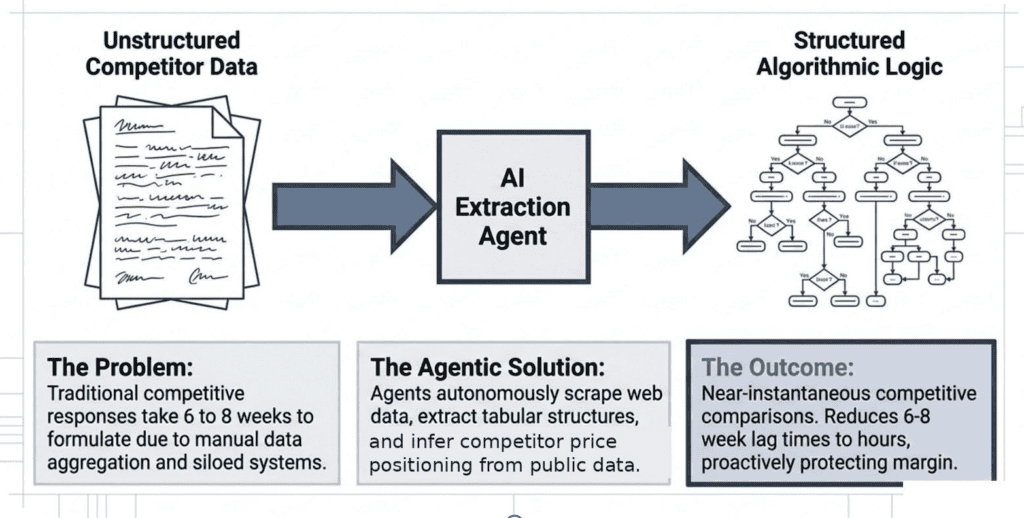
Autonomous pricing agents in action: real-time competitive price monitoring and structured extraction
Competitive Price Monitoring and Alerting
Monitoring is the lowest-risk entry point, and where agentic AI pricing should start for most teams: watching, not acting. It is also the one genuinely agentic pattern in production today: tool-using agents that plan their own sweeps across marketplaces and channels. Agents track competitor prices, promotions, and assortments across marketplaces and channels, normalize pack sizes to price per equivalent unit, and surface exceptions warranting human attention. What used to be an analyst’s Tuesday (pulling competitor data, cleaning it, eyeballing changes) becomes a standing watch.
The judgment call on whether to respond, hold, or investigate remains with the pricing team. If your category strategy involves pack-price moves, agents also make the comparison math honest; our price pack architecture guide explains why equivalized units are the only fair basis for competitive reads.
Scenario Simulation and What-If Analysis
The second production-ready pattern pairs agentic AI pricing with simulation. One US consumer electronics manufacturer we worked with, which had about $100 million in online B2C revenue, was losing $0.83 to $0.87 on every promotional dollar spent on low-elasticity SKUs. The rebuilt approach ran automated data ingestion, baseline calculation, and DoubleML elasticity modeling, then put a scenario simulator in front of the commercial team.
Analysts entered candidate prices; the system simulated revenue, volume, and margin outcomes; humans approved every action. Correctly attributing seasonality raised the measured median promotional lift from under 0.5 to roughly 1.5, and the program targeted a 10-20 percent improvement in promotional ROI, worth an estimated $1–2 million in EBITDA. The agent did the analytical legwork in minutes. Nobody handed in the price list.
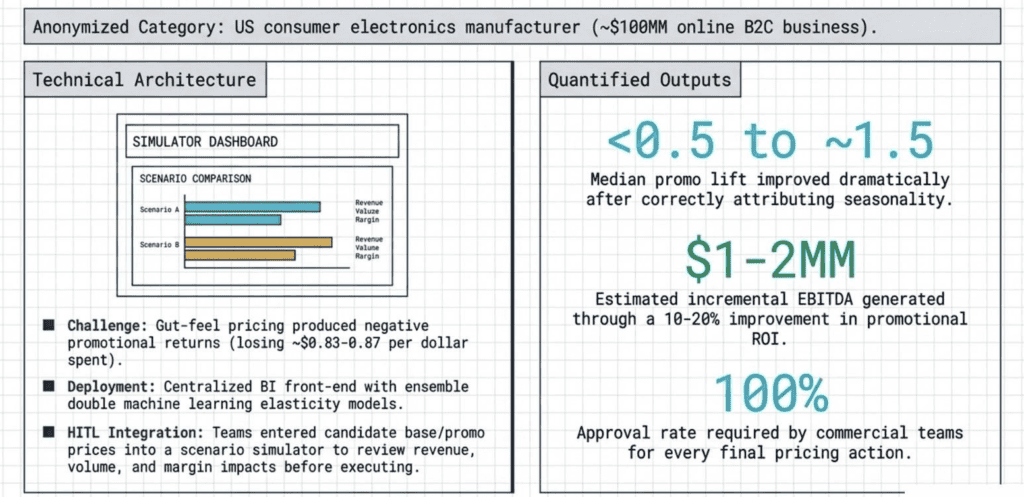
An anonymized consumer electronics case where a human-in-the-loop pricing agent lifted promotional performance
Price Execution: Where Autonomy Gets Risky
Full autonomy, where the agent changes prices with no human in the loop, is where most of the horror stories live. Bounded autonomous execution already works, though, and the guardrail blueprint it proved is exactly what agentic systems will inherit.
A national industrial-products distributor we supported automated clearance markdowns entirely: a rules-based engine calculated and executed markdown prices for discontinued and slow-moving inventory within financial thresholds owned by Finance, including maximum discount limits that protected reserve levels. Results: inventory liquidity improved about 30 percent, annual gross profit rose about 5 percent, and six pricing analysts recovered 80-plus hours a week. The lesson here is narrow. Autonomy earned its place in a low-stakes category, inside explicit guardrails, with Finance setting the bounds.
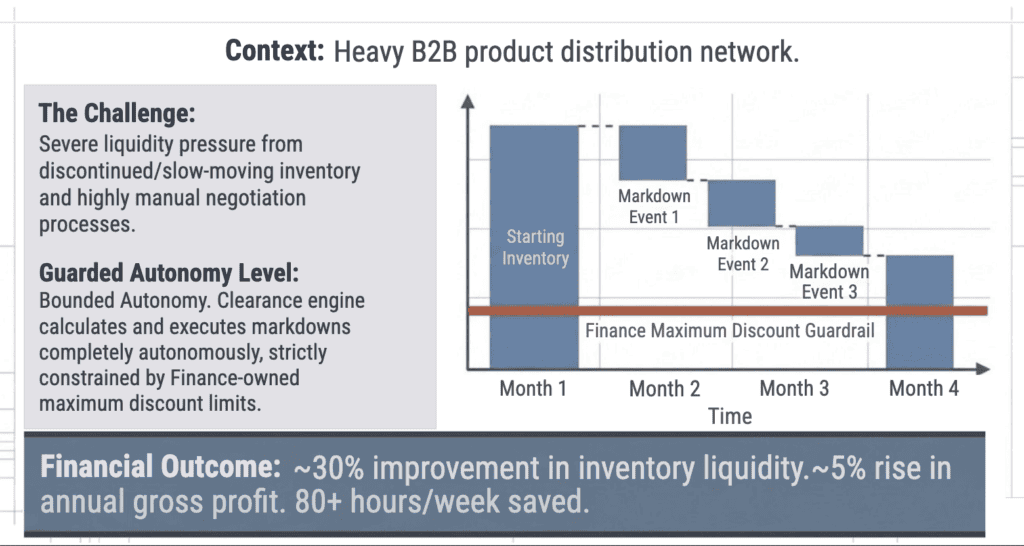
Anonymized national distributor case of bounded autonomous markdown pricing, improving liquidity and gross profit
See how your pricing compares
Our 2025 report looks at how more than 150 business leaders handle pricing and promotions. See what the best companies do differently, and where most fall short.
Where Autonomous Pricing Agents Break Down
Now the uncomfortable section, because the failure data is loud. Gartner predicts more than 40 percent of agentic AI projects will be canceled by the end of 2027, citing escalating costs, unclear business value, and inadequate risk controls. In agentic AI pricing specifically, the failure modes are concrete and expensive. We call the underlying nemesis ungoverned autonomy: giving software the company credit card before anyone agrees on what it may buy.
Failure Modes: Hallucinated Prices, Silent Drift, and Compliance Risk
Four patterns account for most of the wreckage we see:
- The black-box launch. A top commercial food producer spent millions on an automated price optimization application and pushed its optimized prices live without human validation. The algorithm missed a competitor’s product launch; volume and market share plummeted. The model was not wrong so much as blind, and nobody was assigned to look.
- The over-engineered orphan. A consumer durables manufacturer’s data science team spent a year building an ML and mixed-integer optimization pricing model covering 10,000 SKUs and 100,000 customers. It was accurate and heavily automated, and it was built without the commercial stakeholders who had to govern it. The business rejected it outright and was still pricing in spreadsheets a year later.
- Silent drift and verification burden. Agent outputs degrade quietly as data pipelines shift and markets move. McKinsey’s analysis of agentic AI economics finds that about 60 percent of an agentic task’s costs are tied to refining answers, the checking, correcting, and re-running of outputs. Ungoverned autonomy does not eliminate work; it shifts it to verification.
- Compliance exposure. Regulators have moved from speeches to settlements. The Department of Justice’s RealPage settlement restricts feeding nonpublic competitor data into pricing algorithms, and courts have allowed the collusion-by-algorithm theory to proceed in key cases. The FTC’s surveillance pricing study put individualized pricing under scrutiny (our surveillance pricing explainer covers what to avoid), and in the EU, the June 2026 Digital Omnibus pushed the AI Act’s high-risk obligations to late 2027, while the Act’s transparency requirements still take effect August 2, 2026, and prohibited-practice violations already carry penalties up to €35 million or 7 percent of global turnover. An agent that quietly ingests a competitor’s nonpublic price file is a legal event, not a productivity win.
A large share of these failures traces to change management rather than models. A global specialty materials firm invested millions in an advanced pricing program without aligning governance or sales compensation; reps kept their informal processes, and the company realized less than 20 percent of the expected return. The pattern repeats across agentic AI pricing programs: the technology worked, the operating model never arrived.
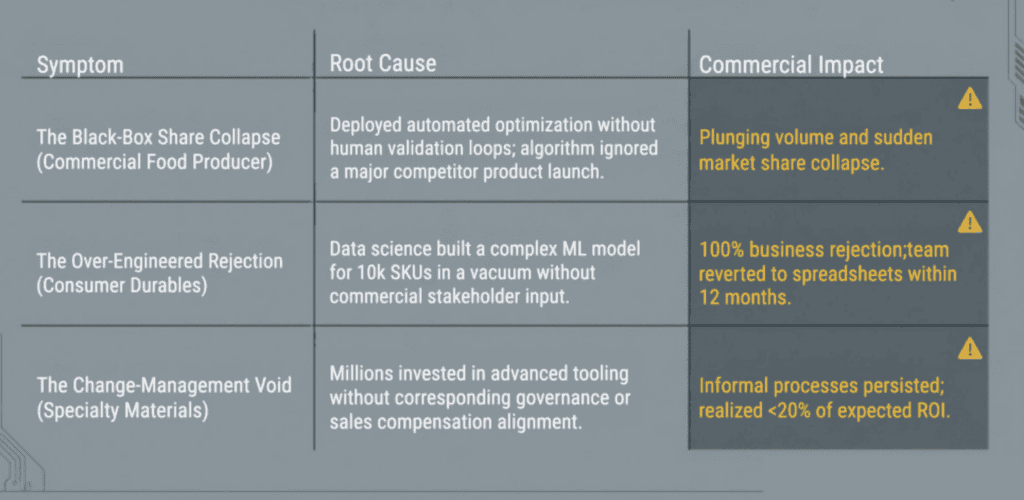
Failure cases of ungoverned pricing automation at a food producer, durables manufacturer, and materials firm
The Guardrails: A Governance-First Operating Model for Pricing Agents
The fix for ungoverned autonomy is not zero autonomy. It is a governance-first operating model where decision rights come before deployment. Two design questions do most of the work in agentic AI pricing: who decides, and inside what bounds.
Human-in-the-Loop Decision Rights
Write down, before the pilot starts, which decisions the agent may take alone, which require human approval, and which are off-limits. A workable default for mid-market agentic AI pricing pilots: agents gather, analyze, and recommend freely; price changes above defined materiality thresholds require pricing-manager approval; list price architecture, contract pricing, and anything customer-visible at scale stays human. A global pharmaceutical and medical device manufacturer we supported ran exactly this way while building an ML pricing engine across emerging markets. Pipelines and models ran systematically; LLM coding agents accelerated the build; and every simulated price change passed through local pricing managers, who validated competitor assumptions before approval. Agent speed, human accountability.
Guardrail Design: Floors, Ceilings, and Escalation Rules
Good guardrails are numeric, few, and owned by someone with P&L accountability:
- Floors and ceilings. Hard price floors from cost plus minimum margin; ceilings from willingness-to-pay evidence; both set per category. The pharma team above capped any recommendation at a 15 percent historical increase limit with regulatory warnings built in.
- Change velocity limits. Maximum price change per SKU per week, and a cap on the share of the portfolio an agent may touch in any cycle. Drift cannot hide inside small numbers if the numbers are bounded.
- Escalation rules. Anything outside bounds routes to a named human with a deadline. A global industrial technology provider embedded deal scoring and discount guardrails directly in its CPQ workflow; sales kept authority to negotiate within governed boundaries, and the program delivered a nine-digit price realization gain with zero undesirable attrition in the pricing team.
- Data hygiene rules. Public data only for competitive inputs, no nonpublic competitor information anywhere in the pipeline, documented provenance for every agentic AI pricing input. RealPage made this a compliance requirement, not a preference.
- Kill switch and rollback. One command reverts agent-touched prices to the last approved state. Test it before going live, the way you test a fire alarm.
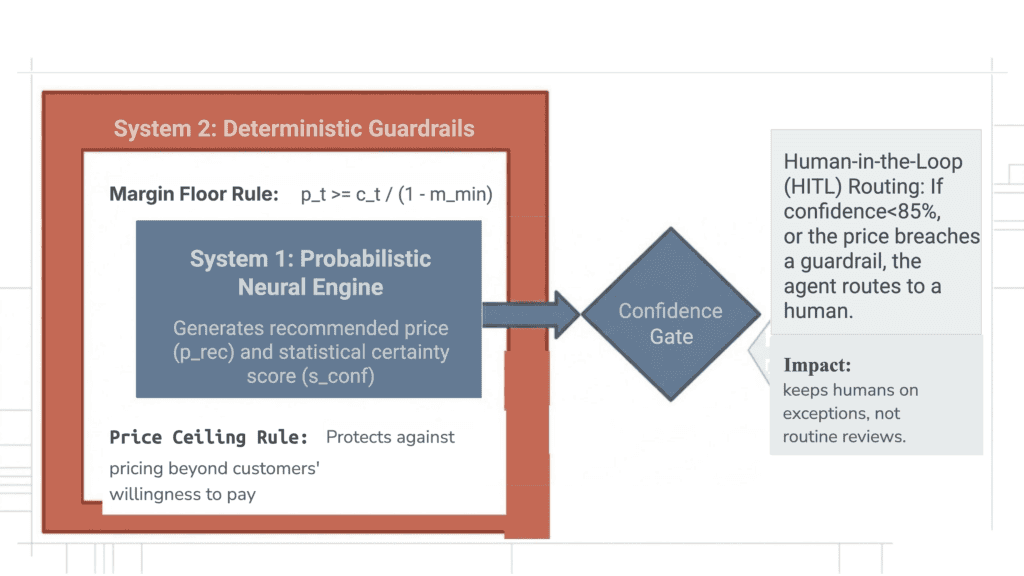
Agentic AI pricing guardrail architecture with margin floor and ceiling rules and a human-in-the-loop confidence gate
| Practitioner Note: Guardrails eat model risk. The agentic AI pricing deployments that survive are rarely the ones with the fanciest models. They are the ones where Finance signed the floors, Sales signed the escalation paths, and one owner could answer “what is the agent allowed to do?” without opening a slide deck. |
Five Questions for Any Vendor Claiming Agentic AI Pricing
- Which decisions can the agent take without a human, and where is that boundary configured: in the platform, or in a slide?
- Show me the audit log for a price the agent changed last month: inputs, reasoning, approvals, and rollback.
- What data feeds competitive moves, and how do you guarantee nothing nonpublic enters the pipeline?
- Who detects elasticity-model drift, and what triggers retraining?
- What share of your live deployments run fully autonomous versus recommend-and-approve? The honest answer to that last question proves the point of this agentic AI pricing guide.
A Crawl-Walk-Run Roadmap for Agentic AI in RGM
Agentic AI pricing rewards patience and punishes leaps. The maturity path we recommend for agentic AI in RGM runs in three stages, each earning the next.
Crawl: Agent-Assisted Analysis
Humans decide everything; agents accelerate the work. Deploy agents for competitive monitoring, data preparation, research synthesis, and code acceleration. The pharma engagement above used LLM coding and research agents to compress weeks of Python development and data wrangling into days: agent-assisted analytics with zero pricing authority. Entry requirements are modest, clean transaction data for priority categories, and a defined owner. Typical timeline to first value: 30-60 days.
Walk: Supervised Recommendations
Agents propose; humans approve every action. This is the scenario-simulator pattern from the consumer electronics case. Agentic AI pricing recommendations arrive ranked, with expected revenue, volume, and margin impact, and the pricing team approves, edits, or rejects each one. Track two numbers: recommendation acceptance rate and realized-versus-predicted impact. When acceptance stabilizes above roughly 70 percent and predictions hold, you have evidence that the system deserves more rope.
Run: Bounded Autonomy
Agents operate within guardrails on explicitly chosen low-risk domains: clearance markdowns, long-tail SKU maintenance, and promotion guardrail enforcement. Bound markdown domains by substitution clusters, not just categories; an agent clearing one SKU at 30 percent off can quietly cannibalize a full-margin substitute unless cross-price effects sit inside its objective. The distributor markdown case from earlier is the blueprint: full automation of a single contained category within thresholds Finance owns. Core list pricing, key account pricing, and new product pricing stay human even at Run. Autonomy is a privilege categories earn, not a switch product flip.
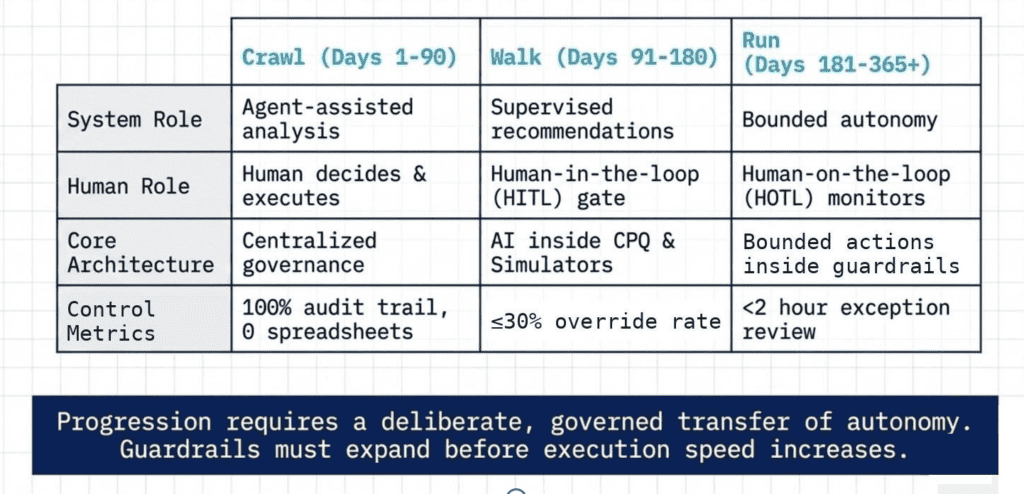
Crawl, walk, run roadmap for agentic AI in RGM, showing rising autonomy with governance gates at each stage.
Worked Example: What Agent-Assisted Pricing Looks Like in Practice
A composite agentic AI pricing example, using round numbers, a mid-market distributor will recognize. Assume $180 million in revenue, 24 percent gross margin, and a $12 million clearance-and-excess category earning 8 percent margin with 1.9 inventory turns.
Step 1: Define the bounded domain. Scope the agentic AI pricing pilot to clearance and discontinued SKUs only, about 2,400 items. Core list prices are untouchable by design.
Step 2: Set the guardrails with Finance. Floor price equals the greater of unit cost times 1.05 or 55 percent of the current list. Maximum markdown step: 10 percent per SKU per week. Portfolio touch limit: 15 percent of category SKUs per cycle. Anything outside the bounds is escalated to the pricing manager within 24 hours.
Step 3: Give the agent objectives, not vibes. Objective: maximize cash recovery subject to the margin floor and sell-through targets by aging bucket (90, 180, and 365 days).
Step 4: Run shadow mode for four weeks. The agent recommends; analysts execute manually. Compare recommendations against analyst decisions. In shadow mode, you are measuring the agent, not the market.
Step 5: Go live inside the bounds, measure weekly. Suppose the agentic AI pricing pilot lifts category turns from 1.9 to 2.4 and recovers 3 additional margin points on marked-down units. Assuming the full $12 million category flows through markdown during the year, that is roughly $360,000 in incremental gross profit, plus about $1.2 million in inventory freed as working capital from the improvement in turns, while your analysts spend their recovered hours on decisions that require judgment.
Step 6: Review the audit log monthly. Every agent action, input, and override in one place. The log is your drift detector, your compliance file, and your case for or against expanding the agent’s domain.
The numbers are illustrative; the structure is not. Every durable bounded-autonomy deployment we have seen follows this shape.
Frequently Asked Questions
What Is Agentic AI Pricing?
Agentic AI pricing is the use of autonomous, tool-using AI agents to perform multi-step pricing work: monitoring competitors, simulating scenarios, recommending changes, and executing price updates within human-defined guardrails. It differs from traditional pricing software by planning and completing tasks on its own rather than waiting for instructions at every step.
What Is the Difference Between Agentic AI and Generative AI in Pricing?
Generative AI responds to requests; it drafts analysis, summaries, and content when asked. Agentic AI initiates and completes work toward goals: it decides which data to pull, runs analyses, and takes actions like queuing or executing price changes. Most production agentic AI pricing systems layer both on top of machine learning models that estimate price elasticity of demand.
Can AI Agents Set Prices Autonomously?
Yes, in bounded domains, and mature teams keep it that way. Production examples include clearance markdown automation inside Finance-owned thresholds and promotion guardrail enforcement. Autonomous repricing of core list prices, contracts, or key accounts remains rare and, in our view, premature. The working standard in agentic AI pricing is bounded autonomy with human decision rights above materiality thresholds.
What Are the Risks of Autonomous Pricing Agents?
The big five: blind or hallucinated pricing actions when models miss market context; silent drift as data pipelines shift; runaway verification costs, with roughly 60 percent of an agentic task’s cost going to checking and refining outputs; legal exposure from algorithmic collusion and surveillance pricing practices; and organizational rejection when agentic AI pricing arrives without change management. Each one is a governance failure before it is a technology failure.
How Do You Govern AI Pricing Agents?
Start with decision rights: document what the agent may do alone, what needs approval, and what is off-limits. Add numeric guardrails (price floors and ceilings, change velocity limits, portfolio touch caps) owned by Finance. Route exceptions to named humans with deadlines, keep a complete audit log, restrict agentic AI pricing inputs to lawful public data, and test a rollback mechanism before go-live.
What Is Agentic AI in Revenue Growth Management?
Agentic AI in revenue growth management (RGM) extends pricing agents across the commercial toolkit: promotion analysis and reallocation, assortment and pack-price moves, and quote governance in CPQ. Early evidence, including our own client work in trade promotion optimization, points in one direction. Agents cut analysis cycles from weeks to days, while reallocation decisions and customer-facing calls stay human.
Diagnostic Checklist and Next Steps
Before piloting agentic AI pricing anywhere, score yourself honestly:
- Can you name the owner of pricing decision rights for the pilot domain, one person rather than a committee?
- Do you have 18 to 24 months of clean transaction data for that domain, with documented provenance for every competitive input?
- Are price floors, ceilings, and change velocity limits written down and signed by Finance?
- Do you have baseline metrics (margin, realization, turns) to measure the agent against, and a tested rollback?
- Does your pricing team know, in writing, whether the agent assists them or replaces a task?
- Would your pipeline pass the RealPage test, with no nonpublic competitor data anywhere?
Two or more “no” answers mean your first project is a data and governance sprint, not an agent purchase. That is normal. It is also fixable in a quarter, and it is precisely the work that determines whether agentic AI pricing compounds margin or compounds mistakes.
If you want a second set of eyes, our team stands up pricing and RGM analytics capabilities (elasticity models, simulators, guardrail design, and the governance to run them) inside client teams in 90 to 120 days, and the governed pricing and RGM AI agents that take on the analyst work while your team keeps the decision rights. Book a complimentary Revenue Growth Analytics consultation, and we will pressure-test your agentic AI pricing readiness against the roadmap above.
Want a second opinion on your pricing?
Tell us what’s going on with your pricing. One of our partners will get back to you the same day or the next.