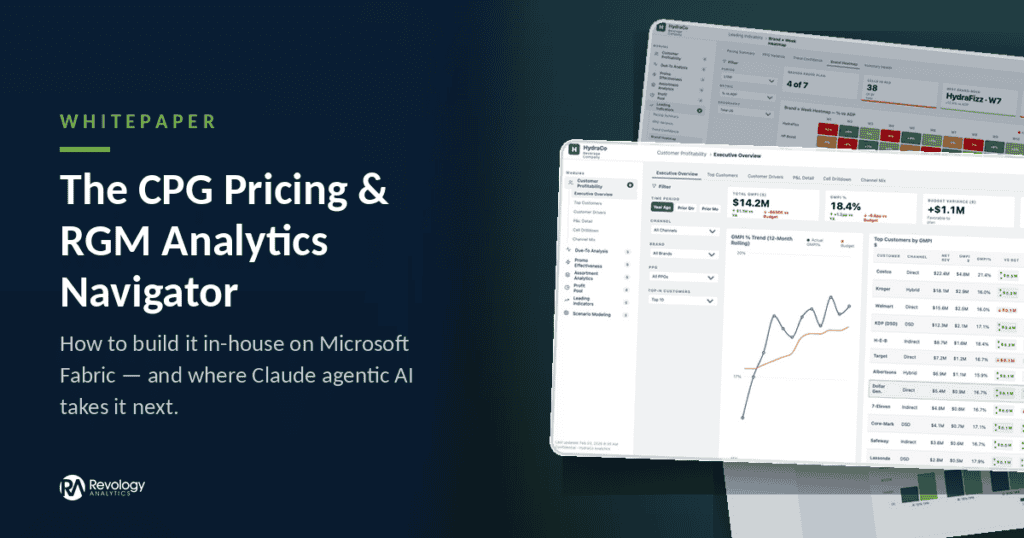
A Pricing & RGM Analytics Navigator Your Team Owns: Six Modules, One GL-Reconciled Foundation, and the Agent Layer That Follows
Most CPG Pricing and Revenue Growth Management (RGM) teams do not have a data problem. They have a navigation problem. On a typical Monday morning, the team has eight tabs open: syndicated POS, the planning tool, the TPM or an Excel deal tracker, the ERP, a GL extract, a competitive ad scrape, and a KAM forecast file from Friday afternoon. A leadership question about why the mix is soft at a priority retailer is already in the inbox. Three sources provide three different figures for customer profitability. Two of the three are wrong, and nobody is sure which.
The data exists. The decision surface does not. The team spends something like 95 percent of the week assembling the picture and 5 percent acting on it. The Navigator inverts that ratio. This 80-page whitepaper is the working blueprint for building that capability in-house, on a stack your team runs after we leave.
Why You Have a Navigation Problem, Not a Data Problem
The Navigator is an in-house commercial analytics capability that connects the systems you already run, applies shared definitions, reconciles customer profitability and promotion ROI to the GL, and gives stakeholders one decision surface for pricing, promotion, assortment, mix, and trade investment decisions. We do not sell a SaaS platform. We build the capability in your stack, with your data, and with your team. When we leave, the intelligence stays in-house.
The navigation problem has a second leg that is even more expensive: the upstream flow. A promotional change made in the TPM is supposed to feed back into the planning tool, so the LE updates, the trade accrual re-rates in the GL, and demand planning re-phases the volume. At most mid-market CPGs, none of that happens automatically. The forecast is stale by week four. The Latest Estimate becomes 40 hours of Senior Manager Excel work every month, and Finance walks into the quarter with a multimillion-dollar trade true-up nobody saw coming.
Buying another platform does not fix this. Most RGM SaaS vendors solve one slice, but each new platform brings its own data model, its own definitions of base versus incremental, and its own reconciliation gap to your GL. The result is more dashboards, fewer decisions. What fixes it is an integrated capability, one set of definitions, reconciled to the GL, sitting on top of the systems you already run.
The core argument
Buy the TPM. Own the analytics. You buy a trade promotion management system because somebody has to hold the deal sheets, push files to distributors, and book trade accruals. That is plumbing, and plumbing is cheap. The analytics and optimization layer that sits on top – promo lift and ROI, scenario analysis, elasticity, the PVCM walk, customer profitability – is where the margin lives, and it is the part a vendor cannot build for you without rebuilding your business inside their product first.
What You Will Learn
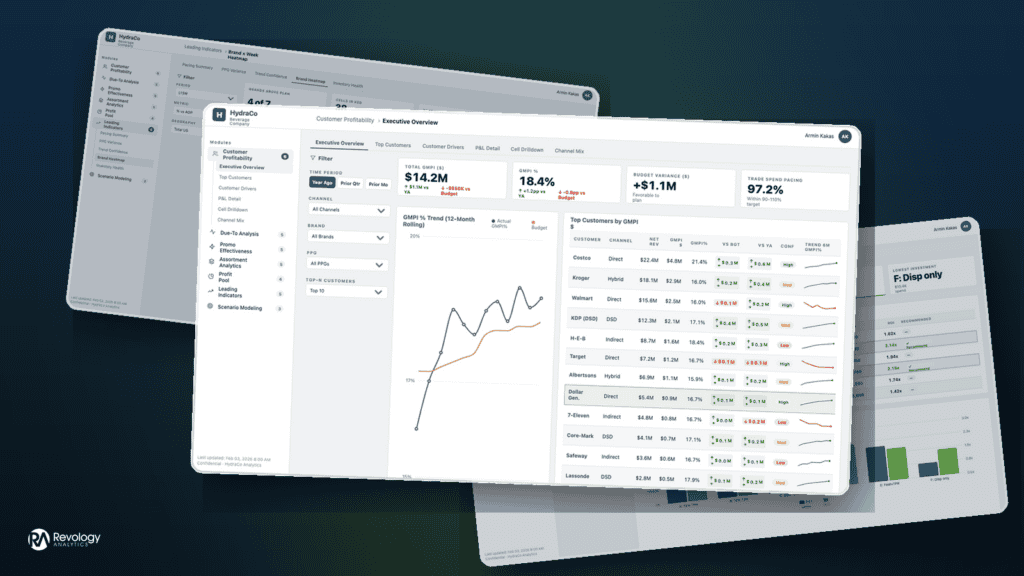
The whitepaper is a build guide, not a think piece. It walks the framework module-by-module, shows two anonymized anchor builds at very different scales, and gives the CIO the reference architecture to evaluate the platform decision. The Navigator is six analytical modules sitting on a single GL-reconciled foundation:
- Customer Profitability. Which customers, channels, accounts, and PPGs are creating profitable growth? The financial control tower – customer P&L, the Price-Volume-Cost-Mix (PVCM) decomposition, cost-to-serve, and the price-realization read, all reconciled to the GL.
- Assortment Analytics. Which SKUs should we expand, defend, fix, or rationalize? ACV and velocity quadrants, hidden-gem opportunities, tail risk, and SKU productivity, a buyer-ready action view.
- Promotion Effectiveness & Optimization. Which events truly drove incremental profit, and what should we do next cycle? Baseline lift, incremental units, manufacturer ROI, and pre-event break-even guardrails are tied back to the TPM key.
- Pricing & Scenario Planning. What happens if we change price, depth, pack, or merchandising support? Elasticity-backed scenarios, break-even lift, cannibalization checks, and price-pack impact, before the decision reaches the buyer’s room.
- Consumption & Shopper Demand Analytics. What is changing in consumer behavior beneath the aggregate sales read? Repeat, switching, household penetration, pack migration, and buyer-cohort patterns.
- Weekly Performance Monitor & Opportunity Gap. What should the team do this week? A ranked action stack with owner, value estimate, source drill path, and status tracking, reading from the other five modules.
The composition matters more than any single module. Customer Profitability tells you what moved; Assortment and Consumption tell you why; Pricing & Scenario Planning tells you what to do before the event ships; Promotion Effectiveness tells you what worked after it closed; the Weekly Monitor surfaces the action this week. All of them reconcile to the same GL-allocated truth.
Designed for CPG Commercial, Technology, and Executive Leaders
The whitepaper gives each leader their part in building their own:
- Heads of Pricing, RGM & Sales. Six modules tied to the weekly work: customer profitability, assortment, promotion, pricing scenarios, consumption, and performance monitoring, and the methodology that makes them reconcile to the GL. The team stops stitching data together and starts driving decisions, walking into the buyer meeting with a ranked action stack.
- CIOs and Data & Analytics leaders. A Microsoft Fabric reference architecture, the source-system integration pattern, the security model, the role of the Revology Flow master-data app, and the handoff plan your data team can own after the 16-week build.
- CEOs and CFOs. A 90- to 120-day path to a governed commercial analytics capability, the build-vs-buy economics, and the four-tier maturity ladder. Year-one client outcomes in CPG typically run 200 to 400 basis points of gross profit improvement when adoption holds.
Key Insights You’ll Gain
- Build vs. buy, settled with economics. Most CPGs no longer need to buy a trade-promotion-optimization platform. The vendor pitch breaks at deployment: a 12-to-18-month build, roughly $500K a year for unfinished work, and a data model you cannot see into. Agentic AI compresses the in-house build to about sixteen weeks, and the clean, GL-reconciled foundation is the same one you would have to build regardless.
- The foundation most builds skip. One set of shared definitions, the Revology Flow business-owned master-data app that stops the platform from decaying within 90 days, and the three-tier GL allocation cascade that ties customer profitability to the CFO’s books.
- Two anchor builds, one operating pattern. An enterprise CPG, a ~$1B multi-channel beverage portfolio on Microsoft Fabric, built in a 16-week engagement, with $5M in projected annualized value (an 18x return). And a ~$100M plant-based F&B brand on a lean Python + BI stack. The methodology is identical; the stack is a choice driven by data volume and team maturity, not ambition.
- The four-tier maturity ladder is phased. Medium (1–2% margin, 1–3% net revenue, 2–4% trade-spend efficiency), High (3–5% margin, 4–8% net revenue, 4–15% trade efficiency), and Very High (4–7% margin growth, 10–15% combined trade-and-revenue lift, 10–25% planning productivity).
- Where Claude API agents take it next. Five narrow, module-bound agents: Price-Volume-Mix Optimization, Assortment Optimization, Promotion Optimization, Trade Investment Planning, and Price-Pack Architecture, plus the RGM Orchestration Agent that synthesizes them into one ranked weekly action stack. Each one drafts; a human edits and owns. That is roughly six hours per analyst per week back, and at a $1B CPG, every 10 basis points of SG&A leverage is $1M in annual EBITDA.
- The 120-day build path. Two modules, one channel, three phases: foundation (weeks 1–4), modules (weeks 5–12), and the earned agent overlay (weeks 13–16). The minimum credible proof that earns the budget for the full build.
Take Action: Build the Navigator
The next decade of CPG pricing performance will be won by the companies that decide to build. Another point solution won’t get you there. Download the whitepaper for the full six-module framework, the two anchor builds, the Microsoft Fabric reference architecture, and the Claude API agent design patterns, the blueprint your team can act on.
Download now to receive the 80-page whitepaper, the companion Revenue Growth Analytics Maturity Scorecard, and a short three-part follow-up from Armin Kakas on the module CPG teams most often skip, and what it costs them.