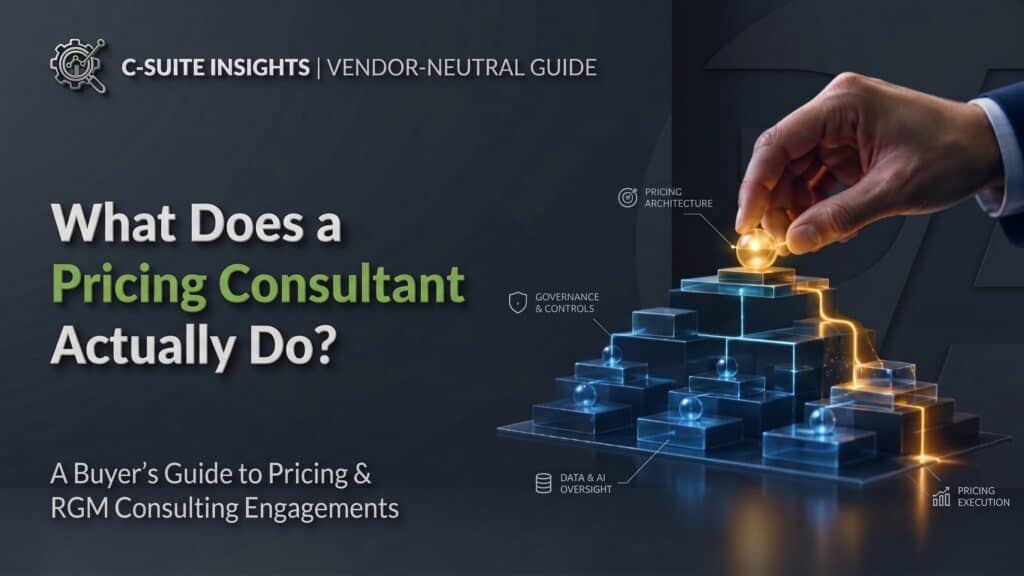
This vendor-neutral guide is designed for CEOs, CFOs, commercial leaders, and private equity operators. It explains the role of a pricing consultant within an engagement, outlines the five engagement models and what each one delivers, provides guidance on selecting between a boutique specialist, a large firm, or an analytics-led partner, addresses why AI has not replaced the need for experienced operators, and details how to secure investment approval before the 2027 budget deadline.
Table of Contents
It is budget season for 2027, and the line item that pricing competes with has never been bigger. Gartner expects worldwide AI spending to reach $2.7 trillion in 2026, up 49.5% from the previous year. In many of the boardrooms we sit in, that number has produced a quiet assumption: fund the AI program, and you will not need a pricing consultant. This guide is written for the executive who has to test that assumption with real money.
A pricing consultant is a revenue management specialist who finds where a company’s price leaks, measures what customers will actually pay, designs the price architecture and discount rules to capture it, and helps the commercial team implement the change so the margin shows up in the P&L. In a typical engagement, the work is phased: a two-to-six-week diagnostic sizes up the prize, a sprint proves it on the company’s own data, and a build stage leaves the analytics and governance within the team.
What Is a Pricing Consultant?
Definition. A pricing consultant (also called a pricing strategy consultant or a pricing and RGM consultant) is an external practitioner or firm engaged to diagnose, design, and implement how a company sets, governs, and realizes its prices. Revenue Growth Management (RGM) consulting extends the same work across every commercial lever: price, pack architecture, promotion, trade spend, mix, and terms. Deliverables range from a sized opportunity and quick wins (diagnostic) to elasticity and promo-ROI models (sprint) to an in-house pricing capability with playbooks and governance (build).
The term ‘pricing consultant’ encompasses a range of providers, from solo practitioners updating software pricing tiers to global strategy firms managing multi-year, multi-country transformations. As a buyer, your primary responsibility is to determine which type of consultant best fits your needs. This guide is structured to support that decision.
Pricing consultant vs. RGM consultant vs. pricing software vendor
A pricing consultant works the price lever: list price, discount discipline, price realization, and price architecture. An RGM consultant works the full set of commercial levers together, which matters in consumer goods and distribution, where a price move rarely lands without a pack, promotion, or trade-terms consequence. A pricing software vendor sells a system that executes rules once they have been written. Software is an input to the work. It does not decide what the rules should be, and it will not win Sales over to them.
Who hires a pricing consultant, and why now
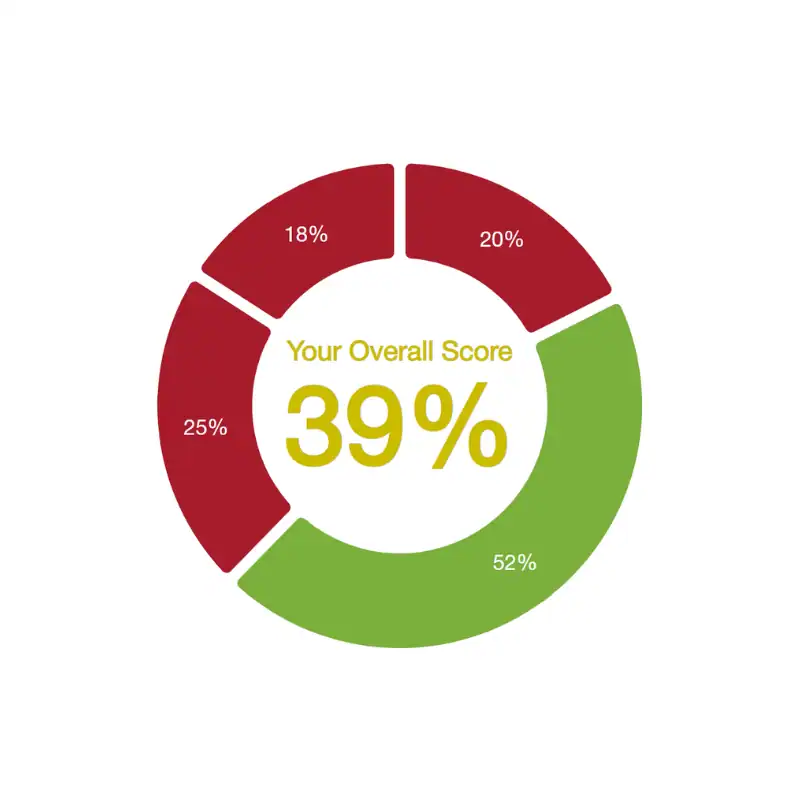
The trigger for hiring a pricing consultant is usually one of five: margins have been declining due to cost pressure; discounting is unmanaged and nobody can state the real pocket price at the customer-product level; the difference between net price and list price has been widening over the years; a private equity owner needs a value-creation plan or a pre-exit margin story; or, most often, either no one owns the pricing function inside the company (or there are too many owners). In Revology’s 2025 Revenue Growth Analytics Maturity Report, 54% of commercial leaders rated their revenue growth analytics as low or medium, and only 2% as very high. That gap has been largely flat since 2023, when we initially started our global survey.
What Does a Pricing Consultant Actually Do? The 7 Jobs Inside an Engagement
Regardless of proposal language, nearly all pricing consulting engagements consist of the same seven core tasks. While the sequence and emphasis may vary by company, the fundamental responsibilities remain consistent.
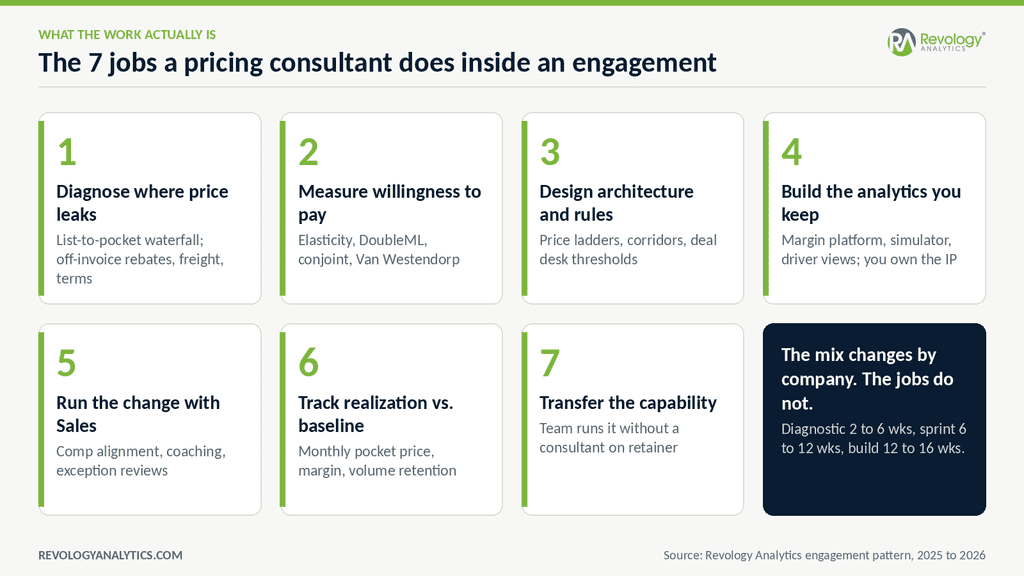
Figure: The seven jobs a pricing consultant performs inside a pricing and RGM consulting engagement.
1. Diagnose where price leaks
Nothing useful happens until someone counts. The consultant pulls two to three years of transactions, customer master files, and discount tables, and builds a price waterfall from list price down to what actually lands in the bank. The surprises are almost always off-invoice: rebates paid on volume that never arrived, freight waived on a Friday afternoon, payment terms that quietly stretched from 30 days to 60. At a global medical device manufacturer we worked with, the waterfall showed unauthorized freight and rebate concessions costing several points on every order that the reported gross margin had hidden.
2. Measure willingness to pay and elasticity
The second job replaces opinion with measurement. Transaction-based elasticity models. Double Machine Learning (DoubleML), where promotions, seasonality, and competitor moves muddy the price signal. Conjoint or Van Westendorp, where the transaction history is too thin to model. What you end up with is a number you can plan against: how much volume walks at a 3% increase, and which segments barely notice. For a deeper dive into these measurement techniques, see our guide to willingness to pay.
3. Design the price architecture and the discount rules
Now, the strategy work most people picture when they hear the words “pricing consultant”: list-price structure, price-pack ladders, segment-specific corridors, and the rules that govern who may discount how much. Governance is the part most companies skip. A deal desk with approval thresholds, a delegation-of-authority matrix in the quoting tool, and a monthly exception review are what stop the new price list from leaking in the first quarter.
4. Build the analytics that the client team will keep and grow
An effective pricing consultant delivers lasting value by providing in-house margin analytics or promotion optimization platforms, detailed profit-driver analyses by customer and SKU, and reproducible simulators for independent scenario testing. All intellectual property, methodologies, and tools should ideally be transferred to the client.
5. Run the change with Sales and Finance
Simon-Kucher’s 2025 value-creation study found that 67% of underperforming pricing initiatives failed due to controllable execution issues, with poor implementation cited by 53% and frontline resistance by 35%. That is why the fifth job exists: comp-plan alignment, rep-level discount-dispersion reviews, coaching on the new deal guidance, and roadshows that get the field to use the tools. We have watched a technically perfect price corridor die in six weeks because the regional sales directors heard about it from a slide. No model survives a sales force that was not consulted.
6. Track price realization against a baseline
The sixth job makes the ROI auditable. Before anything changes, the pricing consultant and the CFO agree on a baseline, then track price realization, pocket margin, and volume retention against it, usually monthly. This is what lets Finance say the gain came from pricing rather than from market tailwinds.
7. Transfer the capability and leave
Capability transfer means your analysts can rerun the elasticity models, your pricing manager owns the corridor rules, and the platform runs without a pricing consultant on retainer. Revology’s engagements are scoped to stand up that capability in 90 to 120 days, which is the difference between renting expertise and owning your pricing analytics.
The 5 Pricing Consulting Engagement Models (and What Each Delivers)
Almost every proposal you will receive from a pricing consultant is one of five shapes. The shape matters less than two other things: who actually runs the work, and what you own when it ends. Fees swing too widely on scope, data condition, and geography to be worth quoting as a range, so ask each firm to price a defined scope rather than hand you a band. What follows is what each model should put in your hands.
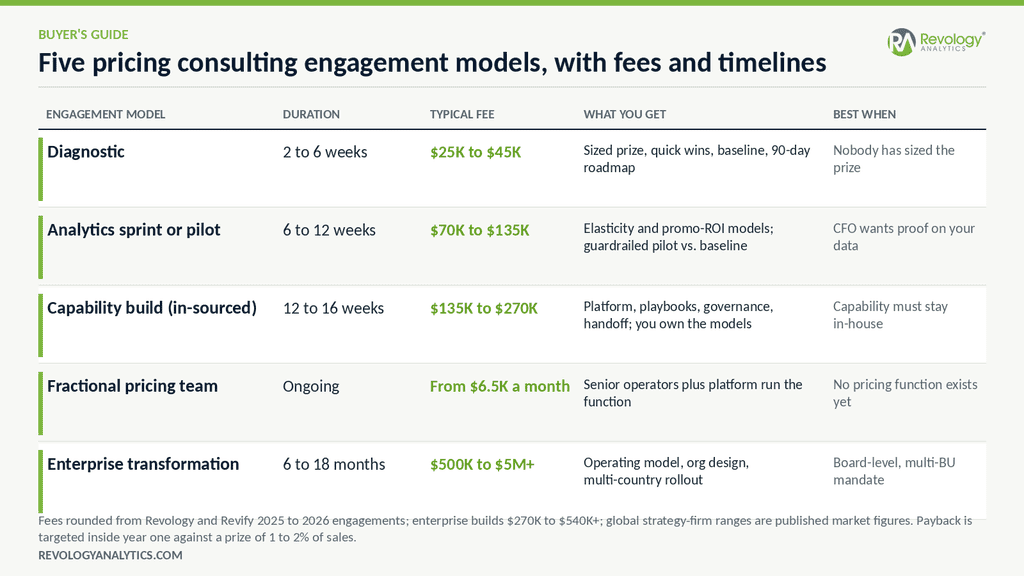
Figure: Five pricing consulting engagement models with duration, what each one delivers, and the question it answers.
Please note: the diagnostic is a checkpoint that uncovers where the value is hiding, not the full engagement. Most of the value lies in the sprint and the build. A small, stage-gated first commitment is almost always easier to get approved than one large one, and it gives you a real exit if the data does not support the case.
How do we run all five
Former practitioners, not career consultants. The person building your elasticity model has carried a pricing number inside a company and lived with the consequences of getting it wrong. We staff a senior on every engagement. There isn’t an analyst layer translating your business to a partner who appears for the readout.
Analytical rigor you can audit. Double Machine Learning (DoubleML) to separate genuine price effects from promotions, seasonality, and competitor moves. Right to Price (R2P) and Price-Quality-Worth (PQW) to establish where you have permission to move and where you do not. Every model is documented, reproducible, and built where your data already lives, so your team can rerun it without us.
You keep the machine. Models, code, playbooks, and governance are stood up inside your environment across a 90- to 120-day engagement and handed over. The deliverable is a working pricing capability, not a deck describing one. In CPG engagements, clients typically realize 200 to 400 basis points of gross profit improvement in year one. They realized it again the following year, because the capability stayed.
Boutique Specialist, Big-Firm Generalist or Analytics-Led Partner: How to Choose a Pricing Consultant
The five models are the shape of the work. The firm type decides who does it.
What each type of pricing consultant is good at
A large consulting firm offers brand recognition, extensive resources, and proven methodologies. This option is suitable for multi-region transformations where board familiarity is important. However, partner involvement is limited, most work is performed by analysts, and deliverables often require further execution by the client.
Boutique specialists are often led by former pricing executives and assign senior staff to projects. Their fees are lower than those of large firms, time-to-value is shorter, and industry expertise is strong. However, there is a risk of dependency if proprietary models are not transferred to the client.
An analytics-led partner builds inside your environment and leaves the machine running. This is how Revology works. Elasticity models, price waterfalls, promo-ROI engines, discount guardrails, and the governance wrapped around them get stood up on your data, in your stack, with your analysts in the room. Then everything transfers: frameworks, methodologies, model code, documentation, and the playbooks that say when to use what. In-sourcing is how the engagement is designed from day one.
The trade-off is real. This model asks for your people’s time during the build, and if they do not show up, the capability does not stick. What you get for that time is a pricing capability you own outright, one that keeps compounding after the invoices stop, instead of a set of slides you re-buy next year when the market moves.
Questions that separate operators from career consultants
When evaluating pricing consultants, inquire about team members’ direct experience with setting price lists, managing distributor negotiations, and operating deal desks. Request data on the success rate of their pricing interventions and clarify whether analytics will be built in your environment or theirs. Consultants who are hesitant to answer these questions may not be the right fit.
Do You Still Need a Pricing Consultant in the Age of AI?
This is the question behind most of the hesitation we hear in 2026, and it deserves a straight answer rather than a defensive one from someone who makes a living selling pricing consulting.
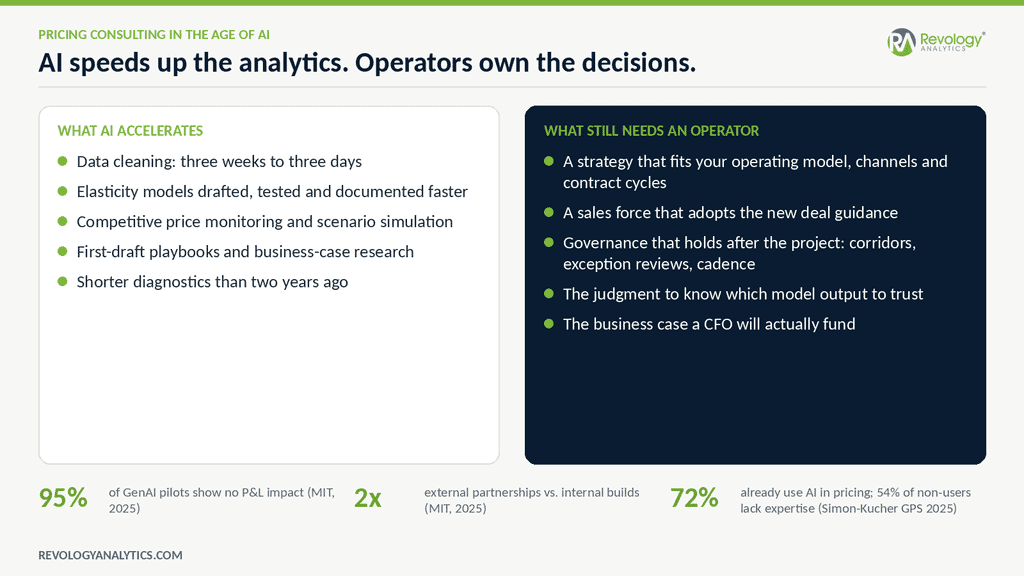
Figure: What AI accelerates in a pricing engagement, and what still needs an experienced pricing consultant.
What AI speeds up in pricing work
AI significantly accelerates many aspects of pricing work. Data cleaning processes that once required weeks now take days. Elasticity models can be developed, tested, and documented much more quickly. Competitive monitoring, scenario simulation, and business case research are also expedited. These advancements have shortened diagnostic timelines across engagements. Consultants who claim AI has had no impact may not be leveraging current tools.
What still needs an operator who has done it
Simon-Kucher’s 2025 Global Pricing Study found that 72% of companies already use AI somewhere in pricing, while average realization on planned price increases has fallen to 43%. The tools are everywhere. The judgment to use them well is the scarce part, and that is what a pricing consultant is hired for.
Our own research says the same thing with more precision. In Revology’s 2025 Revenue Growth Analytics Maturity Report, 42% of mid-market commercial teams use AI mainly to automate manual, repetitive work, and only 6% use it to generate the kind of insight a pricing decision actually turns on. Real-time AI price optimization has barely landed: roughly 15% run dynamic pricing at all, 29.2% revise prices annually or less often, 61.4% still negotiate deals by hand in spreadsheets, and 50.7% have no price waterfall of any kind. Maturity itself has been close to flat through the entire AI boom, with about half of companies in the low or medium band in 2023 and 53.8% still there in 2025. The finding underneath all of it is the uncomfortable one: buying software or AI tools does not move the needle. Talent, process adoption, data hygiene, and change management do.
The broader evidence points in the same way. MIT’s 2025 GenAI Divide research found that 95% of enterprise generative AI pilots produced no measurable P&L impact, and that external partnerships with specialized vendors reached production about twice as often as internal builds. S&P Global reported that 42% of companies abandoned most of their AI initiatives in 2025, up from 17% a year earlier. BCG’s guidance for AI transformation splits the effort 10% algorithms, 20% technology and data, and 70% people, process, and change. Pricing is a change problem with a math component, and the 70% is exactly what an experienced pricing consultant is paid to carry.
Three things do not come out of a model: a strategy that fits how your company operates within its industry, its channel conflicts, and its contract cycles; a sales organization that adopts new deal guidance rather than routing around it; and governance that holds after the project ends. We have written before about why AI will not fix your pricing strategy, and the argument has only strengthened as the tools have improved.
The board conversation: AI budget vs. outside expertise
CEOs and CFOs are under real pressure, from boards or from their own agendas, to show AI investment. Gartner’s September 2026 read is that enterprises are already stepping back from large AI transformation programs toward smaller projects that use AI features within their own software. That instinct argues for the phased pricing engagement rather than against it: fund the diagnostic, let the operators use every AI tool available to shorten it, and judge the program on realized margin rather than on the technology it used.
What ROI Should You Expect From Pricing Consulting?
The 1% rule: Revology’s 2025 study of about 2,000 companies
According to Revology’s research on 2,000 global companies, a 1% improvement in price realization yields a 6-7% lift in operating profit. Excluding highly regulated industries, this figure is in the 10-11% range, and for distributors, it is about 11% (Pricing Still Packs a Punch, Revology Analytics, June 2025). Price is the sharpest lever a commercial team has, which is why pricing power shows up so quickly in enterprise value. The four-pillar benchmarks behind these figures, covering pricing analytics, promotion effectiveness, sales and customer growth, and AI-driven commercial analytics, are in the 2025 Revenue Growth Analytics Maturity Report.
The 1 to 2% of sales planning range
A well-run pricing or RGM initiative is worth 1-2% of sales as a conservative planning figure. Best-in-class programs reach 2 to 5%, and in our CPG engagements, clients typically realize 200 to 400 basis points of gross profit improvement in year one. The range is credible because of the speed of the lever: Simon-Kucher’s value-creation research found that pricing initiatives achieve measurable EBITDA impact in 7.8 months on average, compared with 11 to 17 months for sales-force, product, and expansion levers, with only 4% failing to meet their business case.
What the cost of waiting for a budget cycle looks like
Bain’s analysis of B2B price increases found the median company keeps 68 cents of every dollar of list increase, while the top quartile keeps 95 cents. A company that skips a cycle keeps leaking the difference for another year, and competitors who moved first add 200 to 500 basis points of margin in the meantime.
Worked Example: Sizing and Phasing a Pricing Consulting Engagement for a $250M Manufacturer
The following example uses the 1-2% rule, commonly applied by pricing consultants, to estimate potential impact. You may substitute your own revenue figures, as the calculations remain applicable.
Step 1: Size the prize. $250M revenue x 1% to 2% = $2.5M to $5.0M of annual operating profit at stake. Use the low end in the business case.
Step 2: Phrase the ask. Break it into three gates: a 2-to-6-week diagnostic, a 6-to-12-week sprint, then a 12-to-16-week capability build. Price each gate separately and put a go/no-go decision in front of the sponsor before the next one starts. The first check should be small enough that saying yes costs nobody political capital.
Step 3: Test payback. Whatever the three gates total, divide it by one month of the prize, $2.5M over 12, or about $208K a month of value at the low end. If the answer comes in under six months, the program pays for itself well inside the first year, and in practice, it usually lands at a fraction of that. Even if only the diagnostic and sprint get funded, and the program captures a third of the prize, the return still clears five to one in year one.
Step 4: Price the do-nothing option. Waiting a cycle forgoes the first year of value ($2.5M to $5.0M) and gives competitors a 200- to 500-basis-point head start. Put that number on the same page as the investment.
Step 5: Name the owner and the metrics. One executive sponsor, one accountable owner, and four numbers leadership will watch: net price realization against target, pocket margin after every leak, frontline adoption of the new guidance, and time to the first proven win, targeted inside the first quarter.
This is roughly how a $300M distributor we worked with moved from a diagnostic to a funded program. The diagnostic surfaced a $2.5M-a-year churn leak that averages had hidden; the phased ask cleared sign-off because the first check was small; and pricing, churn, and cross-sell programs followed, with $12M identified and $9M implemented across the engagements.
How to Build the Business Case and Get the Engagement Approved
Securing funding is only part of the challenge. Most initiatives stall during the approval process because Sales and IT typically present quantified business cases, whereas pricing requests are often less concrete. Budget approval is driven by certainty.
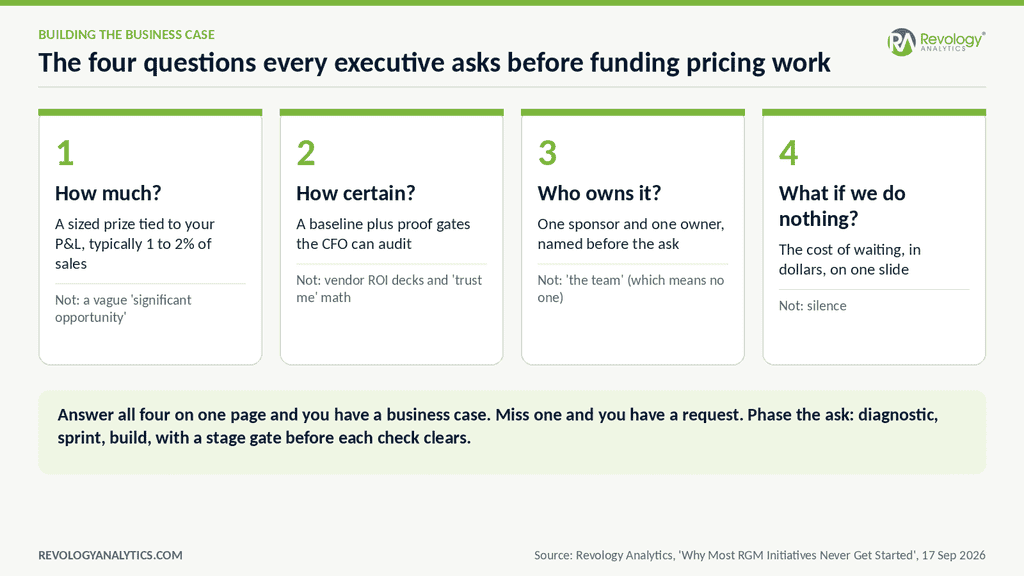
Figure: Every approval turns on four questions. Answer all four on one page, and you have a business case.
The four questions every executive asks
How much? A sized prize tied to your P&L, typically 1 to 2% of sales, not a vague “significant opportunity.” How certain? A baseline plus proof gates the CFO can audit, not vendor ROI decks. Who owns it? One sponsor and one owner, named before the ask. What if we do nothing? The cost of waiting, in dollars, on one slide. Answer all four, and you have a business case. Miss one and you have a request.
The one-page Business Case Canvas
A one-page business case should include seven elements: the opportunity; financial impact relative to a CFO-approved baseline; investment and phasing, with specific amounts per stage; identified risks and corresponding proof gates; a named owner and sponsor; a timeline aligned with the budget calendar; and four key success metrics. Decision-makers will then seek a concise summary, a clear figure, and a definitive date. We have packaged this canvas as a working Excel model, the same RGM initiative playbook we walked through in the webinar, with the sizing, phasing, proof-gate, and success-metric tabs already built. Download the RGM Initiative Playbook. The five stakeholders you have to win, in order to
The CEO evaluates alignment with the company’s growth narrative. The CFO focuses on cost, certainty, and payback timeline. Sales assesses potential impacts on deals and compensation plans. Operations considers implementation feasibility, and IT reviews data ownership and system integration. Securing CFO and Sales support prior to the budget meeting is critical. An engaged executive sponsor is the strongest predictor of a successful pricing consulting initiative.
The four CFO objections and the answers
“We tried pricing before.” The phased approach addresses this concern, starting with a diagnostic and requiring stage gates before scaling. “We do not have the bandwidth.” The diagnostic phase requires only a few data extracts over two to six weeks and minimal team involvement. “Show me the payback.” Value is measured from a pre-agreed baseline, with payback targeted within the first year. “Our data is not ready.” The diagnostic phase assesses data readiness before any significant investment. A qualified pricing consultant will be prepared to address these four objections with supporting data.
The budget clock: September to December
September: Introduce the initiative, estimate potential value, and identify a sponsor. October: Prepare the budget line item, structure the request in phases, and engage the CFO early. November: Present the case in budget reviews with supporting data and proof points. December: Secure funding before allocations are finalized. Missing the December window typically delays the opportunity by a full year.
10 Questions to Ask Before You Hire a Pricing Consultant
1. Who will do the work day to day: senior practitioners who have run pricing inside a company, or analysts working on a template?
2. Which of the five engagement models are you proposing, and what is the stage gate between phases?
3. What data do you need, in what format, and how many hours of my team’s time will the diagnostic take?
4. How will you baseline the starting point so the ROI is auditable?
5. Will the elasticity models, waterfall, and guardrails be built in our environment, and will we own the IP when you leave?
6. What governance will you put in place so Sales adheres to the new rules: deal desk thresholds, corridors, exception reviews?
7. How do you handle change management with the sales force, and what happens to the comp plan?
8. What is the fee structure, and how does it share risk: fixed, hybrid, or tied to realized margin?
9. What share of your pricing engagements hit the business case, and can we speak to two comparable clients?
10. What does the handoff look like, and what does it cost to sustain the capability without you?
Red Flags and Common Misconceptions About Pricing Consultants
“AI pricing software will replace the pricing consultant.” Software and models accelerate the analytics; strategy, adoption, and governance still need an operator. “The big firm is the safe choice.” The safe choice is the team that has implemented pricing at a company like yours, with capability transfer within scope. “The consultant sets our prices.” A good one builds the evidence, the rules, and the capability; your team owns the decisions.
“The diagnostic is the engagement.” It is the first gate; the value lands in the sprint and the build. “ROI cannot be measured.” A pre-agreed baseline and monthly realization tracking make it auditable. And the red flag to watch for in any pricing consultant’s proposal: a deliverable that is a deck, with no data, no model, and no named owner on your side.
FAQ: Pricing Consultants and Pricing Consulting Engagements
What does a pricing consultant do?
A pricing consultant diagnoses where price leaks occur, measures willingness to pay and elasticity, designs price architecture and discount governance, builds analytics, and helps Sales and Finance implement the change and track realization against a baseline.
What is the difference between a pricing consultant and an RGM consultant?
A pricing consultant works the price lever: list, discount, and realization. An RGM consultant works on every commercial lever: price, pack architecture, promotion, trade spend, mix, and terms. Most CPG and distribution engagements need both.
When should a company hire a pricing consultant?
Hire a pricing consultant when the margin has been flat while costs moved, when discounting is unmanaged, when a price increase leaked, before a private equity exit or after a close, or when no one inside the company owns the pricing question.
How long does a pricing consulting engagement take?
A diagnostic takes 2 to 6 weeks, a sprint takes 6 to 12 weeks, and a capability build takes 12 to 16 weeks. Revology establishes a sustainable capability in 90 to 120 days; enterprise transformation programs run for 6 to 18 months.
What ROI can you expect from pricing consulting?
Plan on 1 to 2% of sales as a conservative range; best-in-class programs reach 2 to 5%. Revology’s 2025 study of about 2,000 companies found that a 1% improvement in price realization lifts operating profit by 6 to 7%, and pricing initiatives typically achieve a measurable EBITDA impact in under 8 months.
Can AI replace a pricing consultant?
AI accelerates the research and analytics inside an engagement. It does not set a strategy that fits your operating model, win Sales over, or own adoption. MIT’s 2025 research found 95% of generative AI pilots produced no P&L impact, and external partnerships were about twice as successful as internal builds.
Do private equity firms use pricing consultants?
Yes. Deal teams use pricing due diligence pre-close, operating partners use phased engagements for 100-day value capture, and both use realized-margin proof ahead of exit. Pricing is usually the fastest EBITDA lever available inside a hold period.
Key Takeaways and Next Step
Key takeaways. A pricing consultant’s job is seven things: diagnose the leak, measure willingness to pay, design the architecture and rules, build the analytics, run the change with Sales, track realization against a baseline, and transfer the capability. Five engagement models cover almost every buyer, from a $25K diagnostic to a multi-million-dollar transformation; phase the ask so the first yes is small and gated. A 1% improvement in price realization lifts operating profit 6 to 7% (Revology, 2025). AI accelerates the analytics; it does not replace the operator who fits the strategy to your business and gets the field to adopt it. Approval turns on four questions: how much, how certain, who owns it, and what if we do nothing.
If your 2027 plan has a pricing or RGM line on it without a sized prize, a named owner, or a proof gate, the diagnostic is the place to start. Revology’s Pricing & Revenue Growth Management advisory practice runs a two- to six-week diagnostic that sizes the opportunity using your own transaction data, identifies quick wins, and provides a baseline and a one-page case your CFO will ask for. It is scoped as the small first yes, and the decision to go further stays with you. To scope one, reach out through the contact page and tell us your revenue, your industry, and the pricing question nobody owns yet.
Author: Armin Kakas, armin@revologyanalytics.com, revologyanalytics.com