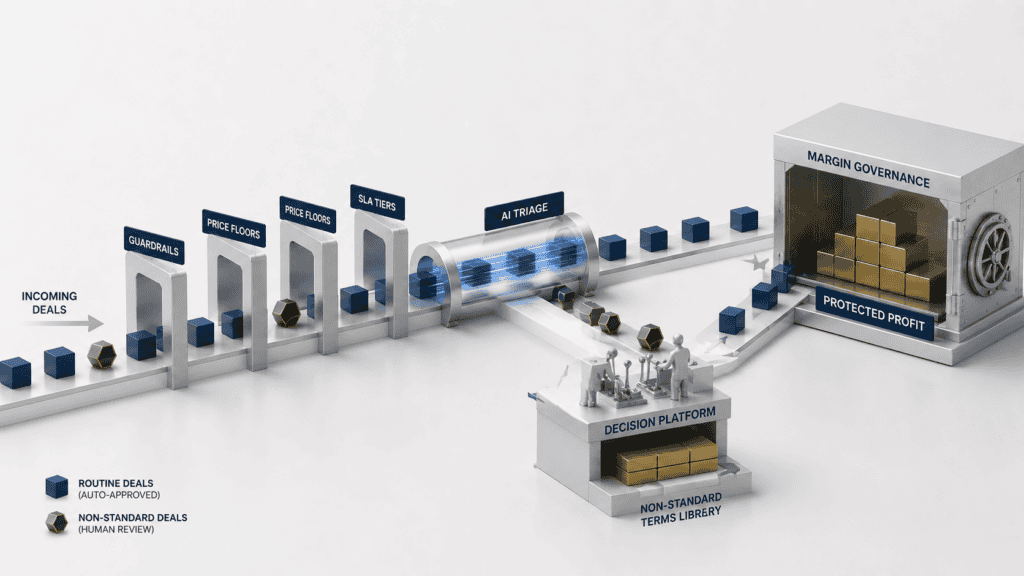
A practical guide for pricing, RevOps, and commercial leaders: what a deal desk actually decides, the margin math that justifies one, the seven guardrails that make it work, and how AI is changing pricing approvals without changing who holds pricing authority.
Table of Contents
The deal desk has become increasingly relevant due to recent regulatory and technological developments. In December 2024, the FTC filed its first Robinson-Patman Act enforcement case in decades, bringing renewed federal scrutiny to differential discounts for competing buyers. The case survived a motion to dismiss in 2025 and has since moved into settlement discussions. At the same time, AI agents have begun drafting quotes, checking compliance with guardrails, and routing approvals within major configure-price-quote (CPQ) platforms. The intersection of these trends is the deal desk: the forum where your company determines, on a deal-by-deal basis, the final approved price.
Many B2B companies rely on informal escalation processes for deal approvals. When a representative requires an exception, they often contact the previous approver and wait for a response. This leads to approval drag: the cumulative cost of slow and inconsistent deal approvals. As quotes age, buyers may choose competitors, resulting in lower win rates. Additionally, each ad-hoc concession can set a precedent for future pricing.
This guide defines the modern deal desk, quantifies the costs of approval drag and discount variance, outlines the seven guardrails that address these issues, and explains how AI can provide meaningful support.
What is a deal desk?
A deal desk is a cross-functional team, and increasingly an AI-assisted workflow, that reviews and approves non-standard B2B deals: pricing, discounts, terms, and configurations. It exists to protect margin and speed up quotes while replacing ad-hoc escalations with guardrails, clear authority levels, and measurable service levels.
| Definition: A deal desk is a standing decision forum, staffed by pricing, finance, sales operations, and legal, that applies your pricing governance to individual deals: which discounts clear, which non-standard terms are acceptable at what price, and which exceptions set precedent. Standard deals inside guardrails should never touch it. |
The previous point is critical: the deal desk adds value primarily by managing exceptions. If every deal requires review, the process becomes a bottleneck, and sales teams will quickly seek ways to bypass it.
What a deal desk actually decides: pricing, discounts, terms, configurations
Four types of decisions belong on the desk. First, price and discount exceptions: anything below the approved floor or outside the corridor for that segment. Second, non-standard terms: extended payment, most-favored-nation clauses, “no greater than” language, unusual cancellation rights, service-level commitments. Each of these is a price cut on a contract’s clothing. Third, unusual configurations and bundles, where cost-to-serve and margin get murky. Fourth, precedent-setting deals: a lighthouse logo, a new vertical, a channel partner whose pricing will be visible to every other partner.
Routine deals are intentionally excluded. An effective deal desk clearly defines which deals it will not review.
Deal desk vs. RevOps vs. pricing committee
The three get conflated constantly, and the confusion is expensive. RevOps owns the revenue engine: the CPQ and CRM plumbing, process design, and data that quoting runs on. A pricing committee sets policy on a quarterly cadence: list prices, floor logic, corridor widths, and the rules for pricing policy across segments. The deal desk applies that policy deal by deal, at quote speed. The committee writes the rules, the desk plays the game, and RevOps maintains the field. When one body tries to do all three jobs, you get either a slow committee approving individual deals or a fast desk inventing policy on the fly. Both leak margins.
Why deal desks exist: the margin math at the moment of yes
Here is the uncomfortable arithmetic. According to Revology’s research across roughly 2,000 public companies, a 1% improvement in price realization produces a 6.4% median operating-profit lift, with wide variation by sector (Pricing Still Packs a Punch, Revology Analytics, June 2025). The quote-approval moment is when realization is won or lost, because it is the last point at which anyone can still say no. After the signature, the price waterfall does whatever the contract specifies.
The evidence for a dedicated function is stronger than most executives expect. Research published in MIT Sloan Management Review found that fewer than 5% of Fortune 500 companies have a dedicated pricing function, fewer than 15% conduct systematic pricing research, and small price variations can move profitability by 20 to 50%. Superior pricing, the authors concluded, is almost always a skill rather than a market condition. A deal desk is that skill, institutionalized at the moment of yes.
Approval drag: the hidden tax on win rate and cycle time
Benchmarks published by CPQ vendors put typical B2B manufacturer quote turnaround time at 24 to 72 hours, while buyers comparing two or three suppliers form strong preferences within about four hours. Requests often sit for four to eight hours before they even enter the quoting system. The same benchmark literature finds that companies responding within an hour win materially more business than those responding in a day or more, at equivalent prices. Vendor numbers deserve a grain of salt, but the direction matches what we see in client win-loss data. Speed is a pricing weapon, which surprises teams who assumed the desk exists only to say no.
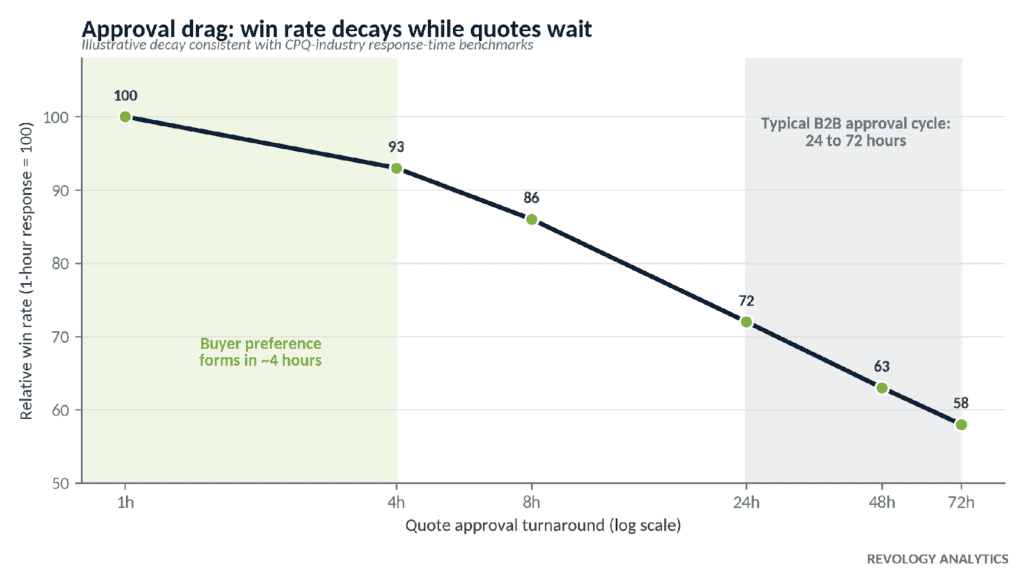
Approval drag in one picture: buyer preference forms within hours, while typical B2B approval cycles run days. The gap is paid for in win rate.
Approval drag compounds quietly. Each additional approver adds a queue. Each queue adds a day. Each day bleeds a little from the win probability on contested deals, and the deals that wait the longest are usually the largest. Sales feel this viscerally, which is why ungoverned organizations develop a gray market in verbal approvals.
Like-for-like discount variance: the leakage evidence
Analyzing two years of transactions and comparing discounts on similar deals, same product family, segment, and volume band, reveals that the spread between the 25th and 75th percentile often spans several hundred basis points. This variation is typically driven by sales habits and regional differences rather than deal economics. Such inconsistency is costly: realized net prices frequently fall 10 to 25% below list price after accounting for rebates, market development funds, and freight concessions. The transition from list to invoice to pocket price is where margin leakage occurs, and the deal desk is uniquely positioned to identify it at the quoting stage.
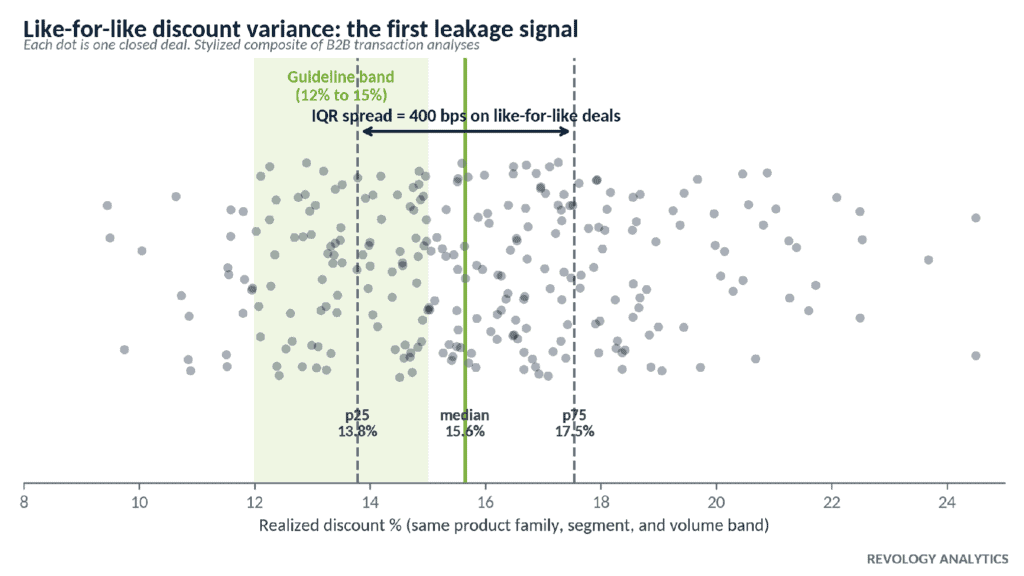
Same product, same segment, same volume band: discount outcomes still spread by hundreds of basis points. Variance, not the average, is the first leakage signal.
| Formula: Variance leakage = Σ over like-for-like deals of (actual discount % − guideline discount %) × deal revenue. If $60M of desk-eligible revenue carries a 400 basis point excess spread and you tighten half of it, you recover roughly $1.2M of gross profit. The worked example below builds this number from explicit assumptions. |
What the 1% price realization math means for deal-level discipline
Consider the relationship between these figures: if a 1% improvement in price realization yields a 6.4% median increase in operating profit, then reducing like-for-like variance by even 50 basis points has a significant impact on EBITDA. In our B2B channel pricing engagements, disciplined quote governance typically recovers 4 to 6% of gross margin, with mid-market clients often achieving 200 to 400 basis points of gross profit improvement in the first year. These gains do not require substantial price increases, but rather the elimination of unnecessary variance.
The 7 guardrails of a modern deal desk
Margin guardrails transform the deal desk from a meeting into a structured system. Seven are most important and function collectively: the first three establish rules, the next two improve efficiency, and the final two provide performance measurement.
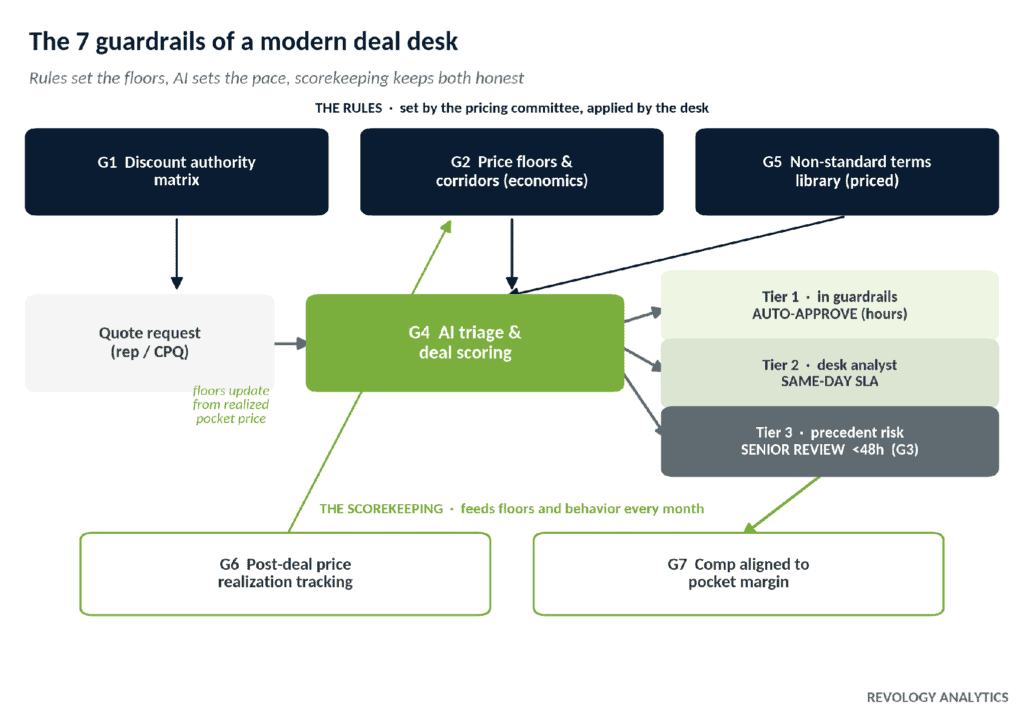
The 7 guardrails of a modern deal desk. Rules (1-3), speed (4-5), and scorekeeping (6-7) reinforce each other; remove one, and the others sag.
Guardrail 1: A discount authority matrix that ends escalation roulette
Document, by role and segment, the specific discount each approval level, representative, manager, deal desk, and CFO, can authorize. The discount approval matrix replaces informal escalation processes and eliminates undocumented verbal approvals, which can obscure precedent. Approval thresholds should be clear and explicit. If a representative is unsure who can approve an 18% discount for a mid-market renewal, the matrix is insufficient.
Guardrail 2: Price floors and corridors set by segment economics
A price floor is only as credible as the analysis behind it. Floors anchored to history’s worst concession simply ratify past mistakes. Set them instead from segment economics: measured elasticity, customer willingness to pay, and pocket-margin targets by segment.
One global data-storage manufacturer we work with governs launch and lifecycle prices inside competitive price-index corridors of 95 to 105 against its direct peer, with discount latitude split by measured elasticity: enterprise lines near -0.5 hold premium pricing with minimal discounting, while consumer lines near -1.5 earn promotional flexibility. Mix and realization moves from that governance were worth roughly $3M of gross margin in a single quarter, and a 1 to 3% net price realization gain worth $3M to $6M of annual EBITDA.
Where demand is measurably inelastic, floors have far more headroom than sales instinct assumes. A pharmaceutical client’s emerging-markets portfolio measured prescription elasticities between -0.26 and -0.45, then corrected underpriced SKUs by up to 70% while continuing to gain share; one pediatric brand took a 5.5% increase while competitors cut real prices and still grew share by almost 19 points. Ad-hoc approvals had normalized systematic underpricing for years. Measurement exposed it.
Guardrail 3: Tiered SLAs that route deals by risk, not queue order
Evaluate each request based on size, discount depth, and term exceptions, then route it according to risk. Standard deals within guardrails are approved automatically within hours. Mid-risk deals are assigned to a desk analyst with a same-day service level, while high-risk or precedent-setting deals receive senior review within 48 hours. This approach addresses concerns about sales delays, as a governed desk can process 80% of deals more quickly than traditional escalation methods. Faster approvals do not require less stringent guardrails; tiering accelerates routine cases and focuses scrutiny where it is most valuable.
See how your pricing compares
Our 2025 report looks at how more than 150 business leaders handle pricing and promotions. See what the best companies do differently, and where most fall short.
Guardrail 4: AI triage and deal scoring in the deal desk process
Modern deal desk software evaluates each request before human review, checking whether the price meets the floor, terms align with the library, the deal compares to the last 20 similar transactions, and the pocket margin after planned rebates. AI triage performs three key functions: routing (auto-approving standard requests), retrieving (providing comparison and waterfall data that would otherwise require significant analyst time), and documenting (creating deal files for audit and legal purposes). However, AI should not make decisions on exceptions. Further discussion on this limitation follows.
Guardrail 5: A non-standard terms library with priced concessions
Every recurring non-standard term belongs in a library with a price on it: extended payment terms cost X basis points, freight concessions Y, an MFN clause Z, or a hard no. Sales then trades from a menu instead of inventing contract language deal by deal. This is also where Robinson-Patman Act exposure gets managed in practice: the FTC’s guidance on price discrimination recognizes cost-justification and meeting-competition defenses, and a terms library plus deal file produces exactly that paper trail as a byproduct. With the agency’s first Robinson-Patman case in decades now moving through the courts, that byproduct earns its storage.
Guardrail 6: Post-deal price realization tracking
After the desk approves a discount, net price realization tracking compares the approved price to the actual pocket price per deal, once rebates and deductions are finalized. This process identifies margin leakage: recurring gaps within a segment may indicate that the floor is set incorrectly, the terms library is mispriced, or additional concessions are being added after approval. Review and update these metrics monthly. Floors that are not regularly updated become outdated.
Guardrail 7: Comp plans aligned to pocket margin, not booked revenue
If sales compensation is based on booked revenue, the deal desk’s efforts may be undermined by conflicting incentives. Align compensation with pocket-margin contribution, or at minimum, tie accelerators to price realization. This alignment reduces unnecessary discount requests before they reach the desk. This guardrail is organizational rather than analytical, which is why it is often overlooked, yet it is essential.
How AI is reshaping deal desk operations
In 2026, vendors are increasingly deploying AI agents throughout the quote-to-cash process, including autonomous approvals and AI-native CPQ systems. Our perspective, as detailed in our analysis of agentic AI in pricing, is pragmatic: while the technology is valuable, the effectiveness of the operating model is even more important.
From manual review to AI-assisted triage: what changes, what does not
AI-assisted triage changes the approval process by automatically clearing standard requests, compiling like-for-like evidence for other cases, and drafting approval memos. This increases deal velocity by reducing manual retrieval tasks. However, the underlying decision logic, such as floors, corridors, and authority levels, remains governed by human-set pricing policies.
Where human authority stays: approvals AI should never own
AI agents should only approve deals that fall within established guardrails, as these parameters have already been defined by human decision-makers. Agents should not set new floors, approve first-of-kind most-favored-nation clauses, or authorize differential discounts with Robinson-Patman Act implications, as these actions constitute policy changes and directly impact financial outcomes. We recommend a phased approach: begin with monitoring and flagging, progress to recommendations, and finally allow bounded autonomy within guardrails, ensuring an audit log is maintained at each stage.
What agentic AI means for the approval workflow
Agentic AI transforms the pricing approval workflow by enabling the agent to internally negotiate on behalf of the representative, verifying whether a concession aligns with the terms library before involving a human. This should be viewed as an efficiency enhancement to existing governance, not a replacement. Without established floors, AI agents can accelerate margin leakage.
Worked example: the business case for a modern deal desk
A straightforward financial model can clarify the business case more efficiently than extended committee discussions. The following is a simple example that can be replicated quickly.
Worked example: a $240M distributor quantifies approval drag (Steps 1-6)
Step 1: Fix the assumptions. An industrial distributor with $240M revenue. 3,000 desk-eligible quotes per year, averaging $80K revenue at a 24% pocket margin. Like-for-like analysis shows a 400 basis point excess discount spread on $60M of desk-eligible revenue. Approval cycles average 3.2 days, with 22% of quotes aging past five days.
Step 2: Define the program. Floors and corridors from segment economics (Guardrail 2), a discount authority matrix (Guardrail 1), tiered SLAs with AI triage auto-approving an expected 60% of requests same-day (Guardrails 3 and 4).
Step 3: Price the variance capture. Assume governance tightens half of the excess spread: 200 basis points on $60M of affected revenue is $1.2M of annual gross profit. Not price increases. Variance removal.
Step 4: Price the drag relief. Assume faster turnaround lifts win rate by 1.5 percentage points on the $48M contested slice (the quotes that currently age). At a 24% margin, incremental gross profit is roughly $170K per year. We deliberately model this lever conservatively; the CPQ-benchmark literature implies more.
Step 5: Total and compare. About $1.4M of annual gross profit against a program cost well under $400K for design, data work, and tooling. Payback lands inside the first year, before counting legal-risk reduction or analyst time returned by AI triage.
Step 6: Read the decision, not the number. The recovery is dominated by variance capture, which means the floors and the authority matrix, the unglamorous guardrails, do the heavy lifting. AI makes the system fast. Governance makes it worth running fast.
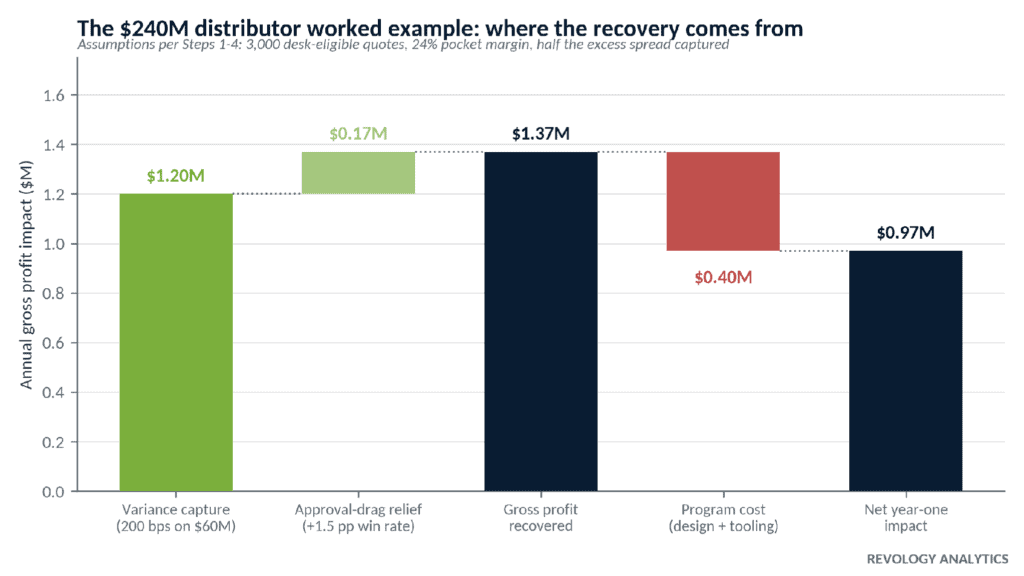
The worked example as a bridge: variance capture ($1.2M) does the heavy lifting; approval-drag relief ($0.17M) compounds it. Assumptions are listed in Steps 1-4.
Sensitivity: Which assumptions move the answer
Focus on the two primary levers: variance capture and win-rate improvement. Even if variance capture is reduced to 100 basis points, the program still generates approximately $770K in returns at the same cost. If the win-rate improvement is eliminated, variance reduction alone justifies the investment. The model only fails if like-for-like variance is minimal, which is rare based on extensive transaction analysis. Conduct your own pricing sensitivity analysis before implementation, using data rather than anecdote.
Standing up a deal desk in 90 days
Implementing a deal desk is a 90-day project, not a full organizational restructuring. The following sequence reflects our approach to establishing margin governance in client engagements.
Weeks 1-4: Baseline the price waterfall and map decision rights
Construct the list-to-pocket price waterfall using two years of transaction data. Quantify like-for-like variance by segment and document the actual approval process, rather than relying solely on policy documentation. This baseline serves as both the business case and the foundation for setting price floors, grounded in customer value-based pricing rather than cost-plus methods.
Weeks 5-8: Guardrails, SLAs, and the approval matrix
Set floors and corridors from segment economics. Write the discount authority matrix and the non-standard terms library. Define the SLA tiers and the deal scoring rules that route between them. Decide, explicitly, what the desk will not review.
Weeks 9-12: Pilot, instrument, and tune
Begin with a pilot in one region or segment. Track three key metrics from the outset: approval cycle time, like-for-like variance, and the difference between approved and realized prices. Adjust thresholds monthly. The initial month may show variability, but by the third month, processes should stabilize. If recurring exceptions persist after three months, review the price floors or compensation plan.
Frequently asked questions about deal desks.
What does a deal desk do?
A deal desk reviews and approves non-standard deals: discount exceptions, non-standard terms, unusual configurations, and precedent-setting contracts. It applies pricing governance at quote speed, protecting pocket margin while shortening approval cycles for routine deals.
Who should sit on a deal desk?
A pricing or RGM lead with decision authority, a finance partner who owns margin math, sales operations for process and CPQ, and legal on call for terms. Small companies run it as a weekly forum with two named owners. What matters is authority and cadence, not headcount.
When does a company need a deal desk?
When exceptions outnumber the rules: discount approvals routing through personal relationships, quote turnaround stretching past two days, or like-for-like variance you cannot explain. In our experience, that point arrives around $50M to $100M of B2B revenue, well before most companies act. The leakage math starts at mid-market volume, not at the Fortune 500.
What KPIs should a deal desk track?
Five earn the dashboard: approval cycle time by tier, like-for-like discount variance, approved-versus-realized pocket price, win rate on desk-reviewed deals, and exception rate by segment and rep. Together, they answer the only two questions that matter: are we faster, and are we tighter.
What is the difference between a deal desk and RevOps?
RevOps builds and runs the revenue engine, the funnel’s systems, and data plumbing. The deal desk is a decision forum that uses the engine to govern individual deals. RevOps makes quoting possible; the desk makes it profitable. In many organizations, the desk reports into RevOps while pricing authority stays with the pricing function.
Does AI replace the deal desk?
No. AI-powered deal desk software handles triage, retrieval, and documentation, and it can auto-approve deals that fall within guardrails humans have defined. Floors, corridor widths, precedent-setting exceptions, and legally sensitive differential discounts stay with people because those decisions are policy, and policy carries the P&L.
Conclusion: govern the moment of yes
| Key takeaways: A deal desk is margin governance applied at the moment of yes: the last point where realization can still be defended. Approval drag and like-for-like discount variance are its two enemies, and both are measurable this quarter. The seven guardrails work as a system: authority matrix, economic floors, tiered SLAs, AI triage, a priced terms library, realization tracking, and comp alignment. AI makes the desk fast; governance makes it worth the speed. And the business case is usually dominated by the least glamorous line: variance you never chose to give away. |
In every organization where we have implemented a deal desk, the loss of margin was not due to a single poor decision. Instead, it resulted from numerous seemingly reasonable exceptions, each approved without clear floors, benchmarks, or sufficient time. By improving the system, these exceptions are addressed automatically.
Our pricing practice partners with commercial teams to implement these processes, from waterfall baselining and elasticity measurement to guardrail design and establishing a sustainable operating cadence, as part of Revology’s Pricing & Revenue Growth Management advisory. If your company’s quote approvals still rely on informal escalation, consider booking a pricing diagnostic with Revology Analytics’ Pricing & RGM Advisory to quantify the impact of approval drag and discount variance before these costs escalate further.
Want a second opinion on your pricing?
Tell us what’s going on with your pricing. One of our partners will get back to you the same day or the next.