

A practical playbook for CFOs, commercial leaders, and small RGM teams at $100M to $2B CPG brands: which revenue growth management moves to make first, what data each one needs, and how each win funds the next.
Table of Contents
The commercial director of a $300M brand has two analysts, a patchwork of planning workbooks, and a trade promotion tool nobody fully trusts. Retailer data arrives months after the event. The CFO wants to know which half of the trade budget works. Vendors keep offering software, and consultants keep offering programs the brand cannot fund. This is where most conversations about RGM tactics at mid-market CPG companies begin.
The brands that make progress don’t start with a platform or a maturity model. They start with the RGM tactics that need the least data and return cash fastest, and they use that cash and credibility to pay for the next move. Below are seven RGM tactics in that order: take stock, close the price realization gap, get usable elasticities, score the promotions you already run, fix packs built only to hit a price point, build a simple account view, and then decide what to build, borrow, or buy. For each, we cover the minimum data, how a small team runs it, and what we have seen in client work.
RGM tactics (definition). RGM tactics are the specific pricing, promotion, pack, and trade-term actions a revenue growth management team takes to grow profitable revenue. RGM strategy decides which of them to pursue; the tactics are the work itself.
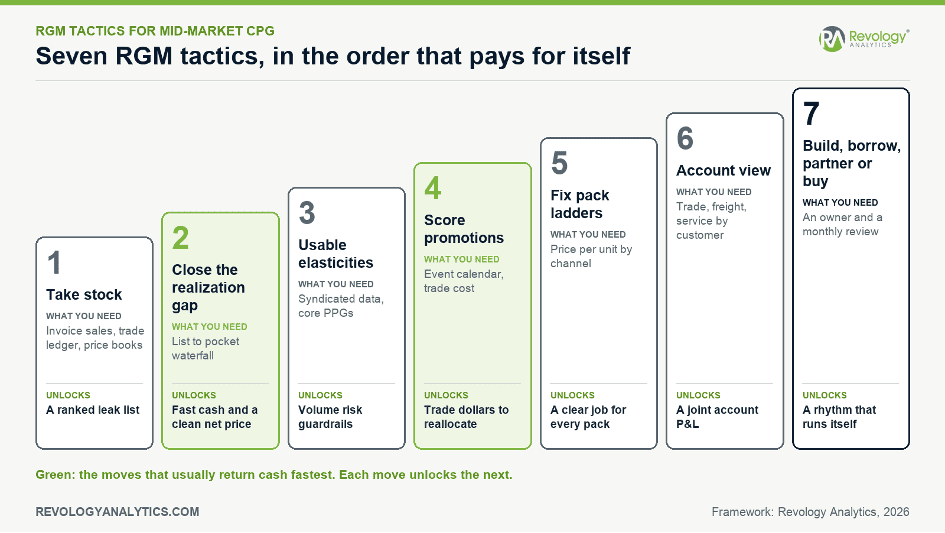
Figure 1. Seven RGM tactics in the order that usually pays for itself. Each move unlocks the next.
Why RGM Tactics Look Different at a Mid-Market CPG Company
Large CPG companies run RGM with dedicated teams, syndicated data contracts, and enterprise software. A mid-market brand runs it with a few people who also own forecasting, account planning, and retailer reporting. The levers are the same. The constraints are not, so the RGM tactics have to be chosen and ordered differently.
A 2026 survey of 50 US CPG brands with $70M to $2B in revenue, commissioned by a trade promotion software vendor, found that 79% use spreadsheets as a primary or sole RGM tool, 36% have no clear RGM owner, and 66% of RGM buying decisions include the CFO. The sample is small, and the sponsor has a product to sell, so treat the numbers as directional. They match what we hear when we talk to mid-market teams about RGM tactics.
Price pressure is real, too. Store brands reached a record 23.5% unit share and 21.3% dollar share in the US in 2025, growing 3.3% against 1.2% for national brands, according to PLMA’s analysis of Circana data. A brand that cannot show why its price premium holds will lose the argument at the shelf and in the budget meeting. Good RGM tactics are how you show it.
What a small RGM team is up against
In our client and prospect conversations, the same five problems come up again and again:
• No owner, no hours. A three-person RGM team at an $800M consumer goods business lost its analysts in a restructuring. Its elasticity and promotion models existed but ran on manual Excel tools.
• Data that arrives too late. A plant-based creamer brand waited four to five months for retailer data. By the time it showed a promotion had lost money, the team had already run the same promotion again.
• Elasticity only for the big products. A beverage brand’s account planning workbooks carried modeled elasticities for core promoted product groups (PPGs) only. The smaller PPGs were out of scope.
• No real list price. A fast-growing pet-care brand negotiated every SKU’s price separately. At one mass retailer, the retailer’s margin was about 60% on one SKU and about 43% on another.
• Can’t fund a big answer. As one of our partners put it, mid-market companies can afford neither a big-ticket project nor a blank check.
None of these needs a new system first. Each one is handled by one of the RGM tactics below, in this order.
Move 1: Take Stock in Two Weeks
The first of the RGM tactics is a stock-take. Before any modeling, write down who owns pricing and trade decisions, where the data sits, and where money obviously leaks. Two weeks is enough for a first pass.
Minimum data. Invoice-level sales for the last 12 to 24 months, the trade spend ledger, a list of active price books and deal sheets, and whatever syndicated or retailer data you already pay for.
What to look for. At the creamer brand, data sat in an accounting package, an inventory system, a trade promotion tool, a syndicated data feed, and a distributor portal. Nothing could be joined until someone built a master customer hierarchy. That is a finding in itself. Fix it before any elasticity work.
Why Sales and Finance trade numbers never match. When Sales and Finance bring different trade numbers to the same meeting, the cause is almost always bucket and denominator drift. Commercial planners track working trade, the scan, off-invoice, and display dollars that actually move volume, as a share of gross sales. Finance includes fixed customer investments like slotting, free fill, shopper marketing, and damage allowances, and often divides by net revenue. Agree one set of metric definitions in week one that separates working trade from fixed account costs, so the monthly review stops turning into a spreadsheet reconciliation. Settle it early: every one of the RGM tactics that follow depends on those definitions.
What done looks like. A one-page list of opportunity areas with a rough size for each. A focused diagnostic usually surfaces around a dozen. Rank them by cash return and by how much data each needs. The RGM tactics in Moves 2 and 4 nearly always rise to the top.
One caution from our own practice: don’t promise a savings number before you know how trade spend is booked. When one prospect’s trade promotion tool allocated spend at a level we had not yet confirmed, we chose not to quote any trade savings until we had.
Move 2: Close the Price Realization Gap First
Price realization is the share of your planned or list price that actually reaches the pocket after discounts, deductions, and trade. Of all the RGM tactics, it is usually the cheapest money in the business, because it needs no demand model. You are not asking customers to pay more; you are stopping leakage on price you already agreed.
Start with the last price increase. How much of it landed, by customer and by SKU? Walk the price waterfall from list to invoice to pocket, and look for off-invoice discounts that grew, deductions nobody approved, and price books that never got updated. Our price realization guide covers the formula and the fixes in detail.
Set a list price you can defend
The pet-care brand did not have a master list price. Every retailer bought off its own negotiated SKU sheet, so nobody could compare retailer margins or tell where list price ended and trade spend began. We recommended setting one published list price per channel and using trade terms to bridge each retailer back to its agreed net price. Retailers paid the exact same landed cost as before, but every concession now sat in the open. The team pushed to lock that structure in before September budgeting so account managers could plan the new year on one set of numbers.
For brands that already have a list price, the realization problem is usually price-book sprawl: fifty bespoke account price tiers created over years of side deals. Consolidating those tiers by average trade rate alone backfires if one retailer runs an everyday low price and another runs twenty weeks of deep high-low features. Group accounts into shared channel tiers only when their promoted shelf prices sit within pennies of each other and their annual promoted weeks match on core packs, and keep custom plans for the handful of anchor retailers that drive most of your volume. Tier clean-up is one of the slower RGM tactics, so plan it over two or three budget cycles.
Illustrative arithmetic. A $250M brand that realizes one more percentage point of its planned price keeps about $2.5M that was leaking. If volume and costs don’t change, nearly all of it reaches gross profit. On a 10% operating margin ($25M), that is roughly a 10% lift in operating profit from one of the least technical RGM tactics on this list.
Watch what the retailer does to the shelf price
Tracking your own net price is only half the realization check. You also have to watch what the retailer does to the shelf price after you take an increase. We regularly see retail buyers pad their own margin on top of a supplier list increase, pushing a branded multipack past a psychological price threshold and widening the gap against private label to 40% or more per unit.
When unit velocity drops 20%, the buyer blames your price increase. Arm account managers with a simple shelf-margin and elasticity readout so they can show the buyer when retailer margin padding is costing the retailer category dollars. This is one of the RGM tactics that protects the premium the private-label numbers above put at risk.
Move 3: Get Elasticities Good Enough to Decide With
Price elasticity tells you how volume responds when the regular price changes. Without it, every price decision is a negotiation between Sales’ fear and Finance’s hope, and the pricing RGM tactics that follow rest on guesses. If you need a refresher on the concept, start with our guide to price elastic and inelastic demand.
A small team only needs to get three modeling rules right:
• Promotional lift is not price elasticity. A temporary 20% price cut backed by an endcap display does not behave like a permanent 5% list price increase. Blending the two in the same regression will make you think a list price increase costs far more volume than it actually does.
• Model at the grain where you actually set prices. That is almost always the Price Pack Group (PPG), all the flavors or varieties that share a pack format and shelf price, not the individual flavor SKU. Add a cross-price term wherever a sister pack or rival brand clearly trades volume with yours.
• Roll up when the history gets thin. When a pack or retailer has sparse volume history, step up to the product family, channel, or national level instead of forcing a noisy SKU-by-week regression.
The cost of getting this done has fallen sharply. Elasticity builds that used to take eight to ten weeks of data science time now take us half a day to a day with AI-assisted code. That is build time only: it excludes the up-front work of pulling, cleaning, and validating the shipment, POS, and trade history. Even so, a mid-market brand no longer has a reason to guess, and cheap elasticities sharpen the RGM tactics that follow.
What to do when a PPG has no elasticity
Every brand has a long tail of small PPGs with too little history to model. The usual workaround is a flat default value for everything, which can make a price increase look safe when it is not. Our rule is simpler and safer: borrow the product-family median, and if there is no family estimate, the overall median. Flag every borrowed number so planners know which elasticities are estimates of estimates, and test them with the next price change.
Illustrative example. Core PPG A has a modeled elasticity of -1.4. Small PPG B has none. The family median is -1.2, and the overall median is -1.0. Use -1.2 for PPG B and flag it. A flat default of -0.5 would have told you PPG B could take a price increase with less than half the volume loss it is likely to see.
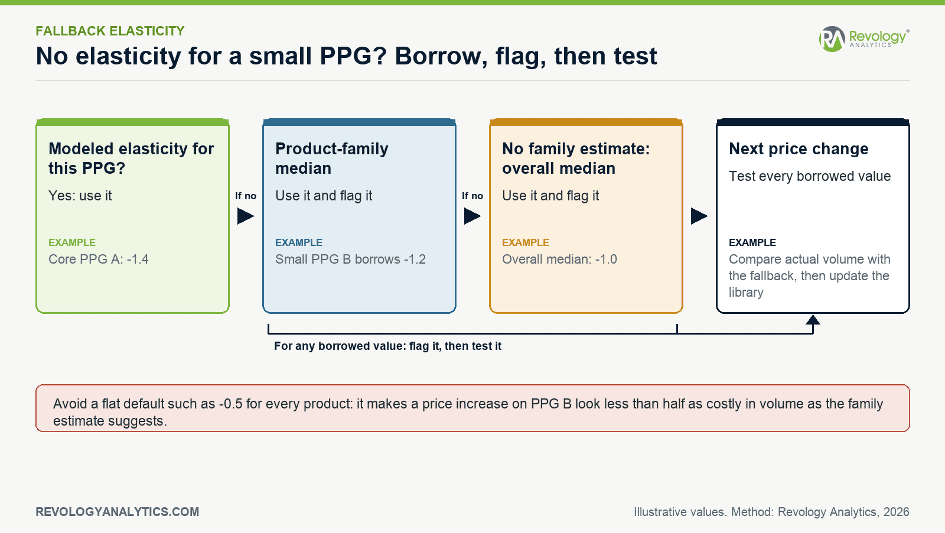
Figure 2. A flagged fallback beats a flat default. Borrowed elasticities are tested at the next price change, like every other input to your RGM tactics.
Move 4: Score the Promotions You Already Run
Trade spend is usually the second largest line after cost of goods. Before you ask for more of it, score what you already spend. Use one return measure and one convention: incremental gross profit from the event divided by the event’s trade cost, where 1.0x is break-even. Our Promotion Scorecard walks through the full method.
When a beverage client first scored its promotions at one large grocery retailer, a meaningful share of events came back below half their cost. A buy-one-get-one event with an eye-catching lift was among the expensive ones; the category lead told us the team had never known what its promotions actually cost.
She made a fair point right after: sometimes you still run a money-losing promotion to defend shelf space, support a new item, or block a competitor’s launch. That is fine as long as everyone walks in knowing the price tag. The scorecard does not make the decision. It makes the cost of the decision visible.
Check how much of the funding reached the shelf
When a promotion misses its lift target, check how much of your trade funding actually reached the shelf. In many categories, a healthy retailer pass-through rate sits between 75% and 85% of the manufacturer’s promotional allowance. When we audited event-level pass-through across major retailers for a national beverage brand, one grocer passed through roughly 85% of the funding into lower shelf prices, while a mass merchant passed through just over 60% and kept the rest as retailer margin. Scoring promotions without checking shelf pass-through blames the brand’s elasticity for a discount the shopper never saw. Put pass-through on the same scorecard; it is one of the cheapest RGM tactics to add.
Fund the analytics from trade you stop wasting
This is how RGM tactics pay for themselves, and it is the argument to take to Finance. The creamer brand’s CFO backed funding promotion analytics from the trade budget it would protect, after seeing a losing event repeated because the data arrived late.
Illustrative arithmetic. A brand spends $30M a year on trade across 400 events. Scoring shows that 25% of events, about $6M of spend, return less than half their cost. Redesigning or stopping half of those frees $3M of budget. That is not automatically $3M of profit: net out the incremental gross profit the cancelled events did earn, plus any replacement activity. Move what is left to events that clear 1.0x, or keep it as margin. Either way, the analytics are paid for many times over without a new budget line. Once the worst events are fixed, trade promotion optimization can tune the rest.
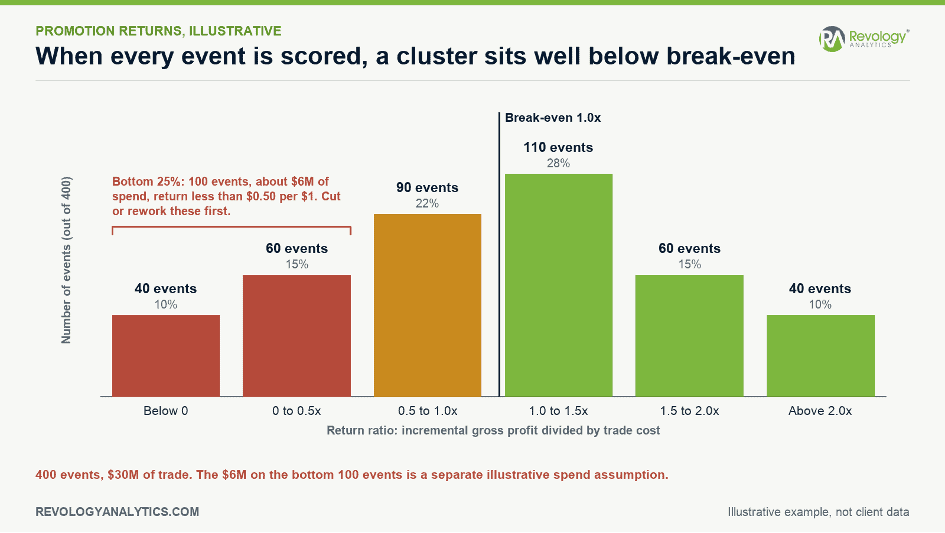
Figure 3. Illustrative only, not client data. The $6M on the bottom 100 events is a separate spend assumption; event counts alone don’t set it.
Move 5: Fix Packs That Exist Only to Hit a Price Point
Many mid-market brands set pack counts to land under a shelf price threshold. The pet-care brand above sized several packs to sit under $20. That can be the right choice, but it should be a decision, not a habit.
Review your price and pack ladder by channel with three checks:
• Does each pack have a job? Entry price, value, trade-up, or club. A pack with no clear job is a candidate to cut.
• Plot your price per ounce or per unit across every pack size. Larger packs usually offer the shopper a lower price per ounce, but that discount slope should be deliberate. If your family size or club multipack is priced 25% cheaper per ounce and carries a lower gross margin percentage than your core pack, every shopper who trades up is quietly eroding your margin.
• Is the threshold real? Test whether shoppers actually stop buying above the price point before you shrink the pack to stay under it.
Keep this move light; of the seven RGM tactics, it needs the least analysis. A full price pack architecture program can come later; the quick win is removing packs that confuse the ladder or cannibalize a better-margin size.
Move 6: Build a Simple Account View Before the Next Negotiation
Move 6 pulls your realized price, promotional spend, and cost to serve onto a single page for each retail account, a simple customer P&L. The goal is to see what each customer actually contributes after working trade, fixed slotting or marketing fees, freight, and warehouse allowances, built on the exact net revenue and margin definitions Finance uses to close the books.
Two reasons it belongs here among the RGM tactics and not earlier. First, it depends on the data clean-up from Moves 1 to 4. Second, it is where the money is negotiated. The beverage brand’s teams had been budgeting against last year’s budget because actuals by retailer were not visible, and their plans sat well off the finance budget for three months before anyone flagged it. Freight alone can move the picture: at one distributor we worked with, freight took gross margin from about 19% to about 14%.
For most mid-market teams, the account view is the RGM tactic that changes negotiations fastest. Start with your top five accounts and one quarter. Reconcile to Finance line by line, then take the view into the next joint business planning meeting.
RGM tactics when you sell through distributors
If you sell through DSD distributors or broadline wholesalers, a two-party customer P&L will mislead you. In a three-tier route to market, off-invoice discounts, distributor allowances, and retail scan bill-backs hit three different P&Ls, and distributors care about blended dollar profit per case rather than percentage margin on a single deal. Most TPM systems also log trade spend against the wholesaler invoice, while POS volume sits under the retail chain. Until you map wholesaler depletions and chargebacks to the end retail banner, your biggest accounts will look artificially profitable and your distributor line will look like a money pit. Fix that mapping before you run any account-level RGM tactics.
Move 7: Decide What to Build, Borrow, Partner, or Buy
Only now does the capability question make sense, because you know which RGM tactics you will run every month and what data they need. Too many brands start here and buy capability for RGM tactics they have not yet tested. There are four realistic options for a mid-market brand:
• Build in-house (one to four people). Best when you have a leader who can own pricing and trade full-time. Watch for: the analyst who also owns forecasting and reporting, and has no hours left for RGM.
• Borrow a fractional or shared lead. Best when the business cannot justify a full-time pricing hire. A PE talent partner described one fractional pricing lead covering eight or nine portfolio companies, as larger PE firms already do. A part-time pricing manager works the same way inside one company.
• Partner to build and hand over. Best when you need the models and the rhythm set up quickly and want your team to run them afterwards. Our guide to what a pricing consultant actually does explains the engagement models.
• Buy software. Best when the process, the data, and the owner already exist and volume makes manual work the bottleneck.
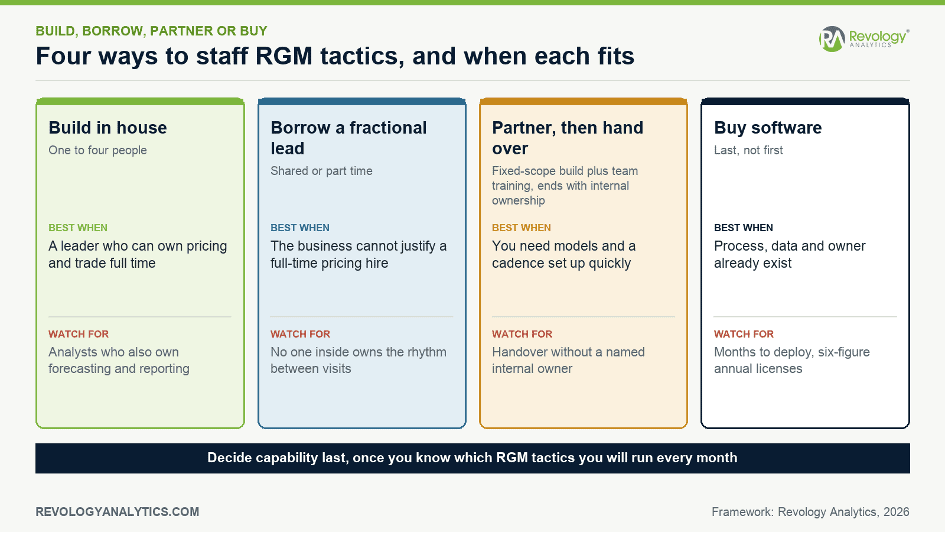
Figure 4. The capability decision comes last, once you know which RGM tactics you will run every month.
When RGM software earns its keep
Enterprise pricing suites typically take months to deploy and carry six-figure annual license costs. For most brands up to $1B to $2B, our view is that a strong trade promotion management (TPM) tool and a base RGM model with semi-automated data pulls come first, with scenario analysis in Power BI or Tableau.
The RGM lead at the $800M business said it plainly when offered a multi-million-dollar optimization system: a small team with a small budget cannot fund it. Fix the data and the process first, then automate the RGM tactics that have proved themselves.
Our article on practical solutions before AI makes the same argument for AI, and our CPG RGM analytics navigator shows what a lean analytics stack can look like.
Put a rhythm and an owner on the RGM tactics
RGM tactics decay without a cadence. Put a recurring monthly pricing and trade review on the calendar with Finance and Sales. Use that hour to check net price realization against plan, review last month’s promotion scorecard, and inspect the bottom customer P&Ls; refresh the elasticity library once a quarter rather than every month. Every workstream needs one named owner on the hook for bringing the numbers.
When a PE-backed wholesaler asked us how to make their new capability stick, our advice was simple: bank one visible profit win early, build the tools alongside the analysts and account managers who will actually run them, and lock down who owns the monthly refresh before the outside team steps back.
How to Get the CFO Behind Your RGM Tactics
In our experience, a CFO judges RGM tactics on three answers: where are we making money, where aren’t we, and how do we do more of the first. Frame every RGM tactic around those questions.
• Lead with the cheapest money. Price realization and the worst promotions return cash without new spend.
• Show the arithmetic. One point of realization on your revenue, and the trade you would stop wasting.
• Let the first wins pay for the next tools. You do not need a multi-year transformation budget to start. Use the margin recovered from fixing leaky account discounts or cutting dead-weight promotions to pay for deeper elasticity or pack work. If your promotional calendar is burning cash today and your list prices are locked for the next six months, score your promotions first and build the elasticity library second.
• Sit with them. Directors who sponsor RGM often don’t control the budget. Walk the CFO through the numbers in person; a dashboard sent by email rarely gets opened.
RGM Tactics FAQs
Which RGM tactics should a mid-market CPG company run first?
Start with invoice price realization and a promotion scorecard, then build a working PPG elasticity library before your next list price or pack change. Closing realization leaks and trimming bottom-quartile promotions only require shipment, invoice, and trade history you already own, so they generate cash fast enough to fund the rest of the roadmap.
Where should a small RGM team start?
Start the RGM tactics with a two-week stock-take of ownership, data, and obvious leaks, followed by the price realization gap on the last price increase.
When should a mid-market CPG company buy dedicated RGM software?
Buy dedicated RGM or trade optimization software only after you have a working monthly process, clean unit-grain data, and a named internal owner to run it. Most $100M to $2B CPG brands get further in year one with their existing TPM system and a governed elasticity and promo scorecard model than with a six-figure optimization platform nobody has time to maintain.
How do you estimate price elasticity with limited data?
Model your high-volume items at the Price Pack Group (PPG) level, where you actually set prices, and roll sparse items up to the product-family or channel level instead of forcing noisy SKU regressions. When a small pack still lacks enough history, borrow the product-family median elasticity, flag it clearly as a fallback assumption in your planning sheet, and replace it with an observed value after your next price change.
How do you get CFO buy-in for RGM?
Answer where the business makes money, where it doesn’t, and how to do more, then fund the next RGM tactics from the savings of the last.
Should we hire a pricing manager or use a consultant?
Match the staffing model to how many pricing and trade decisions you make in a year, not just your revenue tier. If you negotiate year-round across dozens of retail banners and have a commercial leader who can direct an analyst’s weekly work, hire in-house. If you need the models, scorecards, and monthly cadence built first, or only need senior RGM judgment for two or three pricing cycles a year, start with a fractional lead or a build-and-transfer partner.
Key Takeaways
• Start cheap. The first RGM tactics should need the least data and return cash fastest.
• Realization first. Close the gap on price you already agreed before modeling anything.
• Good enough elasticities. Model the core, aggregate the thin, flag every borrowed number.
• Score before you spend. Fix the worst promotions before asking for more trade money.
• Account view before negotiation. Know what each customer earns after trade and freight.
• Check the shelf. Pass-through and retailer margin padding decide whether your price and promotion RGM tactics reach the shopper.
• Capability last. Build, borrow, partner, or buy once you know which RGM tactics you will run every month, and give it an owner and a monthly rhythm.
How Revology Helps Mid-Market CPG Teams
Revology works with mid-market CPG finance, sales, and RGM teams to put these RGM tactics in place in the order that pays: sizing the opportunity, closing realization gaps, building elasticity libraries with flagged fallbacks, scoring promotions, and setting up a monthly review your team can run without us. We do the build work, hand it over, and charge no license fee.
If you want an outside set of eyes on where your margin is leaking, start with a two-week pricing and trade diagnostic. Using the shipment, invoice, and trade exports you already have, we map where realized price diverges from list, which promotions are failing to earn back their funding, and which two or three RGM tactics will pay for the rest of your roadmap. Talk to our team to set one up. For a curated set of further reading on the five most common mid-market problems, see our five most pressing pricing and RGM pain points.