Automated Churn, Cross-Sell & Up-Sell with AI Agents

Act When Customer Behavior Changes, Not When the Campaign Calendar Says So

Cross-sell and up-sell should fire when customer behavior crosses a threshold, not when the quarterly campaign calendar says so. Revology co-designs AI agents with your sales, customer success, and data teams and builds them to monitor account signals continuously and surface next-best-action recommendations to the right rep, channel, or workflow, with approval gates where a person should sign off. For mid-market companies ($100M–$2B), cross-sell propensity, up-sell readiness, and churn risk run from the same lifetime-value engine, so your team sees growth and retention in one view. Built inside your CRM and data stack. Owned by your team. Live in 90–120 days.

What it is

Churn, cross-sell, and up-sell should run from the same customer intelligence layer. Revology co-designs and builds AI agents that route next-best actions inside your CRM.

AI-driven churn reduction and cross-sell strategies for business growth.

How It Benefits Clients

Proactive Retention

Too often, companies find out about churn when it's already too late. Our approach flips the script: you get early-warning alerts for at-risk accounts, so your team can act while there's still time to make a difference. If a subscription customer's usage drops or a loyal shopper goes quiet, the system prompts a targeted retention action, like a personalized discount, loyalty reward, or timely outreach. The uplift model ensures you spend retention dollars only on customers who can actually be persuaded to stay, keeping your program margin-positive and focused on real impact.

Higher Customer Lifetime Value

By analyzing purchase history and behavioral data, the models identify cross-sell and up-sell opportunities that sales or marketing teams would miss. The system might flag, for instance, that a customer who bought product X is likely to buy product Y within 3 months, and prompt a targeted offer. For mid-market clients with 24+ months of transaction history, these offers typically deliver a 15–30% cross-sell lift over rule-based targeting, raising average order value and deepening the customer's relationship with your brand.

Efficient Sales Processes

Sales reps or customer success teams are armed with data-backed recommendations for each account, which means they spend less time guessing which product to pitch or which customers to focus on. The prioritization of leads (who is likely to churn, who is primed to buy more) helps allocate their time to the highest-impact activities. In short, your team can close more upsell deals and save at-risk accounts more efficiently by following the system’s guidance.

Scalability

You shouldn't have to rebuild your analytics every time your business grows. Our churn and recommendation models run on your existing data platform and show up right where your team works, in your CRM or BI tools. As you add new products, segments, or regions, the models are retrained or tweaked, not rebuilt from scratch. The system grows with your business, and your team stays in control.

Our Approach

We build churn and cross-sell agents in four steps, co-designed with your sales, customer success, finance, and data teams so the models fit your data, your products, and the way your reps work.

1
Data & Use-Case Alignment

We roll up our sleeves with your team to pinpoint the churn and cross-sell indicators that matter for your business, whether that's usage patterns, contract renewal dates, customer service touchpoints, purchase frequency, or price and margin history. We baseline your customer base using RFM and cohort analysis, so every model has a clear benchmark to beat. Together, we define the outcomes to predict (like churn in the next 90 days or likelihood to buy a specific product), how your teams will use the predictions (think Salesforce alerts or prioritized lists for account managers), and which actions should run automatically versus those that need a human in the loop.

2
Model Construction & Testing

We use your historical data to build churn, propensity-to-buy, and recommendation models with proven open-source tools like scikit-learn, XGBoost, LightGBM, and survival and uplift libraries in Python or R. Churn gets scored with gradient-boosted classifiers and a survival model for time-to-churn. Cross-sell relies on propensity and product-affinity models built from real transaction patterns and lookalike customer behavior. The uplift model singles out the persuadables, so your offers only go to customers whose behavior you can actually change. We backtest every model against your actual outcomes, measuring precision, recall, calibration, and lift in the top deciles. We keep iterating until your reps have scores they can trust, and act on.

3
Deployment into Your Tech Stack

We put the final models right where your team already works, no new tools, no extra logins. If you use Salesforce, HubSpot, or Dynamics, your reps see churn scores and next-best-action recommendations as fields, tasks, or notifications on each account. Prefer dashboards or automated alerts? We can do that too. High-impact actions like discounts or contract changes route to the right owner for approval, while low-risk actions run automatically. The bottom line: your team gets actionable insights in their daily workflow, not buried in a separate system.

4
Ownership & Evolution

You receive the complete codebase, model documentation, and an "operations playbook" so your team can retrain or refine the models as your business and data evolve. We train your data science or analytics team on how the models work under the hood, so they can adjust features and thresholds and add new data sources over time. The models, code, and IP are yours; there is no license fee and no per-seat license. After handoff your team runs it, and an optional managed-services agreement keeps the models maintained and evolving if you prefer not to.

In our experience, mid-market companies with 24+ months of transaction history see practical, measurable results: cross-sell and up-sell models typically drive a 15–30% lift over rule-based targeting. The churn model arms your customer success team with a prioritized list of at-risk revenue, along with clear reasons for each flag. Instead of chasing a generic campaign list, your sales team focuses on accounts that are ready to buy or at risk of leaving, so every action is targeted and impactful.

Recent Insights

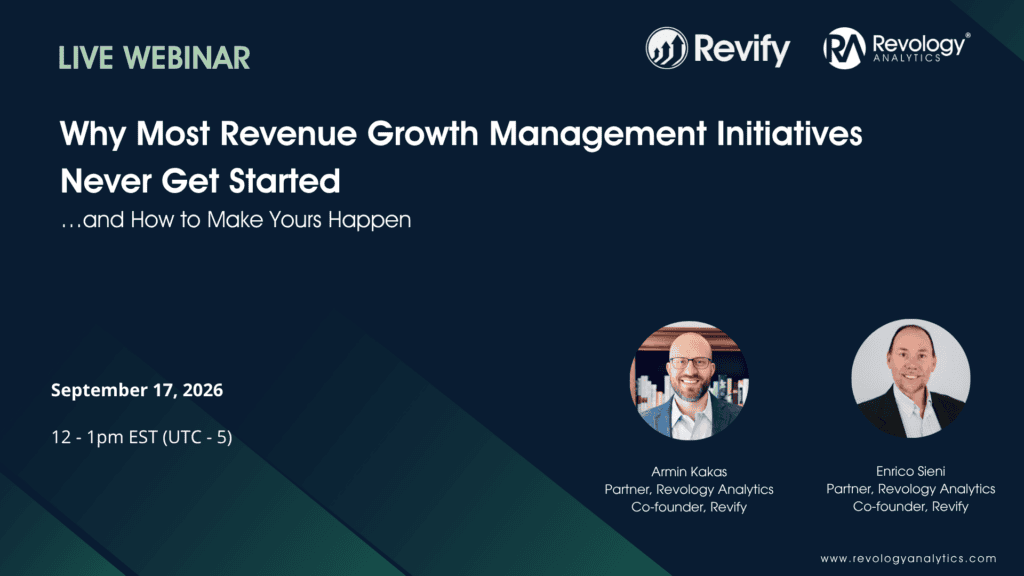
Webinar banner for revenue growth management initiatives by Revology Analytics.

Why Most Revenue Growth Management Initiatives Never Get Started And How to Make Yours Happen

This session is about getting yours started. In 60 minutes, we’ll show you how to frame the business case, estimate what a pricing or AI initiative actually costs, win executive sign-off, and set it up to succeed, including the change management and the KPIs most teams skip. It’s built for companies that already have pricing or AI teams as well as companies that don’t.

Read More »
No more posts to show

Frequently Asked Questions

How does an automated cross-sell agent work?

The agent scores each customer continuously for cross-sell propensity based on transaction history, product affinity, and similar-customer behavior, then routes recommendations to the right rep or marketing automation flow.

Does the agent integrate with my CRM and marketing automation?

Yes. Revology co-designs and builds the agent inside your existing stack - Salesforce, HubSpot, Dynamics, or similar - so the recommendations show up where your team already works.

What lift do the cross-sell scores deliver?

How much lift can you expect? It comes down to your data depth. For most mid-market organizations with 24+ months of transaction history, we typically see a 15–30% cross-sell lift over baseline rule-based approaches. We measure this against a holdout group, so your finance team can trust the results.