

Table of Contents
Ever get that knot in your stomach when a sales rep calls, asking for “just another five points” to close a deal? Or watch helplessly as competitors slash prices, dragging you into a race to the bottom? This isn’t just a bad feeling; it’s often a symptom of significant price leakage – the gap between your list price and what you actually pocket after all discounts, rebates, and allowances. In today’s markets, where savvy buyers are armed with digital tools, price transparency, and commodity prices swing wildly, old-school cost-plus pricing just doesn’t cut it.
Teams that haven’t clearly defined their Best Alternative to a Negotiated Agreement (BATNA) often find themselves reacting out of anxiety, not strength. They grant concessions that bleed gross profit, all without building real customer loyalty. This isn’t just a tactical misstep; it’s a structural weakness. Without a quantified walk-away position, you’re essentially negotiating based on some minimum margin threshold and gut feel. The biggest driver of this leakage isn’t always an “overzealous sales team”; often, it’s the lack of a clear, well-understood pricing and discounting strategy, or guidelines that are too complex or too high-level to be practical.
We’ve seen it across various industries: margin compression can accelerate by 60-90 days once unchecked discount requests become the norm. That’s a critical window – the gap between early warning signs and serious P&L damage. This is precisely where a robust BATNA can turn the tide.
Think bigger than just one deal. Price erosion rarely happens in a vacuum. It can ripple outwards, leading to lower marketing ROI, strained cash flow, and frustrated sales teams watching their targets become moving goalposts. Unchecked, this leakage can trigger desperate cost-cutting that stifles the very innovation needed to stand out. The good news? Businesses that build and codify their BATNA approach can shift the narrative from “what’s your lowest price?” to “what’s the real value here?”. This leads to more controlled negotiations, healthier profits, and a reputation for disciplined pricing that even tough competitors will respect.
A CFO should view BATNA as a vital risk-mitigation tool, as fundamental as managing working capital or inventory turns. When BATNA compliance is tracked and reviewed – often through robust margin analytics platforms that highlight discount outliers and policy adherence – it often correlates strongly with more predictable gross margins. This gives finance leaders a more solid footing for forecasting and guidance, moving beyond just tracking revenue to understanding profitable revenue.
Understanding “Value” in a Competitive Market: It’s Not Just About Price
We hear “value” tossed around a lot, but what does it actually mean? Too often, it’s mistaken for simply “a low price.” In reality, economic value is clearer:
Value = Perceived Quality (Benefits) – Perceived Price
The logic is simple: the more benefits your customer perceives, or the more attractive your price is relative to those benefits and compared to alternatives, the higher the value you offer. This makes them more likely to choose you. Crafting an effective pricing strategy, therefore, goes beyond just undercutting competitors; it’s about strategically positioning your products to maximize market share and enhance profit margins.
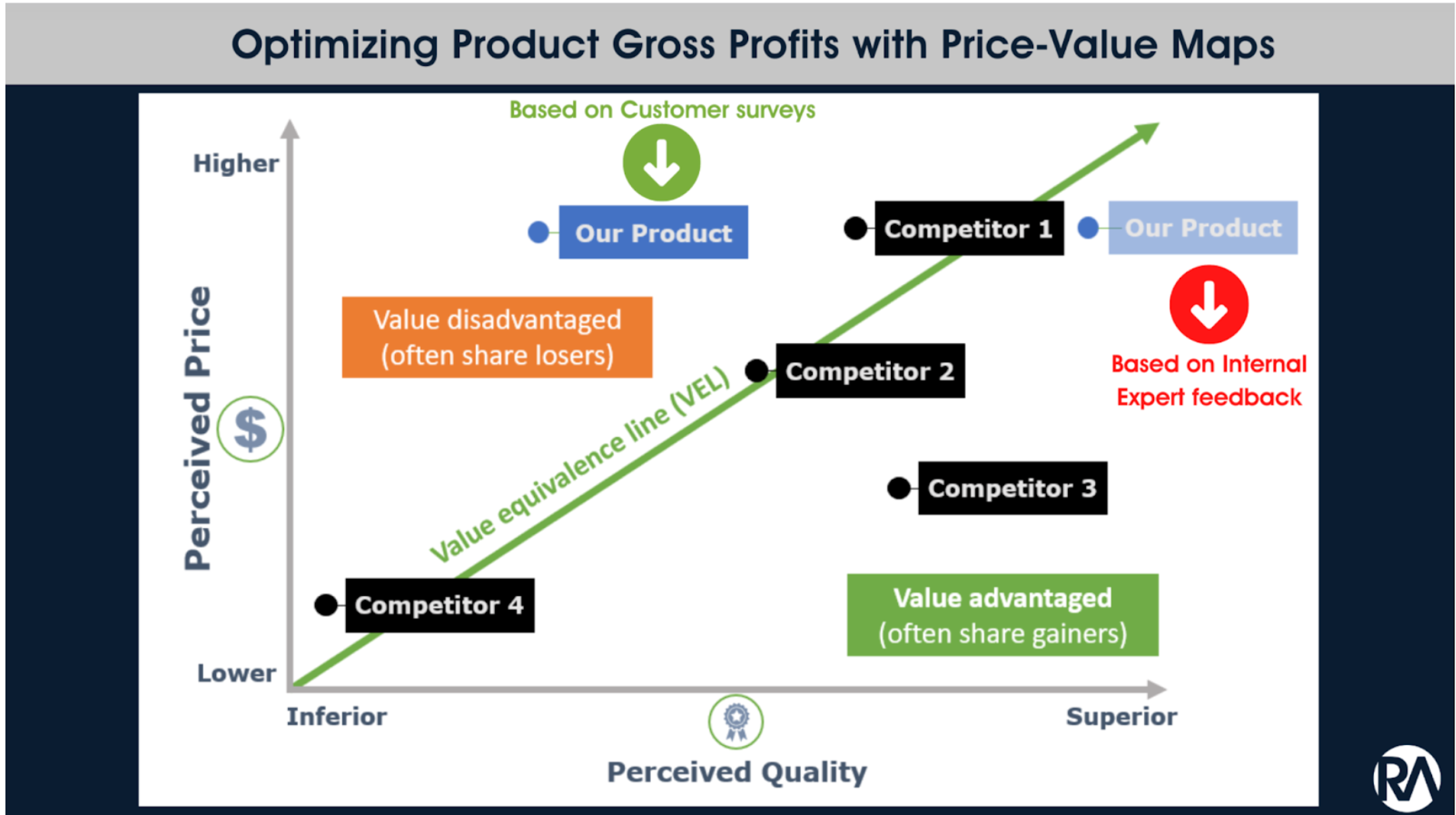
This kind of map helps visualize where you have pricing headroom due to superior quality/benefits, and where simply cutting price is a dangerous game. It clarifies where walking away – a key BATNA outcome – might be wiser than chasing a low-margin deal.
Competitive market pricing is a blend of sharp analytics and reading the subtle cues of the marketplace. You need the hard data – like price-volume curves by channel and customer segment, and insights from competitive pricing analysis (monitoring competitor moves, promotions, and positioning). But you also need to interpret softer signals, like a competitor’s sudden stock issue or a procurement manager’s shifting priorities. Without a clear framework, companies often swing between overly rigid rules and chaotic, ad-hoc decisions. The core problem we often see is a struggle to align fast-changing external benchmarks with internal margin goals.
Think of price changes like ripples in a pond – they spread, especially in visible categories, and competitors often react with their own promotions, affecting even unrelated products. A good system for monitoring these shifts, perhaps using web-scraped data, tools to track competitor price indexing, and regularly refreshed elasticity models, helps you contain negative impacts before they become widespread problems. This doesn’t have to mean complex real-time algorithms from day one; foundational dynamic pricing can start with automating adjustments based on key market signals.
The stakes are high. For a mid-sized distributor, even a small slip in basis points can mean millions in lost EBITDA. Relying on spreadsheets and “tribal knowledge” creates a false sense of security that can vanish when a well-funded competitor unleashes more sophisticated, data-driven pricing. This pressure is exactly why a disciplined BATNA is so crucial.
To navigate this, leaders should focus on:
- Quantifying Willingness to Pay: Go beyond a single elasticity number; understand it at a granular, segment level through customer research and analysis of historical transaction data.
- Weekly or Monthly Competitor Benchmarking: Track competitor moves closely, separating actual strategic shifts from mere price-scraping noise.
- Clear Guardrails for Sales: Translate your strategy into practical guidelines that your frontline team can use confidently, even in tense negotiations. This includes defining clear discount authority levels and processes for exceptions.
If any of these pillars are weak, the stool wobbles, often towards uncontrolled discounting and margin leakage. A strong BATNA is your backstop, making it clear how far you can concede before the deal destroys more value than it creates.
BATNA: Your Most Powerful Tool in Price Negotiations
So, what exactly is your BATNA? It’s the Best Alternative to a Negotiated Agreement. In simple terms, it’s the most advantageous course of action you can take if the current negotiation fails and you walk away.
In a pricing context, your BATNA could be:
- Selling to an alternative customer segment willing to pay your target price.
- Shifting production to a different product mix that protects overall contribution margin.
- Redeploying capacity or resources towards higher-value offerings.
- Even choosing to not sell if the deal would be value-destructive (your “price floor” being an outcome of this). This means understanding your cost structure thoroughly to ensure prices cover expenses and contribute to profitability.
Why does this matter so much? A well-defined BATNA changes negotiation from a fuzzy battle of wills into a disciplined comparison of opportunity costs. It anchors your concessions to real, quantifiable thresholds. It forces everyone – sales, finance, operations – to be explicit about trade-offs, making it easier to get everyone rowing in the same direction.
Many managers mistakenly think of BATNA as something only lawyers worry about during contract disputes. But in pricing and sales, it’s a living, breathing metric, anchored in real-time data and what’s actually feasible for your business. Before your sales team walks into their next big negotiation, have you simulated fallback scenarios? Have you mapped out the unit economics, capacity implications, and opportunity costs of not getting this specific deal?
This process – assessing data, modeling scenarios, aligning on a playbook, and governing in real-time – reframes negotiation. It’s no longer an emotional argument but a probabilistic assessment of payoffs. It elevates the conversation beyond simply “matching a competitor’s price” towards exploring value-based concessions like faster delivery, better service levels, or volume commitments. When sellers know their BATNA, confidence replaces hesitation, and unnecessary concessions shrink. This is particularly important because, without it, you might see sales reps frequently asking for the maximum discount their director can approve, irrespective of customer size or value.
Practical Nuance: Always align your BATNA simulations with your supply chain realities. A fallback option that looks great on paper can vanish if your production or logistics can’t actually support it. Integrating S&OP (Sales and Operations Planning) data ensures your “alternative” is operationally viable, not just financially appealing.
See how your pricing compares
Our 2025 report looks at how more than 150 business leaders handle pricing and promotions. See what the best companies do differently, and where most fall short.
Break-Even Elasticity: A Sanity Check Before You Haggle
Before you even think about your BATNA in terms of alternatives, it’s crucial to understand the financial implications of price changes. This is where break-even price elasticity comes in. It tells you how much your sales volume needs to increase to offset a price cut and maintain your revenue or gross profit. Often, companies offer discounts only to see a small unit lift but significant gross profit erosion. Performing this fundamental financial analysis is essential.


Example: The -40% Price Investment
Let’s say you’re considering a 40% price cut for a promotion.
To break even on Gross Profit $: Using BE Elasticity = -1 / (Current GP% + Price Change %):
Assumptions:
- Assume your Current Gross Profit Margin (GP%) is 30% (0.30).
- Your Price Change % is -40% (-0.40).
BE Elasticity = -1 / (0.30 + (-0.40)) = -1 / (-0.10) = -10.
This means your demand would need to be incredibly elastic (a 10% increase in units for every 1% price decrease) just to make the same gross profit dollars.
If your historical maximum elasticity is -4, then a -10 is highly improbable. This tells you the 40% price cut is likely a bad idea from a profit perspective unless it unlocks massive, unprecedented volume or has other strategic goals (like massive market share capture at a loss, or clearing unproductive inventory).
Understanding these break-even points is crucial. It provides a financial “floor” that directly informs your BATNA. If a proposed deal pushes you below these critical thresholds without a compelling strategic reason, your BATNA (walking away or offering a different, more profitable alternative) becomes much clearer.
Armed with this knowledge, your team enters negotiations grounded and decisive, far less likely to be chipped away by “one-more-round” discounting. They don’t fear walking away because they’ve quantified the downside and, more importantly, identified alternative upsides. That psychological shift alone can often tilt the negotiation in your favor.
Navigating Price Wars with a Strong BATNA
Price wars often erupt like sudden storms. One aggressive move can destabilize an entire market. Companies without a pre-defined response framework tend to scramble, matching discounts and hoping for the best – a recipe for margin erosion. This is where your BATNA, informed by scenario planning and competitive analysis, becomes your strategic compass.
Instead of just matching cuts, consider:
- Surgical Discounting: Only offer discounts in truly price-elastic segments where the lifetime value justifies the hit. Understand customer demographics and price sensitivity. For instance, price-sensitive customers with high RFM (Recency-Frequency-Monetary) scores might respond to higher discounts, while less price-sensitive, low RFM customers might need different engagement strategies.
- Trigger-Based Countermoves: Pre-define competitor price points that trigger specific, pre-approved responses – perhaps a targeted promotion on a different product, or shifting capacity.
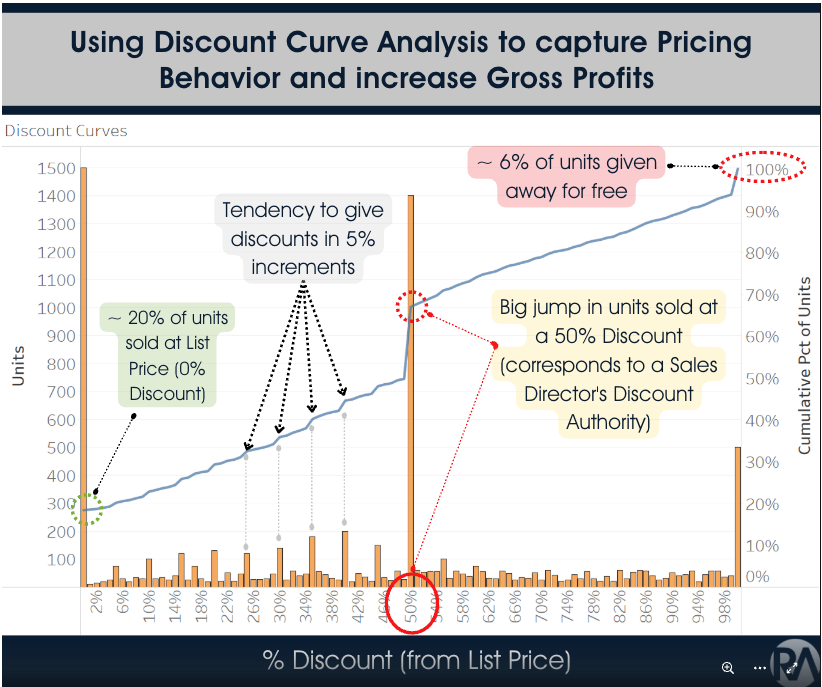
- Margin Firewalls & Discount Guidelines: Configure your quoting systems (ERP/CPQ) so that any quote falling below established BATNA thresholds or pre-set discount guidelines requires a senior-level override. This builds discipline and helps prevent situations where, for example, 90% of your units are sold at a discount. Tools like Discount Curve Analysis (DCA) can reveal these patterns, showing what percentage of units are sold at various discount levels and highlighting tendencies like giving discounts in 5% increments or maxing out director-level approvals.
- Amplify Your Value: When prices are falling, double down on publicizing what makes you different: service levels, reliability, unique features, expertise (your value proposition). Remind customers that a lower price elsewhere often means a compromise on value. This helps in situations where you might pursue premium pricing rather than just matching competitors.
Think of it like chess, not a brawl. Sometimes a decoy promotion in a non-core area can be more effective than a head-on price match. Leadership should also track metrics beyond immediate margin – like customer retention after the price war. Often, disciplined players not only protect their margin better but also enhance their brand perception as “fair but firm,” attracting higher-quality accounts when the dust settles.
Actionable Steps to Build and Strengthen Your BATNA
So, how do you make BATNA a real capability, not just a concept?
- Get Your Data House in Order & Build Margin Analytics: Dirty or incomplete data in your ERP, CRM, or CPQ systems will skew any analysis. Robust margin analytics platforms (which can often be built in-house with familiar BI tools like Power BI or Tableau) are crucial. They help track discounts vs. guidelines, identify patterns (e.g., are your smallest customers generating the best margin %?), and pinpoint discount outliers by account, product, or sales rep. This data is foundational for an effective BATNA.
- Run Regular Scenario Simulations: Quarterly, at least. Pressure-test your margin floors against plausible competitive moves, commodity swings, or demand shocks. What if your biggest competitor drops prices by 15%? What if a key input cost doubles? These simulations highlight your breaking points before they break you and can quantify the potential impact of different BATNA choices.
- Develop and Institutionalize a BATNA & Discounting Playbook: Don’t leave it to chance. Codify escalation paths, approval matrices for price exceptions, and clear discounting guidelines (that aren’t overly complex). Include value-story scripts for your sales team. This isn’t just a document; it’s a tool.
- Train Your Team & Build Capacity: Equip your internal team with the skills to interpret data from your margin analytics, use pricing tools, and understand the ‘why’ behind BATNA. Role-playing negotiation scenarios can be incredibly effective. Sales reps should be able to articulate value and pivot to non-price levers (like service, terms, or bundled solutions) when price pressure mounts.
- Embed BATNA into Your Rhythm: Make BATNA alignment a checkpoint in quarterly business reviews (QBRs). For major deals, require sales leaders to verify the BATNA strategy. This turns theory into practice.
- Monitor and Adapt: Track competitive moves in near real-time. If a rival consistently undercuts you, is it time to re-evaluate your value proposition or cost structure? Also, monitor your own “deal leakage” – the variance between initial quotes and final agreement prices. Use your margin analytics to track KPIs like % discount off list, net price distribution by segment (price bands), and even sales commission vs. margin $.
The result? A virtuous cycle: Better data (from margin analytics) informs a sharper BATNA, which empowers value-centric selling and disciplined discounting, which in turn generates richer data for future decisions.
A Quick Case in Point: From Theory to Tactical Muscle
Imagine a $400 million electrical distributor. Their gross margin had slipped 180 bps due to a regional price war and rampant, unmanaged discounting. They had no documented BATNA, and discount levels were all over the place.
Within eight weeks of focused effort (modeling elasticity, building foundational margin analytics to spot leakage, embedding guardrails in their quoting system, and coaching sellers on a tiered value proposition), they saw a significant turnaround:
- Margin recovered by 140 bps within two quarters.
- Customer churn fell by 11%.
- They even captured 3% market share from less disciplined rivals.
- Crucially, the variance in pricing discipline between branches dropped dramatically, signaling true cultural adoption. This also freed up finance analysts from retroactive cleanup to focus on proactive margin analysis.
This wasn’t just about price lists; it was about making BATNA part of their tactical muscle memory, supported by clear visibility into their pricing performance.
Common Pitfalls to Sidestep
Even with the best intentions, teams can stumble:
- Oversimplifying BATNA to “Lowest Price”: This is the biggest mistake. BATNA is about your best alternative action, which might involve different terms, volumes, service levels, or even walking away entirely – it’s not just a number.
- Using Stale Data: In volatile markets, cost data and competitor pricing can change rapidly, making yesterday’s margin floors obsolete. Refresh your inputs frequently.
- Ignoring Non-Price Cues: Procurement teams often signal their priorities beyond price (e.g., urgency on lead times, requests for bundled quotes). Don’t get so focused on spreadsheets that you miss these opportunities to leverage non-price value.
- Lack of Cross-Functional Buy-In: If finance has one set of rules and sales leadership another, reps will find the path of least resistance. True alignment across P&L owners, supported by a shared understanding from a margin analytics platform, is key to making BATNA a lived discipline.
- No “Fences” for Price Customization: If you offer different deals to different segments (a common BATNA component, like offering better terms for higher volume commitments), you need “fences” to prevent high-value customers from getting low-value deals inappropriately.
- Treating All Discounts Equally: Failing to differentiate between strategic discounts (e.g., for market penetration, rewarding loyalty, volume-based) and value-eroding concessions. Understanding the purpose and ROI of different discount types (on-invoice, off-invoice, rebates, promotions) is key.
Is Your BATNA a Vague Idea or a Strategic Asset?
Developing a strong BATNA, supported by robust margin analytics and clear discounting discipline, isn’t just an academic exercise; it’s a fundamental shift in how you approach the market. It moves your organization from reactive discounting and margin leakage to proactive value capture. It transforms tense negotiations into strategic discussions.
When you truly understand your alternatives, you negotiate from a position of informed strength. You’ll not only protect your margins but also build more resilient customer relationships and a stronger market position. BATNA, when done right, becomes an enduring competitive advantage.
Frequently asked questions about BATNA in pricing
What is BATNA in pricing?
BATNA, the Best Alternative to a Negotiated Agreement, is the most advantageous action you can take if a negotiation fails and you walk away. In pricing it might mean selling to another customer segment at your target price, shifting to a product mix that protects contribution margin, redeploying capacity to higher-value offerings, or not selling at all when a deal would destroy value.
Why does a weak BATNA cause price leakage?
Without a quantified walk-away position, teams negotiate from anxiety, a minimum margin threshold, and gut feel, granting concessions that bleed gross profit without building loyalty. Price leakage is the gap between list price and what you pocket after discounts, rebates, and allowances, and once unchecked discount requests become the norm, serious profit damage can follow early warning signs within 60 to 90 days.
How do you calculate break-even elasticity for a price cut?
Divide -1 by the sum of your current gross profit margin and the price change. With a 30% margin and a 40% price cut, that is -1 divided by -0.10, or -10, so units must rise 10% for every 1% price decrease just to keep gross profit dollars flat. If your historical maximum elasticity is -4, the cut is likely a bad idea unless it serves another strategic goal, such as clearing unproductive inventory.
How should you respond to a price war?
Use your BATNA as a compass instead of matching every cut. Discount surgically in truly price-elastic segments where lifetime value justifies it, pre-approve countermoves triggered by specific competitor price points, and set margin firewalls in your ERP or CPQ so quotes below BATNA thresholds need a senior override. Meanwhile, amplify your value proposition, such as service levels, reliability, and expertise, and track customer retention.
How do you build a strong BATNA?
Clean your ERP, CRM, and CPQ data and build margin analytics, often in Power BI or Tableau, to spot discount outliers. Run scenario simulations at least quarterly, codify a BATNA and discounting playbook with escalation paths and approval matrices, and train sellers to pivot to non-price levers. Make BATNA a checkpoint in quarterly business reviews, and monitor deal leakage between initial quotes and final prices.
What are common BATNA mistakes?
The biggest is treating BATNA as simply the lowest price, when it is your best alternative action, which may involve different terms, volumes, service levels, or walking away. Others include using stale cost and competitor data, missing non-price cues from procurement, letting finance and sales follow different rules, offering segment deals without fences, treating all discounts equally, and ignoring whether fallback options are operationally feasible.
What results can a disciplined BATNA deliver?
In one example, a $400 million electrical distributor whose gross margin had slipped 180 basis points spent eight weeks modeling elasticity, building margin analytics, embedding guardrails in its quoting system, and coaching sellers. Margin recovered 140 basis points within two quarters, customer churn fell 11%, it gained 3% market share, and pricing discipline became far more consistent across branches. Tracking BATNA compliance also tends to make gross margins more predictable for finance.
Want a second opinion on your pricing?
Tell us what’s going on with your pricing. One of our partners will get back to you the same day or the next.