
Table of Contents
Introduction to Commercial Analytics and the Outcome-Based Analytics™ process
Commercial Analytics: A Critical Value Driver for Manufacturers, Wholesalers, and Retailers
For many manufacturers and wholesalers, inflation has wreaked havoc on their financials, with the Producers Price Index for intermediate goods ranging from 15%-55% in August 2022 vs. a year ago.
In the absence of advanced pricing, customer, or market insights, most small to mid-size manufacturers and wholesalers have chosen the path of least resistance and passed on cost increases in the form of annual or semi-annual General Price Increases.
This blanket approach has usually produced highly sub-optimal results if not done surgically. When you don’t have a reasonable estimate of Customer Segment-Product level Price Sensitivities, you cannot structure your Price Increases in a way that provides the best possible Profit outcome.
While this concept sounds foundational, many talented executives in traditional industries still struggle to answer fundamental questions that drive their business forward. Key questions such as:
What is the incremental Profit impact if I rationalize my Customer Discounts by 5%?
What are the expected Profit gain and volume loss if I raise prices by 20% due to inflation?
What is the anticipated Sales and Profit impact if I reduce Sales VPs’ Discounting Authority by 5%?
Which Customers are prime targets for proactive retention efforts, and what is the Revenue upside for us?
Which Customers are prime targets for product upsell, what does the sales priority look like by territory, and what is the potential upside for Company finances and the Sales team?
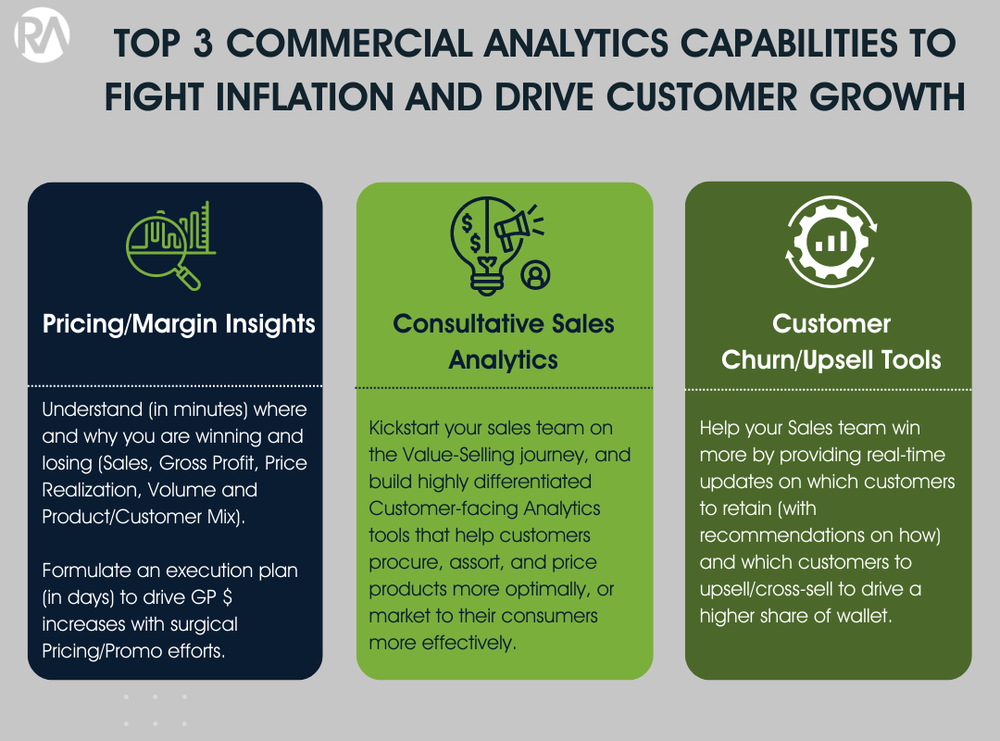
To advance your Pricing Excellence and Sales Productivity efforts and stand out from the competition, especially in inflationary, hyper-competitive, or price-focused (quasi-commodity) environments, I recommend three foundational areas to focus your B2B Commercial Analytics efforts on:
Pricing/Margin: Understand (in seconds) where you are winning and losing (in Sales, Gross Profit, Price Realization, Volume, and Product/Customer Mix Management). Find out (in minutes) why you are losing and what the fastest/most impactful areas are that you can address. Formulate an execution plan (within days) to drive Gross Profits next quarter with surgical Pricing or Promotional efforts.
Consultative Sales Analytics: Kickstart your sales team on the Value-Selling journey, and build highly differentiated Customer-facing Analytics tools that help customers procure and assort products better, price more optimally, or market to their consumers more effectively.
Customer Churn / Upsell: Help your Sales team win more by providing real-time updates on which customers to retain (with recommendations on how) and which customers to upsell/cross-sell to drive a higher share of wallet.
While this list is by no means exhaustive, they provide a solid B2B Commercial Analytics foundation to help your Company and your Customers drive increased returns.
Jason Krantz, one of the leading results-oriented Analytics voices in the consulting world and CEO of Strategy Titan, shared his thoughts on the importance of Commercial Analytics:
“When people tell me that analytics can’t directly impact the P&L, the first things I go to are price management & optimization, discount management, and cost-to-serve analytics.
These things all naturally lead to sales analytics. It is my favorite analytics domain since it 1) directly supports revenue drivers and 2) it can directly impact P&L.
Many put these activities in the FP&A bucket, but it is a mistake not to get analytics experts working on these topics in conjunction with Finance and Sales.
Strategic rifle shot price increases are paramount during times like this to maintain margins and minimize the risk of customer churn.”
Steps for Building an Impactful Margin Analytics Solution: The Outcomes-Based Analytics Process
Especially in an environment characterized by high inflation, competitive pressures, and to need to meet & exceed EBITDA and Cash Flow targets consistently, companies must beef up their Margin Analytics & Optimization capabilities.
Having robust diagnostic and predictive Pricing capabilities enables you to control Price Leakage and Margin erosion better, develop more surgical Pricing Strategies, and set the foundations for a Value-based pricing journey.
There are typically three groups who will consume and drive action with a robust Margin Analytics solution:
Senior Executives need to know global trends, key drivers, and top opportunities to drive additional Gross Profits for the business.
Pricing / Finance / Sales Ops teams need to deep dive within 2-3 clicks into more granular drivers of Price Leakage and Margin erosion and run scenarios to understand the opportunity of fixing each.
Sales teams need pragmatic, easy-to-use modules to understand the top Customer opportunities to drive additional Net Revenue or Gross Profits. Sales Managers need insights to manage Discounting discipline with their teams better.
To ensure you are building a Margin Analytics capability not FOR these stakeholders but WITH these stakeholders, we highly encourage you to follow an engagement process similar to these six steps. It will have the best chance of driving adoption and in-market execution post-launch:

See how your pricing compares
Our 2025 report looks at how more than 150 business leaders handle pricing and promotions. See what the best companies do differently, and where most fall short.
Step 1
Understand the critical Pricing problems and the opportunity of solving them with Margin Analytics capabilities (i.e., “Size of the Prize”)
Step 2
Decompose the problems into sub-components, and collaborate with key internal stakeholders (exec sponsors, internal experts in Finance/Pricing/Marketing, and Sales power users) on iterative diagnostic interviews, followed by concept & design sessions. In these collaborative design sessions, be clear and drive alignment around the key questions that each stakeholder needs answers to.
Step 3
Arrange iterative alignment sessions and roadshows with your key stakeholders where you update them on progress, address critical questions and drive collective decisions/alignment where you need it.
Step 4
Build a Minimum Viable Analytics Solution (MVAS), and collect stakeholder and power user feedback for more refinement. Meet frequently with power users over a 2-3 week period to ensure the MVAS enables them to uncover key Pricing insights and drive execution – aligned with the operational and thought process of the teams.
Step 5
Launch your Margin Analytics solution’s final / production version based on Core Team and Power User feedback. In tandem, develop a Playbook for the Sales Teams to ensure the solution is built into their regular operating rhythm and sales cycle.
Step 6
Within six to eight weeks post-launch, re-engage with the respective teams to understand business impact and to align on additional opportunities for continuous training and solution enhancement.
By following a highly collaborative, sequential approach that leverages internal experts and Sales Team power users, you ensure that your Margin Analytics solution is co-created with the end users. It will guarantee that this new, transformative capability will be pragmatic, easy to use, drive critical last-mile adoption, and, ultimately, grow your sales and profits.
Over the next few weeks, I am publishing a series of articles based on our experience building and deploying rapid, easy-to-use Margin Analytics & Optimization solutions, using tools and techniques that Revenue Management leaders, CFOs and CTOs are already very familiar with.
Part 1 will briefly introduce Commercial Analytics and the Outcome-Based Analytics process to ensure maximum analytics impact.
Part 2 will describe how to co-create your Margin Analytics solution with End Users with concrete examples from Concept to Design.
Part 3 will demonstrate how to drive iterative alignment sessions and senior executive roadshows to build organizational capability momentum and ensure last-mile adoption.
Part 4 will showcase how to build a Minimum Viable Analytics Solution (MVAS) that is ~ 80% ready and will add tremendous value to most companies. We will also provide you with a MVAS type Margin Analytics tool that you can readily use at your companies.
Part 5 will describe the steps to deploying your new Margin Analytics & Optimization capability.
Part 6 will lay the groundwork on how to drive post-launch adoption through continuous training and solution enhancement while building the Analytics DNA of the organization.
Frequently asked questions about margin optimization capabilities
Why do manufacturers and wholesalers need margin analytics?
Inflation hit their financials hard, with the Producer Price Index for intermediate goods up 15% to 55% in August 2022 versus a year earlier. Without pricing, customer, or market insights, most small and mid-size firms passed costs on through blanket general price increases. Unless done surgically, with segment-product price sensitivities in hand, that approach usually produces highly suboptimal profit results.
Which questions should commercial analytics answer?
Examples include the incremental profit from rationalizing customer discounts by 5%, the expected profit gain and volume loss from a 20% price increase, and the sales and profit impact of cutting sales VPs’ discount authority by 5%. It should also show which customers to target for retention and upsell, the sales priorities by territory, and the revenue upside for the company and the sales team.
What are the foundational areas of B2B commercial analytics?
Three areas come first. Pricing and margin analytics shows where you win and lose on sales, gross profit, price realization, volume, and mix, and why. Consultative sales analytics starts the value-selling journey and gives customers tools to buy, assort, price, and market better. Customer churn and upsell analytics tells sales which customers to retain and which to upsell or cross-sell.
Who uses a margin analytics solution?
Three groups. Senior executives need global trends, key drivers, and the top opportunities to add gross profit. Pricing, finance, and sales operations teams need to reach granular drivers of price leakage and margin erosion within two to three clicks and run scenarios on fixing each. Sales teams need simple modules that show top customer opportunities, and sales managers need insights to enforce discounting discipline.
How do you build a margin analytics solution?
Follow a six-step Outcome-Based Analytics process. Size the prize of solving the critical pricing problems, decompose those problems with stakeholders through diagnostic interviews and design sessions, and hold iterative alignment sessions and roadshows. Then build a minimum viable analytics solution with power users, launch the production version with a sales playbook, and re-engage the teams six to eight weeks after launch.
What is a minimum viable analytics solution?
A minimum viable analytics solution, or MVAS, is an early version of the margin analytics tool that stakeholders and power users test and refine before the production launch. Meeting power users frequently over two to three weeks makes sure it helps them uncover key pricing insights and act on them in line with how their teams work. A well-built MVAS is about 80% ready and adds tremendous value.
Why build margin analytics with stakeholders instead of for them?
Co-creating the solution with executive sponsors, internal experts in finance, pricing, and marketing, and sales power users gives it the best chance of adoption and in-market execution after launch. A collaborative, sequential approach keeps the capability pragmatic and easy to use, drives last-mile adoption, and ultimately grows sales and profits.
Related Reading
- What is Your True Net Price? The Ultimate Guide to B2B Commercial Psychology & Profit Realization
- An RGM Deep-Dive Into Spotify’s Latest Price Rise
For broader industry perspective on pricing analytics and revenue growth management, see McKinsey’s Growth, Marketing & Sales insights.
Want a second opinion on your pricing?
Tell us what’s going on with your pricing. One of our partners will get back to you the same day or the next.