This manual is designed for CEOs, CFOs, CCOs, Pricing and RGM leaders, and commercial analytics teams at mid-market CPG manufacturers. It outlines six decision modules, a finance-reconciled data foundation, and a pilot approach that demonstrates margin impact before broader platform deployment.
Most CPG teams do not need a 41st dashboard. They need one decision surface that gives sales, finance, category, and RGM the same answer to the same commercial question: which pricing, promotion, assortment, pack-price, or trade-investment action should we take next, who owns it, and how will finance know whether it worked?
A CPG RGM analytics navigator is a data product and operating model that delivers this unified decision platform. It integrates pricing, promotion, assortment, pack-price architecture, customer profitability, and trade investment analytics into a single governed workflow. Building a CPG RGM analytics navigator involves four key steps: define the decisions to improve, consolidate data to a single level of detail, prioritize high-value modules, and implement governance to ensure outputs drive decisions rather than serve as meeting artifacts.
The stakes are large enough to justify the build. Trade spend consumes 20 to 30 percent of gross sales at a typical CPG manufacturer, which makes it one of the largest controllable lines on the P&L (Deloitte, 2026). McKinsey research found that 72 percent of US trade promotions lose money. Yet many commercial teams still evaluate price, promotion, and assortment decisions in separate tools, with inconsistent definitions of net sales, trade spend, baseline volume, and profit.
Table of Contents
Key takeaways
• Start with the decisions the navigator must improve: price actions, promotion redesign, pack-price moves, customer profitability, and trade-spend allocation.
• Build the first version on a common grain: customer x product x geography x week.
• Make the finance spine explicit: list price, net price realization, trade spend, cost-to-serve, pocket margin, baseline, and confidence band.
• Sequence the build in phases: visibility first, diagnostics second, scenarios third, governance before scale.
• Treat adoption, overrides, and decision closure as key performance indicators. A navigator that is not actively used is merely a rebranded dashboard.
What a CPG RGM analytics navigator does in a commercial review
A CPG RGM analytics navigator is an integrated analytics layer that helps consumer packaged goods teams identify, quantify, prioritize, and govern Revenue Growth Management (RGM) actions across price, promotion, mix, assortment, pack architecture, customer profitability, and channel performance.
A dashboard reports metrics, while a navigator drives decisions. This distinction is evident in meeting outcomes. If a weekly review concludes with “we should look into this,” it reflects a reporting process. If it concludes with “restructure these eight events, close these two terms exceptions, widen this pack-price gap, and route this price action to the CCO by Friday,” it demonstrates the use of a navigator.
A useful navigator gives the review team four things on every action:
• A reconciled number. The metric ties back to finance, not a side workbook.
• A baseline. The team knows what would likely have happened without the action.
• A quantified prize and risk range. The number carries the expected margin impact and uncertainty.
• An owner and decision path. Someone can approve, reject, test, or escalate the recommendation.
For the strategic case behind the model, see why your CPG needs an integrated pricing & RGM navigator. This article is the build manual.
Why dashboard sprawl becomes margin leakage
Most CPG analytics estates grew one report at a time. Sales built a depletions view. Finance built a gross-to-net workbook. Category management subscribed to syndicated data. Trade marketing worked inside a TPM export. Customer teams added retailer portals. Every tool answered a local question. None of them produced a governed commercial answer.

Eight disconnected CPG source systems, each producing its own version of commercial truth
Analyst time is the smaller cost. The larger one is a delayed or disputed action. Teams spend the week reconciling numbers that should already agree. Promotions keep running while finance and sales debate baseline logic. Terms exceptions become permanent because no one reviews net price realization at the account-pack level. Price-pack gaps open, and the team sees them after the retailer review rather than before.
| Key insight: According to Revology’s research of 2,000 global companies, a 1% improvement in price realization produces a 6-7% lift in operating profit. Excluding highly regulated industries, this figure is in the 10-11% range. Source: “Pricing Still Packs a Punch” (Revology Analytics, June 2025). |
The navigator’s primary role is to make incremental margin opportunities visible and actionable by consolidating disconnected analytics into a governed queue of margin-focused actions.
External benchmarks support this approach. The POI 2026 State of the Industry research finds that only a small minority of CPG organizations have achieved prescriptive analytics capability. For mid-market manufacturers, the key takeaway is not to invest in additional AI, but to ensure that the data foundation, metric definitions, and review cadence are reliable and trusted.
The six decision modules every RGM navigator needs
The following six modules address the weekly decisions that drive CPG profitability. They should be developed as integrated components, not as separate dashboards. Consistent definitions for customer, product, channel, cost, price, promotion, and calendar must be maintained across all modules.

Six-module framework diagram showing the unified pricing decision surface for a CPG RGM analytics navigator
| Module | Decision It Supports | Finance Question It Must Answer | Primary KPI |
| Customer profitability and PVCM | Which customers, channels, and packs create or destroy margin? | Did growth come from price, volume, cost, or mix? | Pocket margin by customer-pack |
| Assortment and pack-price architecture | Which items deserve more distribution, less support, or a different price ladder? | Are we shifting volume into lower-margin packs? | Margin-adjusted velocity and price-per-unit gap |
| Promotion ROI and trade promotion optimization analytics | Which events should be extended, redesigned, or stopped? | What was incremental after baseline, cannibalization, forward-buy, and trade cost? | Incremental margin per event |
| Pricing and scenario modeling | Which price action clears margin and volume risk? | What is the expected net realization after leakage and retailer response? | Net price realization and expected contribution impact |
| Weekly performance monitor | Which exceptions need action this week? | Are planned gains actually converting to realized value? | Exception closure rate and value captured |
| Consumption decomposition | Why is the quarter ahead or behind? | Is the gap driven by price, distribution, velocity, promotion, shipment timing, or mix? | Due-to bridge being blocked by the driver |
Module 1: Customer profitability and PVCM
This is the foundation. A price-volume-cost-mix (PVCM) decomposition built on customer-level P&Ls shows where revenue growth actually came from and which accounts create or destroy margin. It also keeps the navigator tied to finance, because every other module uses the same customer, product, channel, cost, and gross-to-net definitions.
A practical test is whether finance and sales can agree on an account’s pocket margin before discussing actions. If not, prioritize building the PVCM module.
Module 2: Assortment and pack-price architecture
This module maps every pack and price point against velocity, distribution, margin, and incrementality. It flags hidden gems whose distribution lags their margin-adjusted velocity, and it surfaces items that hold shelf space on history rather than economics.
It also protects price-pack architecture. A competitor’s new pack size can open a price-per-ounce gap before the category team notices. The navigator should show the gap, the margin implication, and the recommended response before the next retailer conversation.
Module 3: Promotion ROI and trade promotion optimization analytics
Promotion ROI is where the navigator often earns its first funding. The module decomposes every event into baseline volume, promotional lift, forward-buy, cannibalization, trade cost, and incremental margin. Lift alone is not the verdict. Incremental margin is.
The output should be a ranked action list: extend these events, restructure these events, stop these events, and test these events under different depths, durations, features, or display conditions.
Module 4: Pricing and scenario modeling
This module gives the team a controlled way to evaluate list-price moves, net price realization, retailer margin math, elasticity, competitive response, and pack-price moves. It has to separate the list-price intent from the expected realized outcome. A 3% list-price move that lands as 0.8% net price realization after exceptions, rebates, or customer concessions is not a 3% pricing case.
Use this module after the data spine is trusted. Elasticity models trained on unreconciled data produce noisy confidence.
Module 5: Weekly performance monitor and leading indicators
The monitor converts the navigator from an analysis library into an operating cadence. It tracks pacing versus plan, distribution changes, price-gap drift, on-shelf availability, trade-spend rate, realization variance, and exception alerts. Every alert routes to a named owner.
This is also where adoption shows up. If the field ignores a recommendation, overrides it, or routes around the workflow, the monitor should surface that before the quarter closes.
Module 6: Consumption decomposition
Consumption decomposition explains the gap between shipments and consumption, and attributes change to price, distribution, velocity, promotion, calendar, and mix. When the CEO asks why the quarter is soft, this module answers in terms of drivers rather than anecdotes.
A good decomposition also prevents bad calls. A list-price action should not be blamed for softness caused by distribution losses. A promotion should not get credit for volume pulled forward from next month.
The data spine finance will trust
The modules fail without a disciplined foundation. Every navigator should standardize on a common grain, usually customer x product x geography x week, so every module reconciles to the same commercial spine.
The fields that matter
The gross-to-net waterfall supplies the connective math.
Net price = (Gross sales – discounts – rebates – off-invoice trade spend – other concessions) / units Gross margin = Net sales – cost of goods sold Trade spend rate = trade spend / gross sales Promo lift = promotional volume – baseline volume Incremental margin = incremental revenue – incremental trade spend – incremental cost Pocket margin = net sales – COGS – trade spend – freight – cost-to-serve – other attributable concessions
Those formulas look basic. The hard part is enforcing the same definitions across ERP, GL, TPM, syndicated POS, retailer portals, distributor depletions, competitive scrapes, and customer-team files.
Baselines and causal isolation
A CFO will not stop at “the number improved.” Finance will ask what would have happened without the action. So the navigator needs baseline rules before the pilot starts.
For promotion analytics, baseline volume should control for seasonality, holidays, distribution, out-of-stocks, forward-buy, competitor activity, and calendar timing. For pricing actions, separate price realization from mix, volume, and customer-selection effects. Matched cohorts, difference-in-differences, holdout channels, or pre-registered prior-year run rates can all work when the data supports them. The method matters less than the discipline: state the baseline, state the comparison group, and show the confidence range.
Price realization vs. list price
List price is intended. Net price realization is what the business collected after discounts, rebates, off-invoice trade, freight allowances, payment terms, and exceptions. The navigator should carry both. Carry only the list price, and finance will not trust the price case. Carry only net sales, and sales will not know which commercial lever to change.
Master-data governance
Master data drift breaks the proof. Customer master mergers, SKU rationalization, retailer hierarchy changes, and late rebate claims can all shift the measured result without any pricing or RGM action. Lock the data dictionary before the pilot, version every change, and keep bridge files so that finance can audit.
Reference architecture: Microsoft Fabric pricing analytics without tool-first thinking
A typical in-house RGM analytics stack can run on a Microsoft Fabric medallion lakehouse: raw sources land in bronze, conformed tables sit in silver, decision-ready semantic models sit in gold, and Power BI or another consumption layer presents the governed action queue. The Microsoft Fabric medallion lakehouse documentation describes the bronze, silver, and gold patterns.
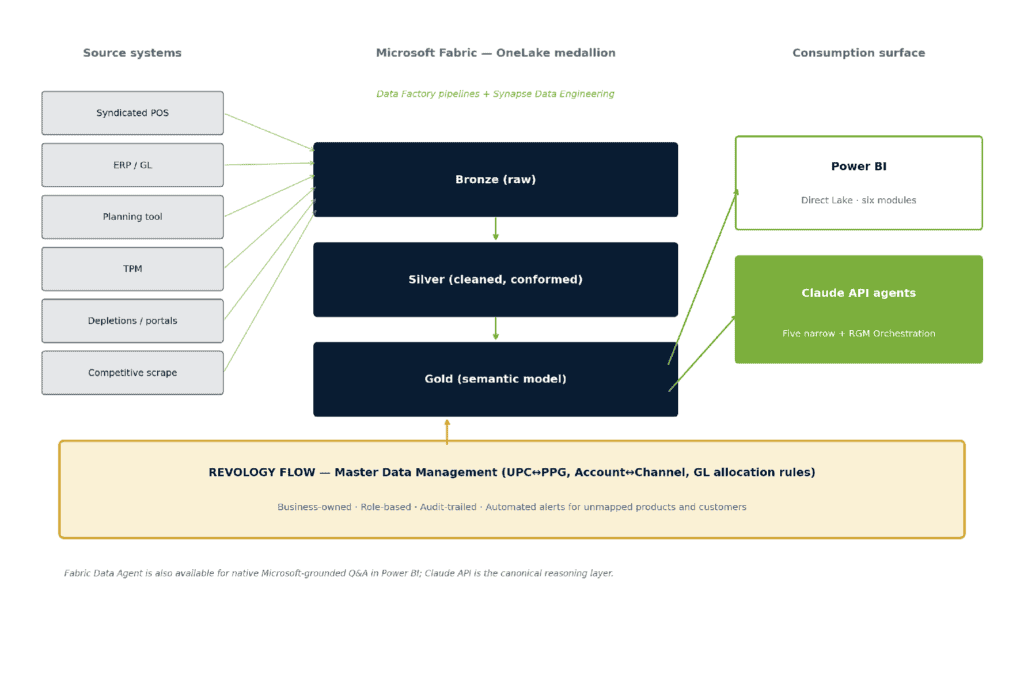
Reference architecture on Microsoft Fabric: sources land in bronze, conform in silver, decide in gold.
Agentic assistants can help with data-quality triage, anomaly summaries, first-draft event analysis, and natural-language explanations. They should not have decision rights. The architecture earns its place because it enforces a single grain, a single metric dictionary, and a single refresh cadence. The tool does not make the navigator work. Governance does.
This is the strongest reason many mid-market CPG companies choose an in-house RGM analytics model over a turnkey suite. A suite can be useful when data is clean, processes are standardized, and the organization can adopt the vendor’s definitions. Many mid-market manufacturers are not there yet. An in-house navigator forces the data cleanup that the suite assumes away, and the operating knowledge stays inside the team.
How to Build a CPG RGM Analytics Navigator in 16 Weeks: One Category, Two Channels
Sequence beats scope. Teams that work out how to build a CPG RGM analytics navigator without an 18-month IT program start narrow: one priority category, two high-value channels, and 24 months of weekly history. That scope is small enough to harmonize quickly and large enough to expose the real operating issues.
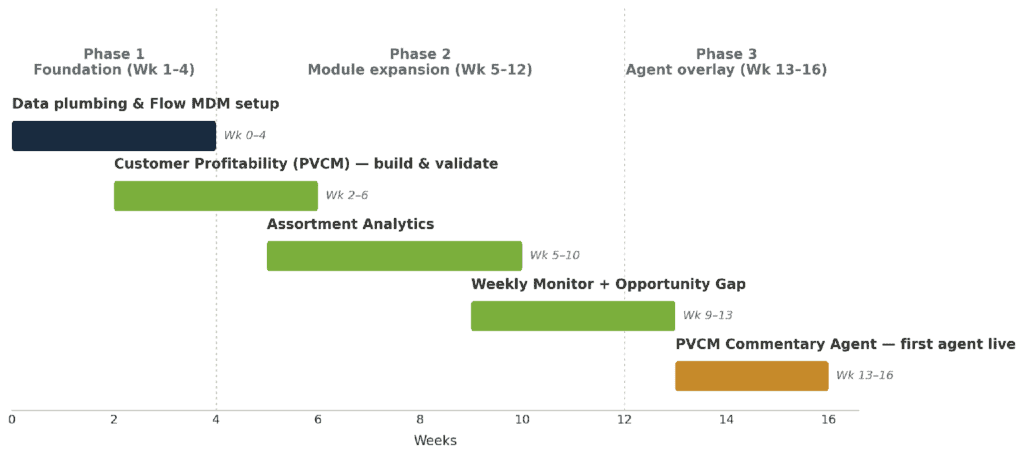
how to build a CPG RGM analytics navigator 120-day build timeline across foundation, module, and agent phases
How to build a CPG RGM analytics navigator in 90 days: pilot proof, not full rollout
The first 90 days of learning how to build a CPG RGM analytics navigator should prove the spine, the first diagnostics, and the action queue. Full four-phase completion usually takes about 16 weeks, including governance and capability transfer. Treat the first 90 days as proof of value, not permission to launch enterprise-wide.
Weeks 1-4: unify the data model. Land shipments, syndicated POS, trade-promotion records, GL actuals, standard costs, and customer/product hierarchies into one model. Build the gross-to-net waterfall. Publish the metric dictionary. Resist every request for a dashboard until the spine reconciles with finance.
Weeks 5-8: stand-up diagnostics. Deliver price-realization variance, promotion lift, and post-promotion dip reads, PVCM decomposition, and customer-channel profitability. This is where the team meets its first uncomfortable numbers: beloved events with negative incremental margins, accounts below terms policy, and packs whose price gaps no longer match the shopper choice set.
Weeks 9-12: add scenarios and an action queue. Layer in price elasticity estimates, event simulation, pack-price gap checks, and a prioritized queue of underperforming promotions, margin-leaking terms, and price-pack moves. Each queue item includes expected value, downside risk, a confidence band, and an owner.
Weeks 13-16: install governance. Metric definitions get owners. The weekly RGM review gets an agenda built from the action queue. Exceptions get thresholds. Escalation paths get tested before they matter. Capability transfer happens here: the client’s analysts run the cadence, not consultants.
Revology’s research across comparable builds puts year-one outcomes at 1 to 2 percent gross margin improvement, 1 to 3 percent net revenue lift, and 2 to 4 percent trade-spend efficiency. The higher ranges, 3 to 5 percent margin, 4 to 8 percent net revenue, and 4 to 15 percent trade-spend efficiency, come into reach as the predictive and agentic layers mature. Treat them as planning ranges until the eligible revenue base, the adoption rate, and the baseline method are locked.
Worked example: how the build runs and what it returns
The example below keeps the anonymized structure from the source engagement and keeps the payoff honest: a range applied to a scoped base, not a single headline number.
Scenario setup
An enterprise CPG manufacturer with a roughly $1B multi-channel beverage portfolio built the navigator at scale. Trade spend ran near $50M across direct-store-delivery channels. Promotion planning lived in sales calendars and TPM exports. List-versus-net visibility lived in finance. No one owned one version of incremental margin.
The scoped pilot did not claim the full portfolio as its base. The price-realization work applied only to the eligible revenue the pilot actually touched. The trade-promotion work focused on the event pool within the DSD channels, with sufficient history to build a baseline and sufficient activity to inform decisions.
Build sequence
1. Data spine. The team unified six sources: distributor depletions, retailer POS, trade deal lines, GL actuals, standard costs, and the promotion calendar. The pilot used a customer x product x week grain in a 16-week build.
2. Promotion diagnostics. Every promoted event received an incremental-margin verdict after baseline volume, lift, trade cost, forward-buy, and cannibalization were accounted for. Roughly one-third of events returned less than they cost, concentrated in two channels and one pack segment.

Promotion effectiveness dashboard plotting every trade event by ROI with portfolio profitability summary
3. Scenario redesign. The team restructured the worst events by reducing depth, shortening duration, and swapping display or feature mechanics where the modeled margin response supported the change.
4. Net price realization actions. The pricing module flagged about 0.5 percent of recoverable net price realization through terms cleanup and pack-price moves on the scoped eligible revenue base.
5. Governed execution. A weekly RGM review took over the action queue. Each action had an owner, an expected value, an adoption status, and an exception threshold.
What the research says about the build returns
Revology’s research across comparable RGM analytics frames the payoff as a range, not a single number, and applies it to the eligible revenue the pilot actually touched.
| Horizon | Gross Margin Improvement | Net Revenue Lift | Trade-Spend Efficiency |
| Year 1, foundational deployment | 1–2% | 1–3% | 2–4% |
| As predictive and agentic layers mature | 3–5% | 4–8% | 4–15% |
These are planning ranges, not guarantees. Where a build lands depends on the eligible revenue base, the adoption rate, baseline rigor, and the percentage of the action queue that actually gets executed. The honest version of the claim is a range applied to a scoped base and governed to realization, not a single headline figure a CFO has to take on faith. In this engagement, the largest year-one moves came from terms cleanup and pack-price corrections on net price realization and from restructuring the roughly one-third of promoted events that were returning less than they cost.
A mid-market parallel shows the blueprint is not limited to enterprise stacks. A roughly $100M plant-based dairy alternative brand used the same six-module logic on a Python-plus-BI stack, harmonized five sources, and refreshed the navigator in 10-20 minutes. Leaner stack, same discipline.
Governance scorecard: owners, cadence, adoption, and overrides
Analytics without decision rights is theater. The operating model assigns every KPI an owner, every threshold an escalation path, and every action a review cadence.
The weekly RGM review
Run a 45-minute weekly RGM review around the action queue, not around a slide deck. Sort by quantified prize. Confirm whether each action is approved, rejected, tested, escalated, or closed. Do not let the meeting become a reconciliation forum; reconciliation should happen before the meeting.
The monthly finance review
Monthly, finance and commercial leadership review realized value against forecast. The navigator’s own ROI gets governed, too. If the expected value is not converting, the team should know whether the cause is baseline error, poor adoption, a sales override, retailer pushback, a supply constraint, or wrong model logic.
| KPI | Owner | Review Decision | Escalation Trigger |
| Net price realization | Pricing + Finance | Correct terms, pack gaps, discounts, or rebates | >25 bps unexplained decline vs target |
| Trade spend rate | RGM + Finance | Reallocate, cap, or redesign spend | Spend rate above plan with no incremental-margin proof |
| Promotion incremental margin | Trade/RGM | Extend, restructure, stop, or test event | Corrected ROI below threshold for two cycles |
| Pocket margin by customer-pack | Finance + Sales | Change terms, cost-to-serve, or account plan | Account below floor after agreed exceptions |
| Mix effect | Category + Finance | Adjust assortment, pack focus, or price ladder | Margin growth explained by low-quality mix shift |
| Adoption rate | Sales/RGM | Coach, enable, or revise guardrails | <80% eligible actions executed within tolerance |
| Override rate and reason code | Sales leadership | Tighten policy or fix bad guidance | >20% overrides or high approval pass-through |
| Exception closure rate | RGM product owner | Close, escalate, or retire alerts | Open exceptions aging beyond review SLA |
Common mistakes when building an RGM navigator
Starting with optimization instead of visibility. Elasticity models on unreconciled data produce confident nonsense. Descriptive trust comes first.
Treating the navigator as an IT project. IT owns the platform. The commercial team owns the product. Builds led only by infrastructure teams tend to deliver clean pipelines and empty review meetings.
Launching enterprise-wide. A category-and-channel pilot finds data problems cheaply. An enterprise launch finds them publicly.
Equating more data with better decisions. A consistent metric dictionary across five harmonized sources beats 15 sources that carry three definitions of net sales.
Debating baselines forever. Baseline methodology matters, but negative-margin events should not keep running for a quarter while the team chases perfect confidence. Publish the baseline rule, show the confidence band, and let governance decide which actions are safe enough to test.
Expecting AI to substitute for governance. Agentic assistants can speed up triage and draft analysis. They do not resolve decision rights, adoption, or the trade-offs between sales, finance, and retailers.
For a deeper diagnostic of the promotion gap specifically, see Promotion Analytics: why 50% of Companies Are Falling Behind. For the broader commercial analytics foundation, see revenue growth analytics for sustainable growth. For the modeling layer the navigator grows into, see Knowing Your Price Elasticities.
FAQ
What is a CPG RGM analytics navigator?
A CPG RGM analytics navigator is an integrated analytics framework and workflow that helps consumer packaged goods teams evaluate and prioritize pricing, promotion, assortment, pack-price, customer profitability, and trade-spend decisions in one place. It pairs harmonized commercial data with decision workflows and governance, which sets it apart from a reporting dashboard.
What business problem does an RGM navigator solve?
It solves the operational problem created when sales, finance, category, and RGM use different data, metric definitions, and baselines for the same decision. The navigator provides the team with a single reconciled view of price realization, trade spend, promotion incrementality, mix, pocket margin, and action ownership.
What data is required to build an RGM navigator?
Most builds need POS or shipment data, list and net prices, discount and rebate detail, trade spend and promotion records, product and customer hierarchies, standard costs, calendar attributes, and channel or geography identifiers. The data has to be conformed to one grain, usually customer x product x geography x week. Most mid-market pilots harmonize five to six sources, and data cleanup often accounts for half the build effort.
Which teams should use the navigator?
Pricing, RGM, finance, sales, trade marketing, category management, supply planning, and commercial analytics all use the navigator, but not in the same way. Finance owns reconciliation and value tracking. Pricing and RGM’s own recommendations. Sales and category own customer and retailer execution. Leadership owns decision rights and escalation.
What analyses should be included first?
Start with customer profitability/PVCM and promotion ROI if resources are limited. Those two modules usually expose the largest near-term margin actions and build the finance trust you need for later elasticity, scenario modeling, price-pack architecture, and agentic analysis.
How is an RGM navigator different from a dashboard?
A dashboard reports what happened. A navigator diagnoses why it happened, simulates alternatives, queues prioritized actions with owners, and governs execution through a review cadence. The distinction shows up in meetings: dashboards generate discussion; navigators generate decisions.
Do you need advanced AI to build an RGM navigator?
No. Clean data, a shared metric dictionary, and practical diagnostics deliver the first wave of value. Predictive and agentic layers compound the return after the foundation earns trust.
How long does it take to build a CPG RGM analytics navigator?
A scoped pilot covering one category and two channels can reach usable diagnostics in 8 to 12 weeks. Full four-phase completion, with governance and capability transfer, is closer to 16 weeks. Capability transfer is the point: the engagement ends, the navigator stays.
Diagnostic checklist and next steps
Use this five-question readiness check before you fund another dashboard:
1. Can you state your trade spend rate and your three worst promotions by incremental margin today?
2. Do sales, finance, and category reconcile to one definition of net price realization?
3. Is there a weekly forum where pricing and promotion exceptions get decided rather than discussed?
4. Could your team model a list-price scenario, including volume risk, retailer math, and competitive response, within a day?
5. Does anyone own the metric dictionary?
Two or more “no” answers mean the opportunity deserves sizing. If you are mapping out how to build a CPG RGM analytics navigator under resource constraints, start with Module 1 and Module 3 on a single category. Those two modules often fund the rest.
Revology stands up navigators inside commercial teams for over 90- to 120-day engagements, with capability transfer included. Watch the CPG RGM Navigator webinar walkthrough, review the Pricing & RGM capabilities assessment and transformation blueprint, or go straight to the conversation: