
Table of Contents
If you haven’t tried Bayesian Analysis to attack common business problems, I highly encourage you to explore it.
Companies’ data science curve often starts with linear regression before a giant leap to ML within weeks or months (ensemble models, even some deep learning).
In pragmatic terms, the power of Bayesian modeling comes from being able to assign probability intervals to predictions.
Suppose you’re creating a demand model (predicting unit sales using price, seasonality, competitor actions, and a host of other variables). You want to use the outputs of this demand model to understand how price changes influence unit sales – and of course, revenues and gross profits.
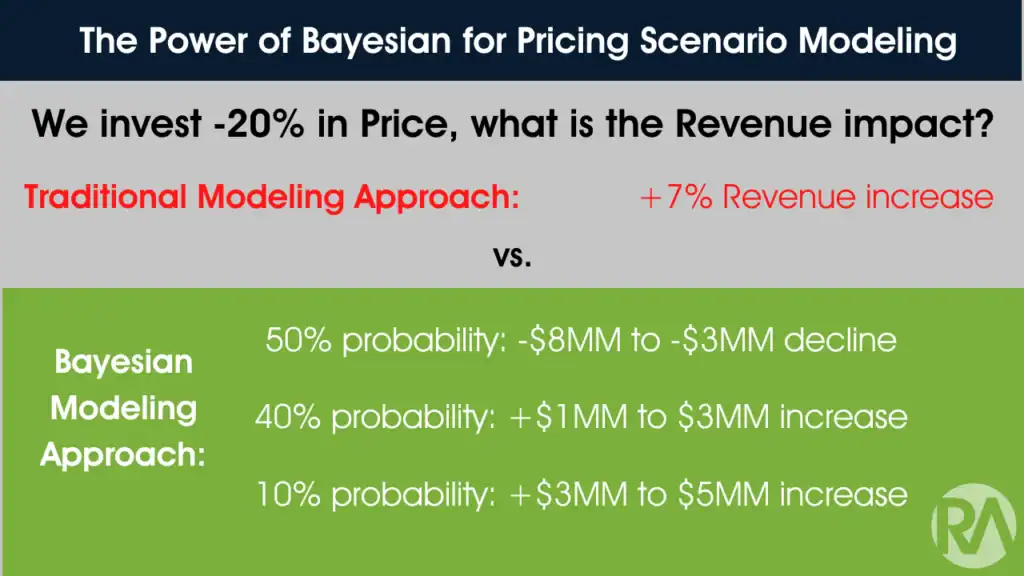
Our traditional models suggest that a -20% price investment would increase unit sales by +35% and revenues by +7%. It’s a sound decision: let’s invest in price to grow our Unit Share and Revenues (let’s ignore that we’re losing Gross Profits for now).
In contrast, suppose that our Bayesian model tells us that:
There’s a 20% probability our units would decline by -20% to -40%
20% probability of declining between -20% and 0
30% probability of increasing by up to 15%
and a 30% probability of increasing +15-50%
Now we can play with these estimates and understand our pricing investment’s risk and the upside. If there is a:
50% probability of losing -$3MM to 8MM in Revenues
40% probability of gaining +$1MM to 3MM
and a 10% probability of earning $3MM-5MM, we will rethink our decision.

Think back to elementary business or stats classes and the concept of Expected Value – or, simply, the probability-weighted outcome.
It’s a compelling but heavily underutilized concept in the business world – except perhaps Business Development / M&A modeling. (Yes, many Finance types still use Monte Carlo simulations – the basis of Bayesian Modeling – in Excel to quantify the risks and upside of business acquisitions or divestitures).
We often hand predictions to our business stakeholders as absolute truths without quantifying risk and reward.
Bayesian modeling, while more complex and time-consuming than popular modeling approaches, gives us the ability to quantify both the risk and upside.
Especially if you are doing Data Science for Pricing, Marketing and Sales problems, I highly encourage you to dive deeper to understand how you can apply Bayesian techniques to your critical use cases:
Should we invest $10MM in this new ad campaign?
Should we deploy $20MM in promotions/price investments next quarter?
Should we reorganize the sales territories in XYZ way?
Should we introduce these three new products next year?
Learn how customers react to price changes
Our free 50-page guide, Mastering Price Elasticity Modeling, shows step by step how to measure the way your customers respond when prices go up or down.
Frequently asked questions about Bayesian analysis for pricing
What is Bayesian analysis in pricing?
In pragmatic terms, the power of Bayesian modeling is that it assigns probability intervals to predictions. Instead of a single forecast, a Bayesian demand model shows how likely different outcomes are, such as the chance that unit sales fall or rise by different amounts after a price change, so you can weigh the risk and the upside of a pricing decision.
How does a Bayesian demand model differ from a traditional one?
A traditional model gives one answer, for example that a 20% price investment raises unit sales by 35% and revenue by 7%. A Bayesian model gives probabilities instead: in the example, a 20% chance units fall 20% to 40%, a 20% chance they fall by up to 20%, a 30% chance they rise by up to 15%, and a 30% chance they rise 15% to 50%.
How does expected value change a pricing decision?
Expected value is the probability-weighted outcome. If a price investment carries a 50% chance of losing $3MM to $8MM in revenue, a 40% chance of gaining $1MM to $3MM, and a 10% chance of gaining $3MM to $5MM, the decision needs a rethink, even though a single-point forecast made the same investment look sound.
Why is Bayesian modeling underused in business?
It is more complex and time-consuming than popular modeling approaches, and many companies jump from linear regression straight to machine learning. Outside business development and M&A, where finance teams still run Monte Carlo simulations in Excel, predictions are often handed to stakeholders as absolute truths without quantifying risk and reward.
Which business questions suit Bayesian analysis?
It is especially useful for pricing, marketing, and sales problems where risk and upside matter, such as whether to invest $10MM in a new ad campaign, deploy $20MM in promotions or price investments next quarter, reorganize sales territories, or introduce three new products next year.
Related Reading
- How US Mobility has Eroded and Accelerated Retail Sales from 2020-22
- Pricing Surveillance: How It Works, How to Detect It, and How to Govern It
For broader industry perspective on pricing analytics and revenue growth management, see McKinsey’s Growth, Marketing & Sales insights.
Want a second opinion on your pricing?
Tell us what’s going on with your pricing. One of our partners will get back to you the same day or the next.