

Table of Contents
Why is it essential to understand the business impact of Price changes and Promotional investments, and what are the analytical approaches to estimating Price elasticities?
With continued data proliferation and the democratization of popular Machine Learning methods among the data analyst community, knowing your Price and Promotional elasticities at the Customer-Product level is fundamental to Finance, Sales and Revenue Management.
Real example: A premium pet food brand raised its prices even with cheaper competitors around, and lost very few customers. Read the case study →
How many of us have been in situations where:
✘ We are giving away too many promotions and discounts to customers.
✘ Our pricing strategy is to index to competitor prices.
✘ Our price investments (promotions, discounts, rebates) are growing faster than Operating Profit (or worse, Price investments grow, EBIT declines).
✘ Margins and Net Revenue are substantially lower than what they could be.
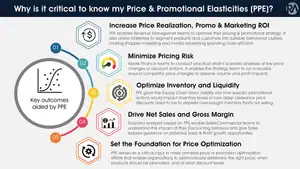
Below is a visual guide (two slides) describing:
Business outcomes enabled by Price and Promotional Elasticities (PPE).
Popular data science techniques to estimate PPE using a good/better/best approach.
Elasticities are derived from Demand Models (typically predicting Unit Sales). If you are serious about modeling PPE in your organizations, please remember the following five rules to ensure you have a robust Demand Model – and an accurate Price Elasticity:
Collaborate with internal experts as you build the model: have an initial hypothesis about what other variables besides Price and Seasonality influence Unit Sales. Afterward, carefully vet your model with cross-functional leaders in Sales, Marketing, Supply Chain, and Finance.
Choose simplicity over sophistication: if you have an 80% accuracy using a Multiplicative Regression Model with six variables and an 82% accuracy using Random Forest, choose the former. There is a time and place for choosing Machine Learning over traditional Regression approaches, as outlined briefly on slide 2.
Pay attention to outliers: always do some exploratory analysis/summary statistics to understand the variance in your data. If needed, normalize your data or exclude gross outliers to ensure the accuracy and stability of your Demand Model.
Pay attention to multi-collinearity: for most Demand Models, Price and other variables will be highly correlated. If needed, employ a model regularization technique or a tree-based ensemble model (e.g., Random Forest or Gradient Boosting) that is naturally great at handling outliers.
Test the effectiveness of your model: compare new in-market results with your model predictions to ensure your Demand Model (and Price Elasticities) remains accurate against previously unseen sales results.
Learn how customers react to price changes
Our free 50-page guide, Mastering Price Elasticity Modeling, shows step by step how to measure the way your customers respond when prices go up or down.
Frequently asked questions about price elasticities
Why is it important to know your price elasticities?
With data proliferating and machine learning methods now common among analysts, knowing price and promotional elasticities at the customer-product level is fundamental to finance, sales, and revenue management. It matters most when a company gives away too many promotions and discounts, simply indexes to competitor prices, sees price investments grow faster than operating profit, or earns lower margins and net revenue than it could.
Where do price and promotional elasticities come from?
Price and promotional elasticities, often shortened to PPE, are derived from demand models that typically predict unit sales. They show the business impact of price changes and promotional investments such as discounts and rebates. Popular data science techniques for estimating them can be ranked in a good, better, best approach, from traditional regression to machine learning.
How do you build a reliable demand model?
Follow five rules. Collaborate with internal experts on which variables besides price and seasonality drive unit sales, then vet the model with sales, marketing, supply chain, and finance leaders. Choose simplicity over sophistication. Explore the data and handle gross outliers. Control for multicollinearity. Finally, test the model against new in-market results so the elasticities stay accurate.
Should you use machine learning or regression to estimate elasticity?
Favor the simpler model. If a multiplicative regression with six variables reaches 80% accuracy and a random forest reaches 82%, choose the regression. There is a time and place for machine learning over traditional regression, but a two-point accuracy gain is not reason enough to switch.
How do you handle outliers and multicollinearity in demand models?
Always run exploratory analysis and summary statistics to understand the variance in your data, and normalize it or exclude gross outliers when needed to keep the model accurate and stable. Price and other variables are usually highly correlated, so apply a regularization technique or use a tree-based ensemble model, such as random forest or gradient boosting, that handles these problems well.
How do you check that price elasticities stay accurate?
Compare new in-market results with the model’s predictions. Testing the demand model against sales results it has not seen before confirms that the model, and the price elasticities derived from it, remain accurate as conditions change.
Related Reading
- AI Won’t Fix Your Pricing Strategy. This Will.
- Revenue and Profit Growth Drivers: A Foundational Revenue Growth Analytics Capability
For broader industry perspective on pricing analytics and revenue growth management, see McKinsey’s Growth, Marketing & Sales insights.
Want a second opinion on your pricing?
Tell us what’s going on with your pricing. One of our partners will get back to you the same day or the next.