
Table of Contents
It often amuses me that in the era of ChatGPT (and despite the countless books I have in my library on AI/ML), I’ve never used any Deep Learning model for any of my client engagements or prior advanced analytics leadership roles.
For 99.95% of data problems in traditional (non-tech) companies, Deep Learning (and any of its derivations like LSTMs, GANs, CNNs, etc.) are overkill at best and a complete waste of time (or not applicable) at worst.
In Revenue Growth Analytics, we help answer the following types of questions to drive more Sales, Profit, or both:
What are my optimal prices, and what is the price-value trade-off for my products?
What new markets/customer segments should we expand to?
What product whitespace opportunities exist based on detailed market analysis?
How can we improve Net Revenues and Gross Profits through Customer and Product Mix Management?
Where are my most significant Customer retention, upsell and cross-sell opportunities to drive volume growth?
What is the ROI of my Marketing Spend, and how can I optimize my Marketing Mix to drive greater Sales and Profit?
Which prospective customers have the highest propensity to drive high Customer Lifetime Values?
How should we adjust our sales and marketing efforts based on a segmentation of customer purchase patterns (to maximize profits)?
How else can I leverage my data assets to drive incremental value for my Sales Teams?
What internal analytics tools can I modify (or newly build) for our Customers to help them optimize their assortment, pricing, or purchasing, to drive customer stickiness and incremental sales?
To solve these problems, I mostly stick to the basics (think data munging / diagnostic analytics in Excel / R / Tableau / Power BI, mainly using middle-school math and plenty of domain expertise).
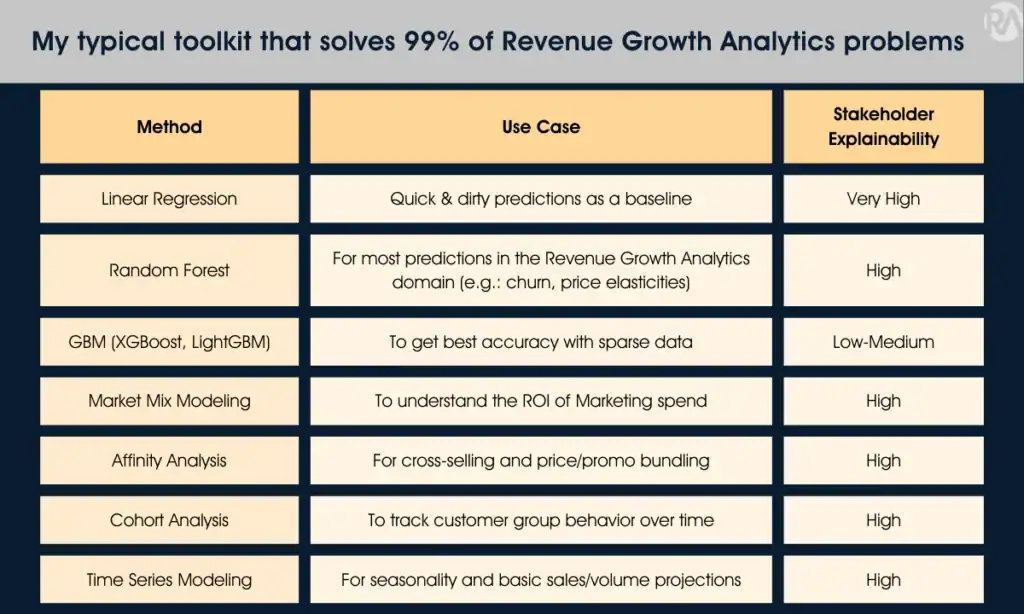
For more advanced work, I typically rely on the following:
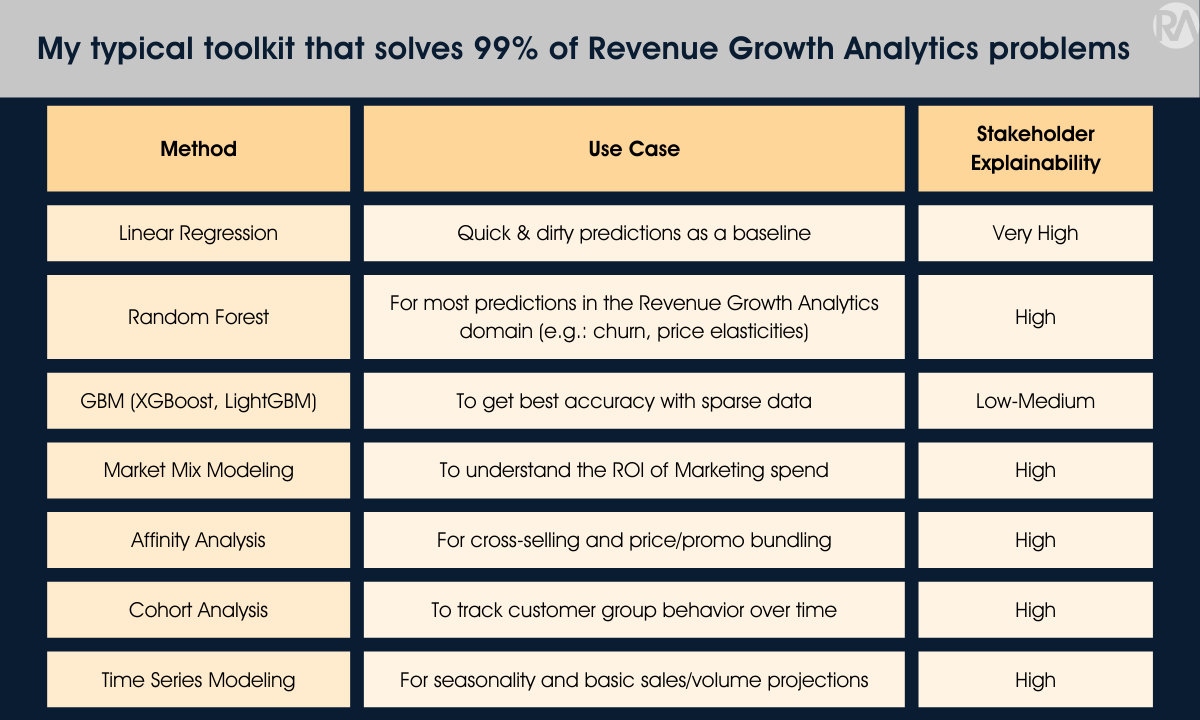
Linear Regression: for quick & dirty predictions (either as a baseline to compare things to or if the data is simple and I have enough domain expertise to know the relationship is primarily linear).
Random Forest: for most prediction problems, including customer churn and price elasticity estimations. RF is always a good choice for me when my data is pretty complete, I have lots of features to work with, and when multi-collinearity is a problem (which is almost always the case for commercial analytics problems). Despite its computational intensity (although ideal for parallelization even on standard laptops), Random Forest is also straightforward to explain to executive stakeholders in a way they can conceptualize and understand.
GBM (typically XGBoost): for churn, likelihood to purchase, and price elasticity problems. Use it less frequently than RF, typically when my data is sparse and prediction errors are substantially more costly to the business (also, when I have considerably more time to build the models). LightGBM is a faster but less accurate option. Also, much more work to explain to your stakeholders.
Market Mix Modeling: to help companies understand the return on their marketing spend and help optimize budgets for greater Sales or Gross Profit return.
Affinity Analysis (or Market Basket Analysis): to help with optimal B2B cross-selling and to understand the best pricing & promotional bundling opportunities.
Cohort Analysis: to track customer behavior over time on dimensions such as retention, repeat purchase, or customer lifetime value.
Time Series Modeling (mostly the “prophet” package): using simple forms of TS to visualize seasonality or obtain optimal Fourier terms (continuous predictors in linear regressions instead of using countless dummy variables). TS modeling is also helpful for basic revenue or volume projections as inputs to Revenue or Profitability scenario analyses.
To recap, for most business pain points in traditional companies, more advanced ML is not needed, and foundational ML techniques like Linear Regression, Random Forest, Market Mix Modeling, Affinity Analysis, and some Time Series Analysis are more than enough. These methods are easy to explain to stakeholders and provide accurate enough output to make a decision, measure impact and move on.
Most of these techniques have been around for decades (and centuries in the case of linear Regression), and I suspect we’ll still predominantly use these simple tools to solve critical business pain points for another few decades.
See how your pricing compares
Our 2025 report looks at how more than 150 business leaders handle pricing and promotions. See what the best companies do differently, and where most fall short.
Frequently asked questions about machine learning in revenue growth analytics
Do traditional companies need deep learning?
Rarely. For 99.95% of data problems in traditional, non-tech companies, deep learning and its derivations such as LSTMs, GANs, and CNNs are overkill at best and a waste of time or not applicable at worst. Foundational methods like linear regression, random forest, marketing mix modeling, affinity analysis, and simple time series analysis are more than enough.
What questions does revenue growth analytics answer?
It answers questions such as what the optimal prices and price-value trade-offs are, which markets and customer segments to expand into, where product whitespace exists, and how customer and product mix management can lift net revenue and gross profit. It also finds retention, upsell, and cross-sell opportunities and measures the return on marketing spend.
When should you use random forest versus XGBoost?
Random forest suits most prediction problems, including customer churn and price elasticity, especially when data is fairly complete, features are plentiful, and multicollinearity is a problem, and it is easy to explain to executives. Gradient boosting, typically XGBoost, is used less often, when data is sparse, prediction errors are costly, and there is more time to build models.
When is linear regression good enough?
Linear regression works for quick predictions, either as a baseline to compare other models against or when the data is simple and domain expertise suggests the relationship is mainly linear. Most business questions start with the basics anyway: data munging and diagnostic analytics in Excel, R, Tableau, or Power BI, using simple math and plenty of domain expertise.
Which other analytics techniques are most useful?
Marketing mix modeling shows the return on marketing spend and helps optimize budgets. Affinity or market basket analysis supports B2B cross-selling and pricing and promotional bundles. Cohort analysis tracks retention, repeat purchase, and customer lifetime value over time. Simple time series modeling, often with the prophet package, shows seasonality and feeds revenue or volume projections into scenario analyses.
Why do simple models work well for business problems?
They are easy to explain to stakeholders and give output that is accurate enough to make a decision, measure the impact, and move on. Most of these techniques have been around for decades, or centuries in the case of linear regression, and they are likely to remain the main tools for critical business pain points for decades to come.
Related Reading
- Optimizing Profit Margins for Auto Service, Repair & Tire Retailers: Tactics for Smart Pricing and Revenue Growth Management
- Equilibrium Pricing: Definition, Calculation, and Practical B2B Implementation
For broader industry perspective on pricing analytics and revenue growth management, see McKinsey’s Growth, Marketing & Sales insights.
Want a second opinion on your pricing?
Tell us what’s going on with your pricing. One of our partners will get back to you the same day or the next.