Overview: Revenue growth management analytics in Practice
This article from Revology Analytics explains revenue growth management analytics in the context of modern pricing analytics and revenue growth management. It draws on real engagements with mid-market and enterprise clients to turn revenue growth management analytics from a buzzword into a measurable commercial capability. Read on for the full perspective, and see our related reading for additional depth.
Situation
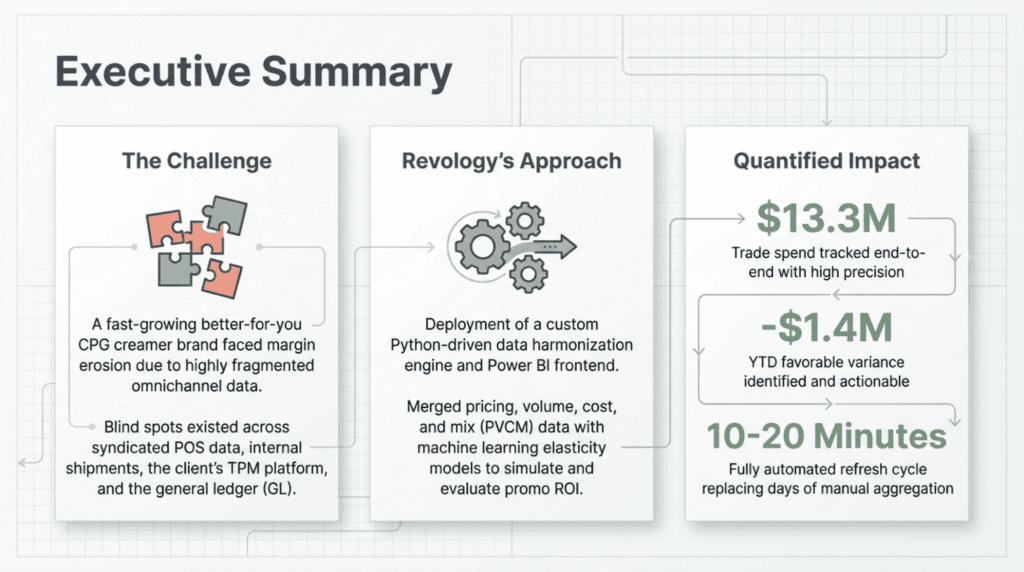
A fast-growing plant-based creamer brand had built a national omnichannel footprint across mass, grocery, club, natural, and e-commerce. Growth was strong. Visibility into the actual economics of trade and promo was not. Annual trade spend had crossed $13 million, spread across everyday low pricing, off-invoice allowances, manufacturer chargebacks, scans, slotting, and free fills, routed through a mix of direct retailers, distributors, and broker-led regional banners.
The commercial team knew this level of complexity could not be run out of spreadsheets anymore. They wanted to move from retrospective trade tracking to a forward-looking Revenue Growth Management capability that could plan, simulate, execute, and measure promotional activity with real analytical discipline. They also wanted full control of the economics heading into the next annual operating plan, especially given how many trade dollars flowed to first receivers where true end-retailer ROI was invisible.
Revology Analytics was engaged to build an in-house Pricing and RGM Analytics capability inside their existing Power BI and Python environment. The client wanted to own the asset, not rent a black box.
Obstacles
A handful of interconnected problems stood between the client and a credible in-house capability.
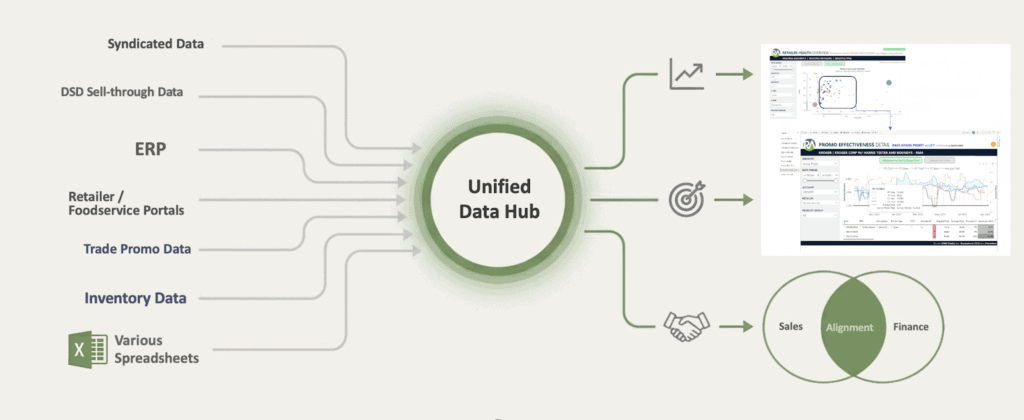
- Four disconnected source systems. Sales data lived in a syndicated POS system, shipments in a warehouse platform, trade spend in a dedicated TPM tool, and financials in the GL. Every system used its own customer hierarchy, product hierarchy, and time cadence. Without a harmonization layer, there was no way to compute net revenue, trade ROI, or gross profit at the customer-SKU-week grain.
- Distributor-driven blind spots. Trade dollars were often billed to distributors rather than the end retailer. Customer-level ROI and elasticity were impossible to compute without a volumetric allocation workaround. In one case, the TPM platform could not programmatically split a major distributor’s spend across its regional divisions, which forced hardcoded allocation and masked real performance by banner.
- Latent spend leakage. A full year of deduction streams from a major mass retailer’s customer pickup program were missing from the TPM system. Any spend tagged as “All Products” or “All Customers” was being dropped from roll-ups entirely.
- No causal elasticity or pre-event promo simulation. Promo planning ran on intuition and lapping historical promo calendars. There was no way to isolate the causal impact of price, or simulate promo ROIs before the event went live.
- Brittle hierarchies. Syndicated hierarchies needed manual auxiliary mapping for corporate geographies. Any upstream schema change in the POS or TPM export could quietly break the pipeline, a serious risk for a team running AOP on this data.
Action
We delivered the capability in three phases, all running inside the client’s existing Python and Power BI stack.
Phase 1. Data harmonization and pipeline engineering
- Local Python processing engine. The engine ingests weekly syndicated POS, internal shipments, TPM trade spend, and GL financials, then harmonizes them against a canonical customer-product-time spine. Full refresh runs in 10 to 20 minutes and outputs the updated AOP and pricing models on demand.
- Volumetric allocation logic. This is what bridges distributor-billed trade spend back to end-retailer performance. Customer-level ROI became computable for the first time across the full promotional portfolio.
- Plugged the historical blind spots. We reconstructed the missing deduction streams from the major mass retailer’s customer pickup program and built logic to recover the “All Products / All Customers” spend that had been dropping out of roll-ups.
Phase 2. Analytical modules: the RGM Analytics Navigator
Six integrated Power BI modules sit on top of the harmonized data.
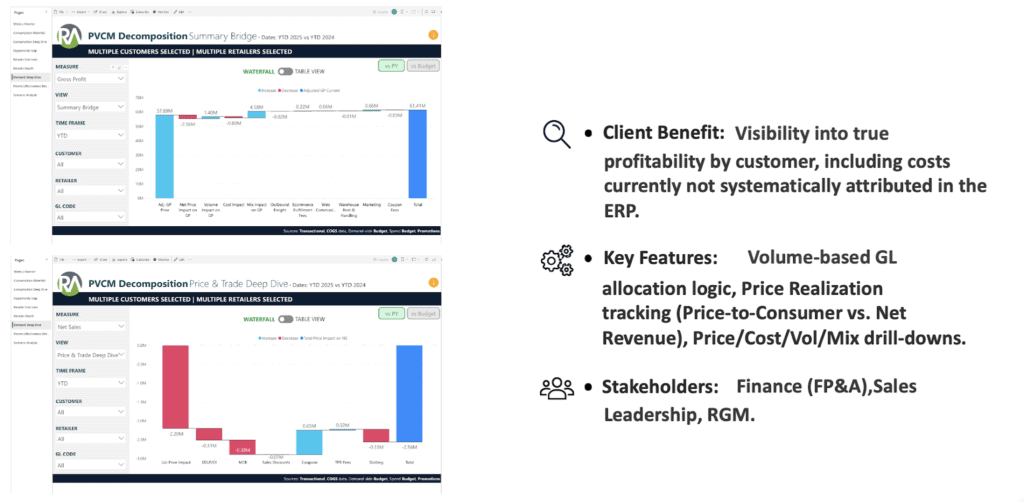
- Demand Deep Dive with PVCM decomposition. A Price-Volume-Cost-Mix view that bridges Revenue and Gross Profit performance vs. a baseline period (or vs. budget), so the team can see exactly where growth or leakage came from by customer, brand, pack, and channel.
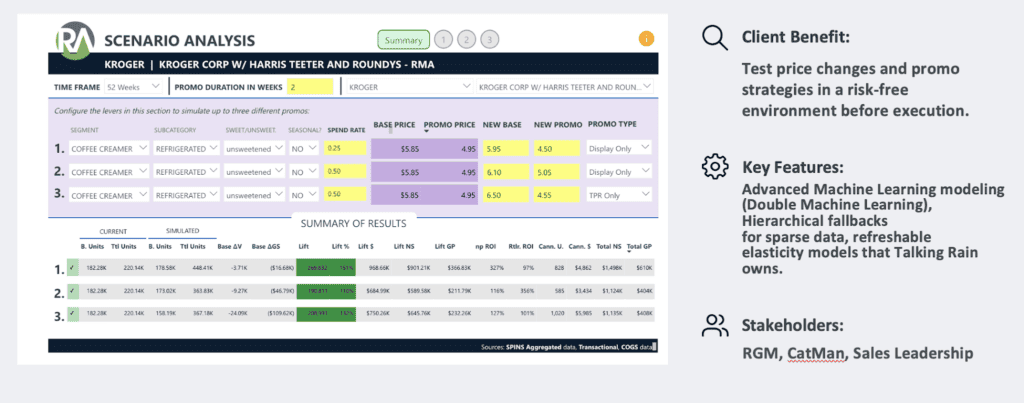
- Elasticity and scenario analysis. A pre-event simulator built on scikit-learn and econml. Double Machine Learning isolates the causal effect of price, which feeds own-price elasticity, own-promo elasticity, and merchandising lift factors. Planners can test depth, duration, and merchandising combinations before they commit trade dollars.
- Promotion lift and ROI. A retrospective post-event tool that compares actual promo periods against a statistically derived base and computes incremental volume, incremental profit, and true ROI, net of the full retailer, distributor, and broker economics.
- Weekly monitor. A rolling scorecard that surfaces trade spend, pricing, and share signals before they turn into quarterly surprises.
- Opportunity Gap Analysis. A competitive frame that benchmarks the brand’s promo depth, frequency, and assortment velocity against comparable peer brands to quantify the addressable gap.
- Retailer overview and health detail. Customer-by-customer health scorecards so planning conversations sit on top of each retailer’s actual economics.
Phase 3. Change management and enablement
- SOP and methodology playbook. We documented the full Pricing & RGM Analytics Navigator, the Python engine architecture, the elasticity methodology, and the promo ROI calculation so the capability lives with the client, not with us.
- Trained the commercial and finance teams. How to read the dashboards, run scenarios, and govern the underlying assumptions.
Results
The RGM Analytics Navigator is now the commercial team’s single source of truth for trade, promo, and pricing decisions.
- Full visibility into $13M+ of annual trade spend. Expected vs actual trade spend is now tracked at the line-item level across every mechanism, customer, and banner.
- Decision speed: 10 to 20 minute refresh. The productized Python pipeline runs the full data harmonization, elasticity refresh, and dashboard update end-to-end. What used to be a multi-day and multi-week, analyst-dependent job now runs on demand, so the team spends their time on interpretation instead of data plumbing.
- Slotting discipline. In 2024, actual slotting spend within 0.1% of plan. In prior periods, slotting was effectively unmanaged at the portfolio level.
- An in-house RGM capability the client owns. The Python engine, Power BI modules, elasticity methodology, and playbooks all sit inside the client’s own tech stack. They can extend it, tune it, and retrain the models as the business evolves.
- A foundation for forward-looking RGM. With Modules 1, 4, 5, and 6 in production, the team is now set up to move from reactive deduction management to proactive promo planning, pack-price architecture work, and AOP-integrated scenario planning.
Related Reading
- Driving Profitable Growth with Insights-Driven Pricing Transformation in Auto Service Retail
- Solving Unproductive Inventory Challenge with Dynamic Markdown Pricing – Case Study
For broader industry perspective on pricing analytics and revenue growth management, see McKinsey’s Growth, Marketing & Sales insights.