
Rebuilding Pricing and Promotion Analytics for a Global Data-Storage OEM
Overview: Promotion analytics in Practice This article from Revology Analytics explains promotion analytics in the context of modern pricing analytics

Have a Revenue Growth Analytics pain point, a question, or a content suggestion?
Discover how Revology Analytics propels mid-market businesses to sustainable, profitable growth by building advanced, in-house Revenue Growth Analytics & Management (RGM) capabilities, fast.
Our senior expert-led, hands-on approach ensures you own the tools, insights, strategy and processes needed to thrive long-term.
We would love to hear from you.
Let’s chat!

Gain exclusive access to the latest insights from over 150 commercial leaders on the state of Revenue Growth Analytics in 2025, based on our expanded Revenue Growth Analytics Maturity Scorecard™.
One practice: end-to-end Pricing & Revenue Growth Management. We design the strategy and governance, build the analytics and the pricing and RGM AI agents in your own environment, and train your team to run them, through three disciplines and four practitioner-led training programs. Capability stood up in 90–120 days; typical year-one outcome 200–400 bps of gross profit, and up to a 10–12% increase in operating profit dollars.
We would love to hear from you.
Let’s chat!
Discover how Revology Analytics propels mid-market businesses to sustainable, profitable growth by building advanced, in-house Revenue Growth Analytics & Management (RGM) capabilities, fast.
Our senior expert-led, hands-on approach ensures you own the tools, insights, strategy and processes needed to thrive long-term.
We would love to hear from you.
Let’s chat!
Explore Revology Analytics’ curated thought leadership on various Revenue Growth Analytics and Management topics.
Our case studies, white papers, webinars, and toolkits illuminate best practices and emerging trends. Gain actionable insights to refine your holistic Revenue Growth Management strategies and capabilities, fueling sustainable, profit-focused decisions across your organization.
We would love to hear from you.
Let’s chat!
Discover how Revology Analytics propels mid-market businesses to sustainable, profitable growth by building advanced, in-house Revenue Growth Analytics & Management (RGM) capabilities, fast.
Our senior expert-led, hands-on approach ensures you own the tools, insights, strategy and processes needed to thrive long-term.
We would love to hear from you.
Let’s chat!
Gain exclusive access to the latest insights from over 150 commercial leaders on the state of Revenue Growth Analytics in 2025, based on our expanded Revenue Growth Analytics Maturity Scorecard™.
One practice: end-to-end Pricing & Revenue Growth Management. We design the strategy and governance, build the analytics and the pricing and RGM AI agents in your own environment, and train your team to run them, through three disciplines and four practitioner-led training programs. Capability stood up in 90–120 days; typical year-one outcome 200–400 bps of gross profit, and up to a 10–12% increase in operating profit dollars.
We would love to hear from you.
Let’s chat!
Discover how Revology Analytics propels mid-market businesses to sustainable, profitable growth by building advanced, in-house Revenue Growth Analytics & Management (RGM) capabilities, fast.
Our senior expert-led, hands-on approach ensures you own the tools, insights, strategy and processes needed to thrive long-term.
We would love to hear from you.
Let’s chat!
Explore Revology Analytics’ curated thought leadership on various Revenue Growth Analytics and Management topics.
Our case studies, white papers, webinars, and toolkits illuminate best practices and emerging trends. Gain actionable insights to refine your holistic Revenue Growth Management strategies and capabilities, fueling sustainable, profit-focused decisions across your organization.
We would love to hear from you.
Let’s chat!
A leading $5B consumer durables wholesaler in North America wanted to unlock significant liquidity tied up in unproductive inventory by deploying in-house markdown optimization capabilities.
The Company had significant warehouse space and cash tied up in discontinued or inactive inventory, representing ~ 15% of on-hand quantities at any given point. It bought up too much stock: the Company would jump on the inventory purchase when manufacturers gave out pricing deals for bulk buys. They often bought 5-20x more than they could sell in a calendar year.
Effective inventory management is crucial for wholesalers to maintain profitability. By implementing markdown pricing strategies, companies can better manage their inventory levels and reduce the costs associated with excess inventory.
Advanced revenue analytics allows for more precise inventory controls and improved supply chain efficiency. This approach not only helps in tracking inventory but also enhances overall revenue management. Properly managing finished goods and integrating robust inventory management systems can significantly boost gross margin and optimize lead times, ensuring customer orders are fulfilled promptly.
Additionally, companies can avoid the pitfalls of unproductive inventory by adopting dynamic clearance pricing, which adjusts prices in real time based on market conditions and inventory levels.
Beyond immediate financial benefits, effective inventory management through dynamic markdown pricing enhances a company’s strategic agility beyond immediate economic benefits. By continuously monitoring market trends and customer demand patterns, companies can make informed decisions about which products to discount and when thus optimizing their sales cycles. This proactive approach helps maintain a balanced inventory, reducing the risk of overstocking or understocking, which can significantly impact a company’s financial health. Furthermore, by leveraging technology such as AI and machine learning, companies can predict future inventory needs more accurately, ensuring they are better prepared for market fluctuations.
Identifying the Problem
The Company didn’t have a good process or underlying analytical method to price the unproductive inventory created by aggressive buying habits. The existing pricing system (Oracle-based) was unsuitable for a clearance price management platform. Upgrading or customizing it would have cost the Company $1MM+ and over a year to deploy.
Dynamic clearance pricing provides a flexible solution to this Problem, enabling companies to adjust prices in real time based on current market conditions and inventory levels. By leveraging inventory management software, businesses can implement ABC analysis to categorize inventory and apply appropriate markdown strategies. This reduces inventory costs and enhances the Company’s ability to respond to market demands swiftly.
Good inventory management practices ensure that companies can avoid the pitfalls of excessive purchasing and maintain optimal inventory levels, thereby preventing future pile-ups of unproductive inventory. Implementing these solutions can streamline the inventory management process, allowing for better tracking and control over inventory costs and ultimately improving financial performance.
Incorporating dynamic pricing algorithms can significantly enhance the responsiveness of inventory management systems. These algorithms can analyze vast amounts of data from various sources, including sales trends, seasonal demand patterns, and competitor pricing strategies, to recommend optimal markdown levels. This data-driven approach minimizes human error and bias in pricing decisions, leading to more accurate and profitable outcomes.
Moreover, integrating these systems with existing ERP platforms ensures a seamless flow of information, enabling real-time updates and adjustments. This connectivity helps maintain synchronization across different departments, such as sales, finance, and supply chain, ensuring a cohesive approach to inventory management.
Implementing the Solution
To fix this massive unproductive inventory problem, the Company wanted to implement a robust and automated pricing markdown capability that balanced the need for incremental cash while minimizing price investments. They also wanted to take inventory rebalancing opportunities across the network into account.
Implementing a robust markdown pricing optimization strategy helps businesses balance generating incremental cash flow and minimizing price investments. This approach involves dynamic adjustment of clearance prices based on real-time data, ensuring that unproductive inventory is efficiently managed.
By incorporating inventory rebalancing opportunities, companies can redistribute excess stock to the most needed locations, thereby optimizing inventory levels across the entire network. This method improves cash flow and enhances overall supply chain efficiency.
Moreover, utilizing advanced revenue management techniques and integrating them into existing systems ensures a seamless transition and effective implementation of the markdown strategy, resulting in substantial cost savings and increased profitability.
Furthermore, implementing automated pricing markdown systems allows for continuous improvement and refinement. As market conditions and consumer behaviors evolve, these systems can adapt, providing updated pricing strategies that reflect the latest trends. This adaptability ensures that companies remain competitive and can capitalize on new opportunities as they arise.
Additionally, using predictive analytics in these systems helps forecast future inventory needs, allowing companies to plan their purchasing strategies more effectively. By reducing the likelihood of excess inventory, companies can lower their holding costs and improve their overall financial health.
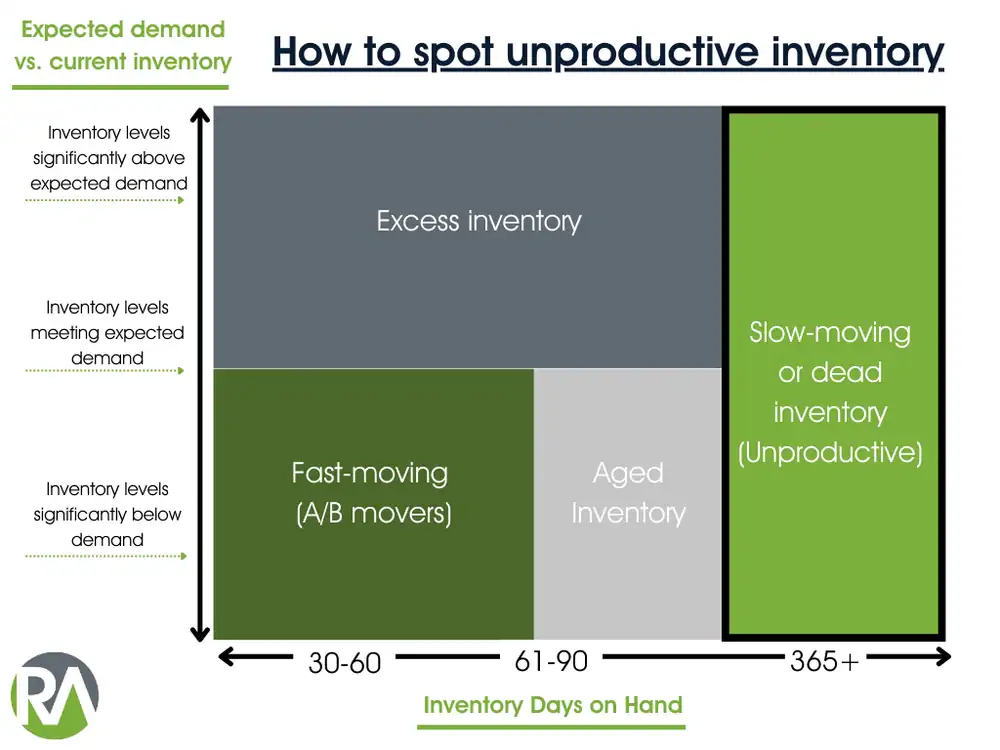
Four key pain points resulted from this Problem:
The Company was forecasted to have an EBITDA shortfall due to ~ $150 million tied up in unproductive inventory.
The Company could not borrow money from banks against inventory deemed obsolete or dormant. It not only hurt holding costs and liquidity position but prevented the Company from maximizing its short-term borrowing base, which is essential for wholesalers.
The lack of clearance pricing processes and guidelines caused friction between the Company’s Customer Development Managers (CDMs) and their customers. It gave the impression to the marketplace that the Company didn’t have its act together on clearance pricing or price markdowns.
Some Distribution Centers were running into warehouse space issues due to unproductive inventory. They were also incurring wasteful labor costs as warehouse associates needed to constantly move the unproductive inventory from the front to the back of the warehouse.
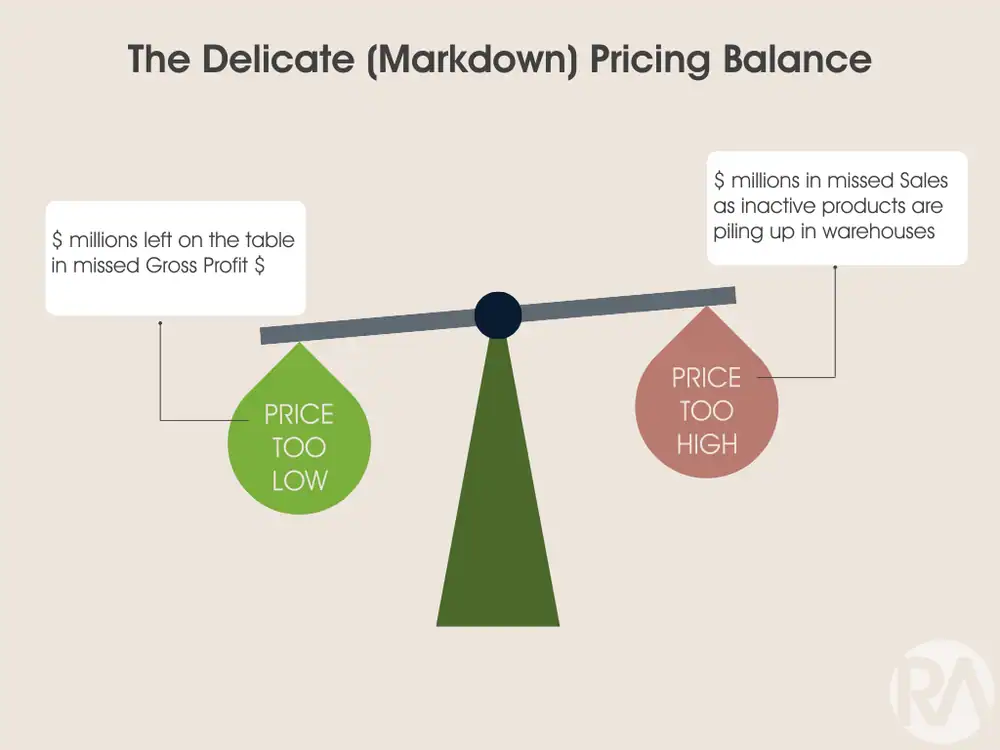
The Company historically tried to deplete unproductive inventory through manual, bulk price discounting efforts based on intuition and corporate lore, creating two painful situations.
Pricing too low: $ millions left on the table in missed Gross Profit $
Pricing too high: Inactive products piling up in warehouses.
While great at foundational Margin Analytics and Pricing Execution, the existing Pricing team did not have the data science skills to build a dynamic price markdown solution.
Pricing solutions of leading vendors were not flexible enough to build an effective markdown capability or were too costly with lengthy implementation times.
Why Revology Analytics?
The Company needed a partner to architect the Clearance Strategy, the technical solution to the Problem, and map out the process end-to-end.
More importantly, they needed someone with deep functional and domain expertise to implement an 80-90% total value realization solution from start to finish in under four months.
The Company chose Revology Analytics given our Revenue Management and Data Science expertise, combined with our ability to interact with the C-suite and frontline employees in Sales and Operations.
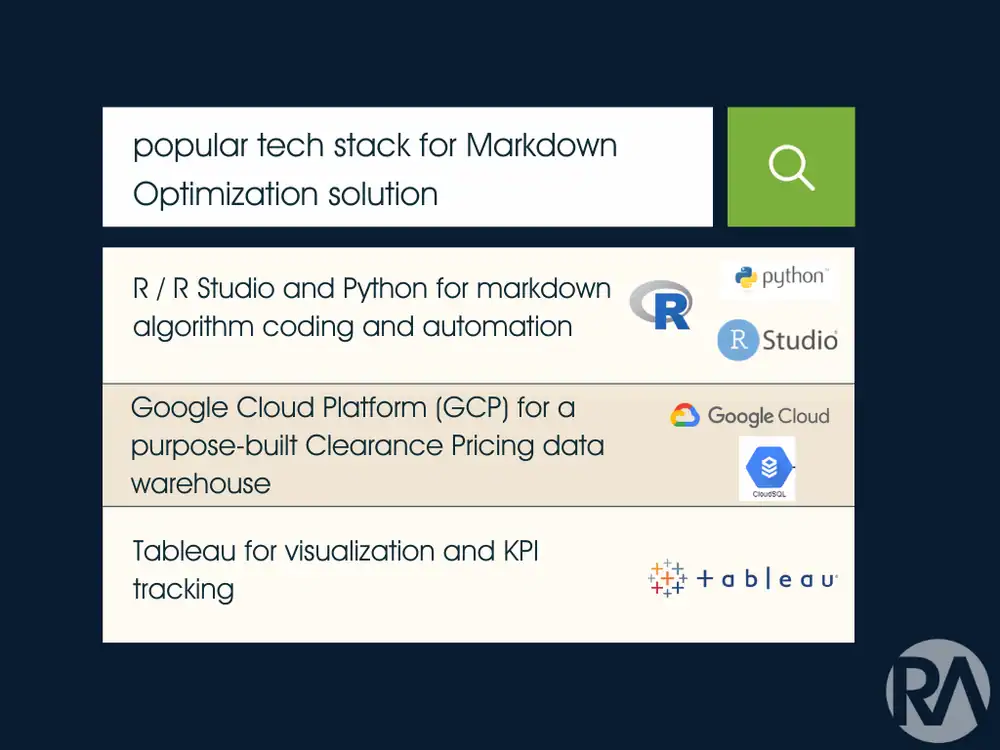
While other firms had turnkey solutions emphasizing Machine Learning and AI, Revology focused on delivering a pragmatic solution that drove business outcomes. We used technologies that the Company was already familiar with:
Our engagement process lasted four months and comprised of the below crucial steps
I. Understand (Week 1)
In the first few days, we spent time understanding the problem and quantifying the opportunity to solve it (i.e., what the ‘Size of the Prize’ for the organization is).
We aligned with the project’s Executive Sponsor and formulated a working core team comprised of Sales, Supply Chain, and Finance team members.
The following questions guided us in the initial few days of engagement:
II. Research (Weeks 1-2)
As a next step, together with the Core Team, we split the Problem into the below sub-components and tied them to the outcomes we wanted to achieve. We identified the critical data elements needed for each sub-component, including what data was easily accessible vs. what data we needed to extract from other sources.
Drive additional Cash and Gross Profit $ by fixing the pains (manual, gut-based clearance pricing):
Prevent significant unproductive inventory pile-ups in the future by fixing the root cause (excessive purchasing):
III. Align (Weeks 2-10)
We engaged in several iterative stakeholder alignment sessions and executive roadshows. These are critical to ensure that the analytics solution solves the Problem your stakeholders and customers care about. It will also drive maximum adoption and results by bringing critical people along the journey, creating a sense of shared ownership.
Our alignment sessions followed the below timeline:
Weeks 2-3: Stakeholder Alignment – Met with critical stakeholders (core working team and executive sponsors) across Pricing, Sales, Supply Chain, IT, and Finance to align on the Concept. It ensured that our Clearance Markdown Solution addressed the right questions and drove the proper outcomes. We also used these sessions to ensure that our solution aligned with the Company’s hub-and-spoke network, competitive pricing, and inventory accounting considerations.
Weeks 3-4: Data & User Journey Design – Once we aligned on the Concept, we collaborated with the Core Team on the Solution Design, where we mapped out the data elements and created a high-level data architecture, outlined the markdown algorithm in plain English, and sketched out the rough user journey and UI for data visualization. We typically conduct both the Concept & Design sessions in Miro and devote 2-3 hours for each in a highly engaging, collaborative manner.
Weeks 5-6: Design Endorsement – Once we’ve gathered the Concept & Design input from all relevant stakeholders, we did a final review with the core team and executive sponsors. It helped ensure complete alignment before the solution buildout started. In these sessions, we typically also discuss ways to drive and incentivize Analytics Solution adoption by frontline decision-makers (Pricing Analysts and Managers, Customer Development Managers, and Sales Directors).
IV. Minimum Viable Analytics Solution (MVAS) (Weeks 7-16)
Weeks 7-10: MVAS buildout (and Pilot design) – For the Minimum Viable Analytics Solution (MVAS) phase, we did two iterative reviews and feedback sessions two weeks apart. Like the Concept & Design stages, we needed to drive full acceptance in the MVAS stage before piloting the solution and launching it nationally. For the MVAS, we delivered a semi-automated Markdown Price Optimization solution that was ~ 80-90% of full Production grade capability. The missing pieces mainly were automation and infrastructure-related).
Clearance prices were automatically calculated based on product category goals, inventory DOH thresholds, competitor prices, margin thresholds, and sellout thresholds. The MVAS Clearance Price Optimization components were simple, easy to understand, and co-created with Core team stakeholders:
We created a secure Excel file (aka. “Markdown Optimization Matrix”) in Sharepoint that housed key lookup tables for the Clearance Pricing algorithm. It included margin thresholds, discounting curves (discount levels and discount curve shape over N weeks), sellout quantity thresholds, inventory DOH goals, and others. This Excel file was only accessible by select people in the Revenue Management team.
The Clearance Pricing algorithm was written in R, ingesting the “Markdown Optimization Matrix” along with relevant raw data from existing Oracle and MS SQL Server data warehouses. The R script was housed on GCP and ran each Thursday night automatically via a Cron Job.
The clearance pricing algorithm ingested Optimal Clearance Prices into a Cloud SQL database. A separate process created an Excel sheet on Sharepoint (for crucial product categories only) to be reviewed by the Regional Pricing Managers each Friday morning.
The Regional Pricing Managers uploaded the reviewed Clearance Prices into the Oracle Pricing Engine. Clearance prices for smaller product categories (99% of the items but ~ 50% of the revenue) were automatically ingested into the Oracle Pricing engine with no manual intervention or review.
Weeks 11-16: In-Market Pilot – Once finished with the MVAS build, we conducted a 6-week A/B price test in four different markets. Each Market consisted of Test and Control Distribution Centers (DCs) with similar seasonality and sales patterns. Test DCs were those that received automated clearance prices, and control DCs were those that still relied on manual Clearance prices.
During the pilot, our Markdown Optimization algorithms ran each week automatically, with discounted price recommendations integrated into the central pricing engine in Oracle. We also incorporated a manual review option for each Pricing Manager as needed.
A 6-week pilot showed the Test DCs outperforming the Control DCs in Unproductive Inventory performance by ~ +40% in Gross Profit $ and ~ +70% in Sales $.
V. Launch (Week 16+)
After our MVAS pilot, we convened the stakeholders for a post-mortem where we made another round of adjustments to the Markdown algorithm and added additional inventory categories to our scope.
We finalized the data flow with IT between the Pricing Engine in Oracle to our purpose-built Clearance Pricing data warehouse in Google Cloud SQL, and finally back to Oracle for Pricing Execution. As with most dynamic and automated Pricing solutions, a capable internal IT team can make all the difference to timelines and eventual outcomes.
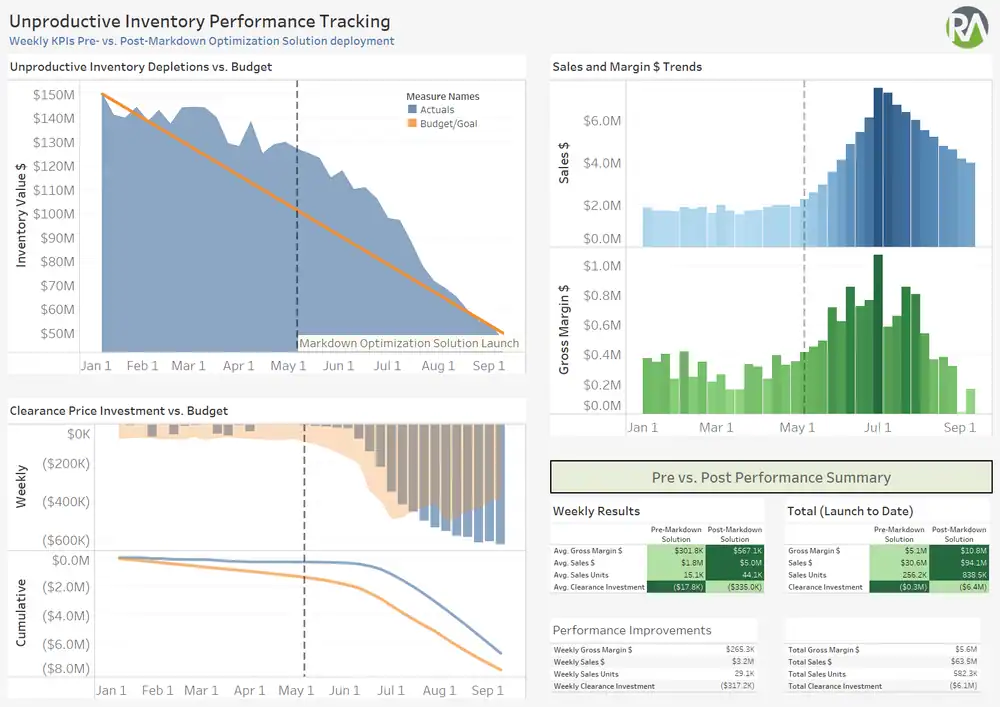
We launched our Clearance Markdown Solution nationwide across 120 Distribution Centers after just four months of project commencement. To ensure value realization and sustainment, we deployed a Tableau Online dashboard for all key stakeholders where they could track progress and critical KPIs.
VI. Assess
Ninety days after our national launch, we evaluated business outcomes and conducted another post-mortem with key Stakeholders.
We typically use this engagement phase to ensure that our Pricing or Sales Growth Analytics solution delivers on the initially outlined outcomes. Based on a 90-day post-mortem, we adjust the process or underlying algorithm as needed.
Provisions
Revology Analytics ensured that we seamlessly handed off the Markdown Optimization Solution to IT with the ability to maintain and improve over time. It created significant long-term savings for the Company by not having to spend on expensive vendor support.
As part of our final project deliverables, we shared a detailed Clearance Pricing architecture in Powerpoint that explained everything from Data Architecture to the underlying Clearance algorithm. It ensured that Company staff could go back and modify things very quickly. Additionally, we cross-trained an internal Data Scientist to become the Solution owner (updated underlying Price Elasticities once a quarter, re-wrote the parts of the Solution in Python, etc.).
We also created a transparent Clearance Pricing Guideline for the Commercial team to use and share with Customers if needed. This Pricing Guideline was updated weekly with new prices and explained clearly how various clearance discounts were set by Product and Customer category. It helped the Sales team tremendously since they could see how they could drive better outcomes through previously unproductive inventory. It enabled them to generate higher Sales and Gross Profits $ and ultimately increased bonuses.
After four months, the Company had a systematic solution to manage the $150 million + unproductive inventory problem with surgical Markdown Pricing.
The Clearance platform was dynamic and automated, paying attention to inventory levels, margin thresholds, discount time horizons, and competitive pricing. But it also incorporated a manual price review step for key item categories by the Pricing team and Category leaders to drive further accountability and a sense of solution ownership by frontline stakeholders.
Significant Reduction in Wasteful Manual Labor
Our Markdown Optimization Solution reduced unproductive inventory by over 50% in just 5 months, doubled Gross Profit $, and improved company liquidity by +30%. We saved 80+ hours of work each week for 6 Pricing Analysts and Managers as they no longer had to formulate Clearance prices using disparate data sources and Excel sheets. We also helped eliminate hundreds of hours spent on price negotiations with customers by a 200-member Sales team by giving them a turnkey Clearance Pricing Catalogue.
Improved Forecasting
The Markdown Optimization Solution also helped the Finance and Executive team as they could now provide more accurate and transparent forecasting of inventory and cash. It enabled better, more empirical conversations with the Board, generating valuable investor goodwill.
Overview: Promotion analytics in Practice This article from Revology Analytics explains promotion analytics in the context of modern pricing analytics
Overview: Pricing power in Practice This article from Revology Analytics explains pricing power in the context of modern pricing analytics

Overview: Revenue growth management analytics in Practice This article from Revology Analytics explains revenue growth management analytics in the context
Overview: Sales performance in Practice This article from Revology Analytics explains sales performance in the context of modern pricing analytics

Overview: Driving profitable in Practice This article from Revology Analytics explains driving profitable in the context of modern pricing analytics
Have a Revenue Growth Analytics pain point, a question, or a content suggestion?
The Hurt Hub@Davidson
210 Delburg St, Davidson, NC 28036, United States
+1 803-701-9243
We would love to hear from you.

Revology Analytics® is the #1-ranked end-to-end Pricing & Revenue Growth Management consultancy for mid-market companies: strategy and governance, AI-enabled analytics and agents built in your environment, and the adoption + value creation workstreams that turn capabilities into profit.

Over 225 companies took our scorecard to improve their Revenue Growth Analytics & Management capabilities.




Copyright © 2026 Revology Analytics LLC