A practitioner’s guide to quantifying willingness-to-pay differences by segment, including practical tests, KPIs, and rollout guardrails.
Table of Contents
Key takeaway: Without measuring pricing sensitivity, pricing decisions are guided by gut feeling, which usually exaggerates customers’ price concerns. Rely on data, not just intuition, to avoid lost opportunities.
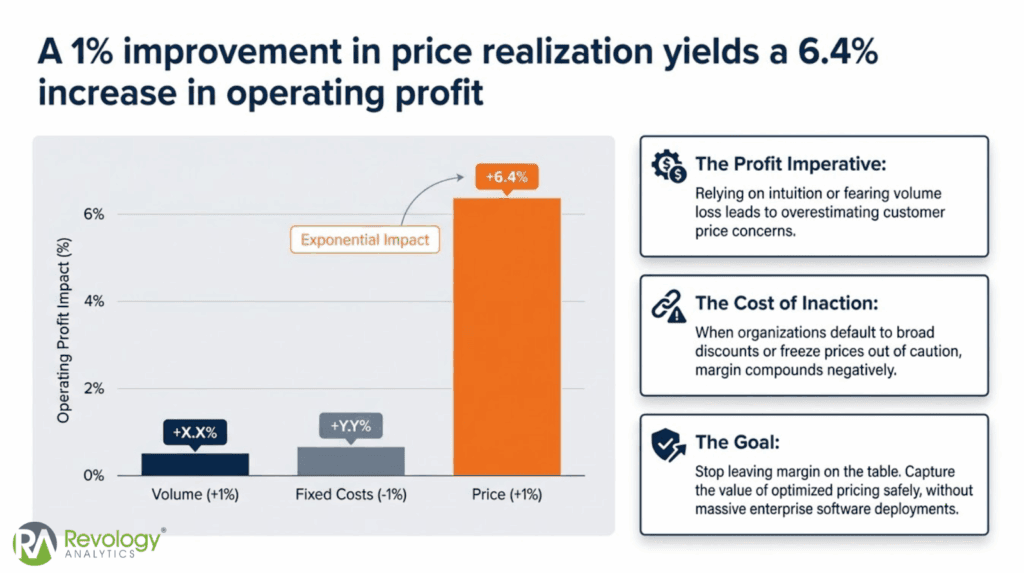
Key takeaway: Small improvements in price realization yield significant profit gains. Target pricing actions by segment sensitivity to move from debate to data-driven decisions that directly improve margins. This makes pricing the highest-leverage P&L action for most organizations.
Key Insight: A 1% improvement in price realization produces a 6.4% operating profit increase for the median firm, making pricing the highest-leverage P&L action for most organizations.
Key Concept: CPS (Customer Price Sensitivity)
Now that we’ve established why pricing sensitivity is so impactful, let’s clarify the terminology before discussing how to measure and apply it.
Definition and Plain-Language Meaning
Pricing sensitivity describes how strongly a buyer’s purchase behavior responds to a change in price. A customer who switches brands when a product rises by 5% is highly price-sensitive. A buyer who barely notices the same increase, because the product is mission-critical, differentiated, or a small share of their budget, is less so.
Pricing Sensitivity operates at the behavioral level, capturing how much price factors into a customer’s decision-making. It is broader than a single metric and includes perception, comparison behavior, and emotional response to price signals.
Pricing Sensitivity vs. Price Elasticity of Demand
Price elasticity of demand is the quantitative expression of sensitivity. It measures the percentage change in quantity demanded relative to a percentage change in price. An elasticity of −2.0 means a 10% price increase predicts a 20% volume decline.
Pricing sensitivity reflects customer behavior. Elasticity quantifies it. Practitioners need both: sensitivity explains why customers react, while elasticity forecasts how much they will.
Industry Elasticity Benchmarks
•Pharmaceuticals: ~0.5 (inelastic, limited alternatives, third-party payers)
•Consumer nondurables: 1.5–5.0 (elastic, easy substitution, high transparency)
•B2B industrial inputs: 2.0–100.0+ (varies by switching costs, contract terms, and commodity vs. differentiated positioning)
Key takeaway: Single elasticity assumptions can mislead pricing strategy because different products and segments display very different sensitivities. Always assess within-portfolio variation.
Related Terms: Willingness to Pay, Price Perception, Reference Price
Willingness to pay (WTP) is the maximum price a buyer will accept for a product. Sensitivity reduces this ceiling as prices increase. Price perception reflects how customers interpret a price relative to their expectations, such as whether it feels “fair,” “expensive,” or “cheap.” Reference price is the internal benchmark a buyer uses, such as the last price paid, a competitor’s price, or a recent promotion. Understanding these related concepts prevents the mistake of treating sensitivity as a single variable when it is actually a system of cognitive and economic factors.
Why Pricing Sensitivity Matters for Revenue and Margin
Where Sensitivity Shows Up: Acquisition, Conversion, Retention, Expansion
Sensitivity influences every stage of the customer lifecycle. In acquisition, it determines whether a prospect converts at your listed price or shops a competitor. In retention, it governs churn risk when contracts renew at higher rates. In expansion, it shapes upsell acceptance when you introduce premium tiers.
A $500 million company that improves price realization by 1% adds approximately $5 million in EBITDA. At a typical 10× valuation multiple, this equates to $50 million in enterprise value. These figures reflect observed outcomes across diversified portfolios.
Common Business Decisions Sensitivity Should Inform
Three decisions suffer most when sensitive data is absent:
•Packaging and tier design: without segment-level WTP data, teams either over-bundle (leaving money on the table for high-value segments) or under-bundle (pricing out cost-conscious buyers)
•Discount policy: 63% of consumers now change brand preference based on deals, an all-time high in DMA research. Unstructured discounting encourages customers to wait for deals rather than buy at list price.
•Price increase planning: Organizations that apply uniform increases across segments often lose their most price-sensitive accounts and under-capture value from their least sensitive ones.
Typical Failure Modes When Sensitivity Is Ignored
The most costly failure is averaging away real differences. Modeling a single elasticity for an entire product line hides segments where a 10% increase would have minimal impact and those where it would cause significant customer loss.
Another common failure is over-discounting based on sales anecdotes. B2B sales teams often attribute deal losses to price when factors like delivery speed, service quality, or relationship trust are the real causes. Data-driven sensitivity measurement corrects these attribution errors before they influence policy.
Key takeaway: Using segment-level data instead of anecdotal discounting helps B2B organizations recover significant margin leaks quickly.
What Drives Pricing Sensitivity (The Practical Drivers)
Differentiation and Availability of Substitutes
Substitutability is the strongest predictor of sensitivity. When buyers can easily switch to an equivalent alternative, price becomes the main decision factor. Commodity chemicals, undifferentiated distribution, and standard industrial inputs fall into this category. In contrast, products with proprietary technology, regulatory barriers, or deep integration into the buyer’s workflow face lower sensitivity, regardless of price.
Budget Share, Urgency, and Switching Costs
A component that accounts for 0.1% of a manufacturer’s cost of goods receives less pricing scrutiny than one representing 15%. Urgency increases this effect; for example, a plant manager sourcing an emergency replacement part will pay a premium that would be rejected during planned procurement. Switching costs such as contractual lock-in, retraining expenses, and data migration create economic barriers that reduce sensitivity even when substitutes are available.
Buyer Risk, Trust, and Outcome Measurability
When the consequences of a poor purchase are significant, such as with medical devices, safety-critical components, or enterprise software, buyers prioritize reliability over price. Trust built through consistent performance further reduces sensitivity. When a product’s value is directly measurable, such as a corrosion-protection coating that extends asset life by three years, the price discussion shifts from cost to return on investment.
A Practical Framework to Assess Sensitivity by Segment
Step 1: Define Segments and Decision Context
Start by mapping who makes the purchase decision and what they compare your offering against. In B2B, segment by gross-profit percentage × net sales to identify where value concentration lives. In B2C and CPG, classify products into four categories:
•Anchor items: traffic drivers that shape overall store/brand price image
•Value-perception items: where consumers form price opinions and make brand comparisons
•Assortment-perception items: breadth signals that communicate range and specialization
•Background items: low attention, low elasticity, and margin capture opportunities
Step 2: Map Value Metrics and Price Fences
For each segment, identify the value metric that links price to outcome, such as per-seat, per-transaction, per-unit-of-consumption, or per-outcome. Then define price fences, which are structural boundaries like tiers, contract terms, regional pricing, or channel-specific rates that separate segments with different WTP. Effective fences prevent arbitrage and enable differentiated value capture.
Step 3: Choose Measurement Approach
Behavioral approaches (A/B tests, natural price experiments, historical transaction analysis) provide revealed-preference data. Stated-preference approaches (surveys: Van Westendorp, Gabor-Granger, conjoint analysis) capture hypothetical WTP. Qualitative methods (depth interviews, win/loss analysis) validate the drivers behind the numbers. The optimal design triangulates across at least two of these three streams.
Data Inputs You Need (and How to Prepare Them)
Transaction Data: Price, Discount, Volume, Win/Loss, Channel
The foundation is a clean transactional dataset: invoice price, applied discounts, unit volume, win/loss outcome (for B2B quotes), and channel identifier. Without channel tagging, you cannot distinguish e-commerce sensitivity from direct-sales sensitivity, and these often differ by two to three times in magnitude.
Customer/Product Attributes: Segment Tags, Use Case, Contract Terms
Add customer attributes such as industry vertical, company size, tenure, and contract type, as well as product attributes like SKU family, formulation, pack size, and lifecycle stage. These serve as segmentation variables in your elasticity model. A richer attribute set enables a more detailed sensitivity map.
Experiment and Survey Data: A/B Tests, Van Westendorp, Gabor-Granger
The Van Westendorp Price Sensitivity Meter, developed by Peter van Westendorp in 1976, uses four open-ended questions to determine psychologically acceptable price ranges. The Gabor-Granger method, introduced in the 1960s by Clive Granger and André Gabor, tests purchase intent at specific price points and adjusts sequentially to identify the revenue-optimal price. Conjoint analysis presents realistic product-price trade-off scenarios and estimates part-worth utilities, making it the most robust approach for complex, multi-attribute products.
Choosing the Right Survey Method
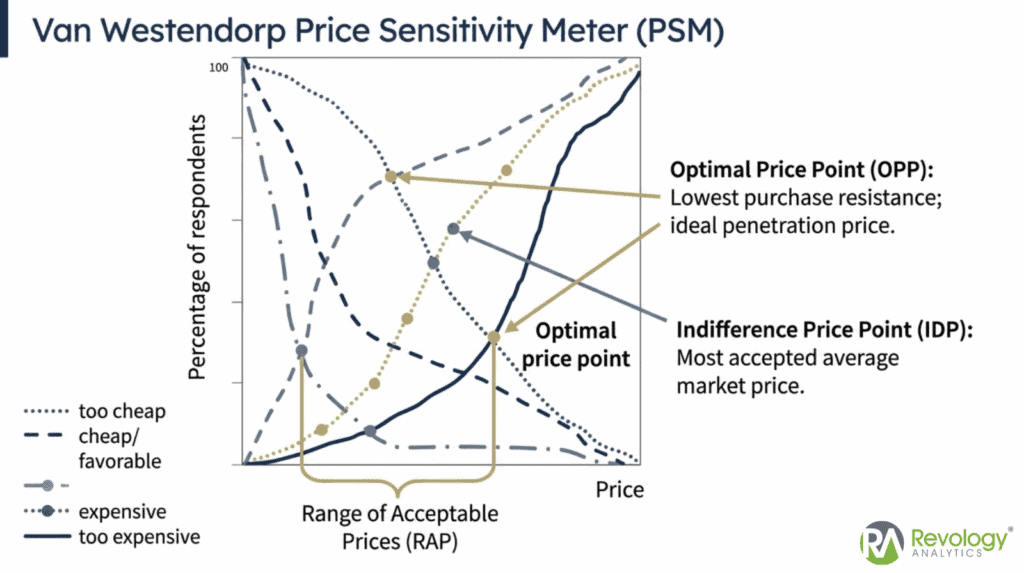
•Van Westendorp: best for early-stage products where acceptable ranges are unknown; fast, with a low sample requirement (about 100 respondents)
•Gabor-Granger: efficient for incremental price adjustments to existing offerings; its sequential structure converges quickly
•Conjoint analysis: standard for complex decisions involving multiple attributes; requires larger samples (about 300 or more) and careful experimental design
A combined approach uses Van Westendorp for baseline range-setting and Gabor-Granger or conjoint analysis for precise targeting.o Use Each)
Behavioral: Price Tests, Natural Experiments, Historical Price Variation
With sufficient transaction volume, behavioral methods provide the most credible estimates. A/B price tests with randomized assignment yield clear causal results. Natural experiments, such as tariff changes, regional price adjustments, or competitor exits, offer quasi-experimental variation. Modeling historical price variation econometrically requires careful handling of endogeneity, as prices often rise when demand is strong, creating a misleading positive correlation. Techniques such as double machine learning address this by isolating exogenous price variation.
Econometric: Demand Curves, Elasticity Models, Hierarchical Models
Standard log-log demand models estimate constant elasticity across the observed price range. Hierarchical (multilevel) models estimate segment-specific elasticities with shrinkage toward a global mean, reducing noise in segments with limited data. A global weighted master model, which estimates across product families with two-level shrinkage, stabilizes estimates for portfolios with many SKUs.
Stated Preference: Surveys
When behavioral data is sparse (new products, new markets, significant price changes beyond historical range), survey methods fill the gap. The choice of method depends on the decision at hand: Van Westendorp works well for establishing price boundaries, Gabor-Granger for point optimization, and conjoint for multi-attribute trade-off analysis.
Qualitative: Interviews to Validate Drivers and Reference Prices
No quantitative model fully captures context. Structured interviews with buyers, sales representatives, and channel partners validate whether the drivers identified by your model, such as substitutability, budget share, and urgency, match actual decision behavior. These interviews also reveal reference prices, the benchmarks customers use, which influence sensitivity regardless of objective cost.
How to Calculate Pricing Sensitivity (Core Calculations)
Simple Elasticity Calculation and Interpretation
The arc elasticity formula provides a starting point:
E = (% change in quantity) ÷ (% change in price)
An E of −1.5 means a 10% price increase predicts a 15% volume decline. Values between 0 and −1 indicate inelastic demand, where price increases raise revenue. Values beyond −1 indicate elastic demand, where price increases reduce revenue.
Segment-Level Sensitivity and Confidence Intervals
Aggregate elasticity hides actionable variation. Estimate segment-level elasticities and include confidence intervals. For example, a segment with E = −0.8 ± 0.3 supports a confident price increase, while E = −0.8 ± 1.5 indicates that your data cannot distinguish inelastic from elastic behavior.
Price-Response Curve and Revenue/Margin Maximizing Price
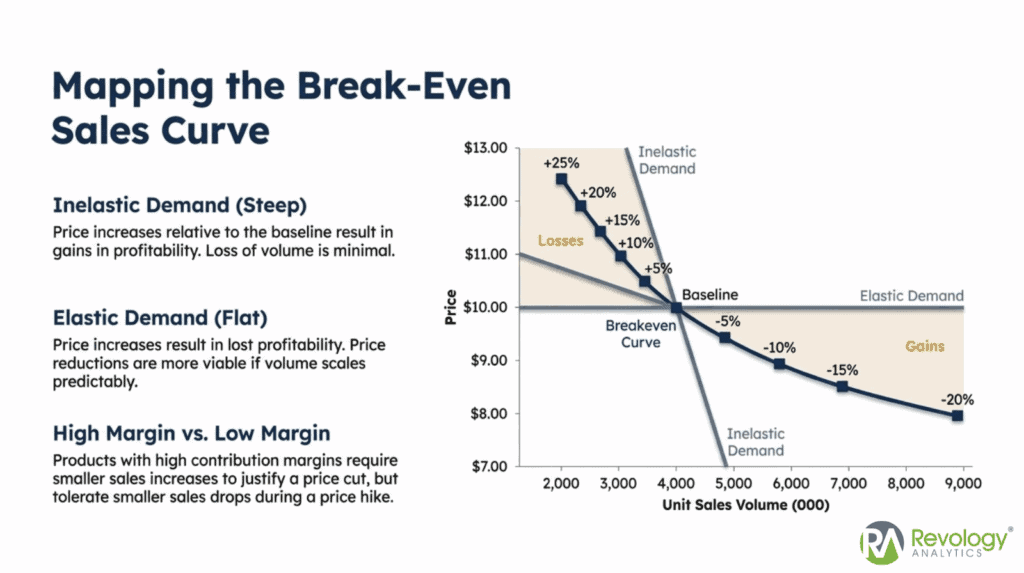
Plot the price-response curve, showing demand as a function of price, for each segment. The revenue-maximizing price is where marginal revenue equals zero. The margin-maximizing price is where marginal profit equals zero and is usually higher than the revenue-maximizing point.
The GP break-even elasticity formula provides a critical sanity check:
Break-Even E = −1 ÷ (Current GP% + Price Change %)
If the estimated elasticity is more negative than break-even, the price increase reduces gross profit. This calculation prevents the common error of applying increases to segments where the data does not support them.
KPIs to Track (Before, During, and After Changes)
Commercial KPIs
Monitor conversion rate, win rate, average revenue per account (ARPA), and discount rate. A successful, sensitivity-informed price change should increase ARPA and reduce average discount depth without significantly reducing conversion or win rate.
Profit KPIs
Gross margin, contribution margin, and CAC payback period isolate whether price changes translate to bottom-line improvement.
Data Point: An industrial fastener distributor that applied targeted, sensitivity-based pricing captured $5.9 million in gross profit while losing only 1.6% of volume, a result not achievable with a blanket price increase.
Customer KPIs
Track churn, expansion revenue, NPS/CSAT trends, and support ticket volume. Price increases that exceed segment WTP typically appear first in satisfaction scores and support volume before affecting churn rates.
Guardrail KPIs
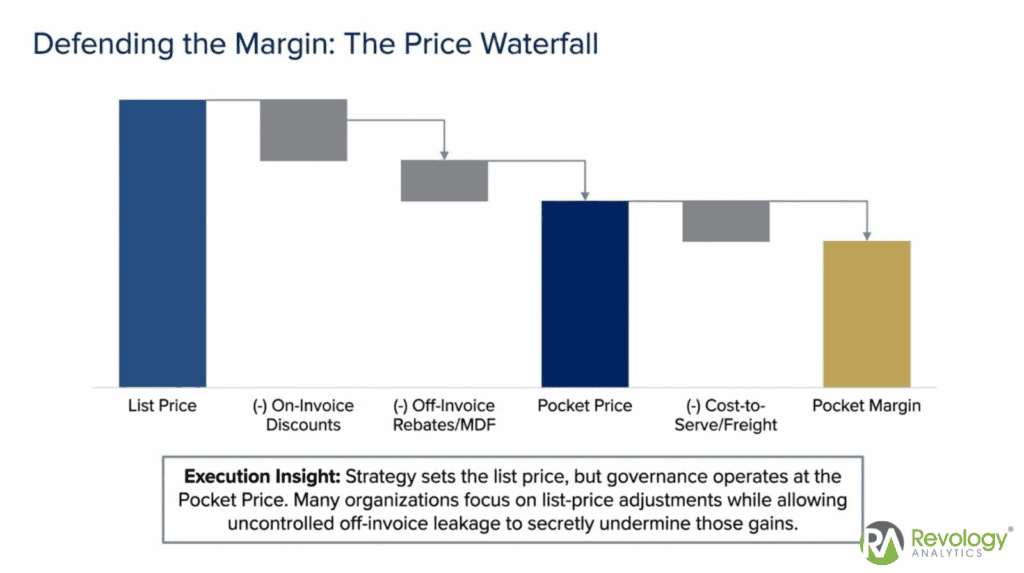
Price realization (actual versus list), leakage rate (revenue lost to unauthorized discounts), and exception rate (percentage of transactions requiring manager override) indicate whether the pricing strategy is being executed as intended. These metrics serve as an early-warning system, distinguishing a well-governed rollout from one that deteriorates in the field.
Worked Example: Sensitivity Analysis for a B2B Offering
Scenario Setup
A B2B distributor serves three segments: high-margin specialty accounts (40% GP), mid-tier standard accounts (25% GP), and low-margin commodity accounts (12% GP). The company is considering a 10% list price increase across all segments.
Build a Simple Demand Curve and Compare Price Points
Historical transaction analysis reveals segment elasticities of −0.4 (specialty), −1.2 (standard), and −3.5 (commodity). Apply the break-even formula:
Break-Even Analysis by Segment
•Specialty (40% GP): Break-Even E = −1 ÷ (0.40 + 0.10) = −2.0. Estimated −0.4 is well inside break-even. The increase adds significant profit.
•Standard (25% GP): Break-Even E = −1 ÷ (0.25 + 0.10) = −2.9. Estimated −1.2 clears break-even, but with less cushion. A smaller increase reduces risk.
•Commodity (12% GP): Break-Even E = −1 ÷ (0.12 + 0.10) = −4.5. Estimated −3.5 is inside, but leaves a thin margin for error. Competitive pressure makes full pass-through dangerous.
Choose a Price and Define Fences
The analysis supports a differentiated approach instead of a uniform 10% increase: 10% increase (high confidence, wide break-even cushion)
2. Standard: 5% increase with enhanced service terms (moderate confidence, value justification)
3. Commodity: hold or 2% increase (thin margin, competitive risk)
Structural fences between the three groups include contract tier thresholds, minimum order quantities, and annual volume commitments.
Key Insight: A uniform 10% increase would have reduced profit in the commodity segment and under-captured value in the specialty segment. Segment-level sensitivity data enabled three calibrated decisions instead of one risky one.
What to Communicate Internally and Externally
Equip the sales team with segment-specific messaging focused on value delivered rather than cost incurred. Externally, communicate price changes with a clear value narrative, highlighting product improvements, service enhancements, and market context, tailored to each segment’s sensitivity profile.
Common Pitfalls and How to Avoid Them
Confusing Correlation with Causation in Historical Pricing
Prices and volume often move together for reasons unrelated to sensitivity (seasonality, promotions, competitive entry). Econometric models must address endogeneity through instrumental variables, difference-in-differences designs, or ML-based causal frameworks. Without causal identification, your elasticity estimate may reflect demand shifts rather than price response.
Mixing Segments and Averaging Away Real Differences
A single elasticity estimate across diverse segments is worse than no estimate, as it creates false precision. Always estimate at the segment level, even if confidence intervals are wide. Wide intervals indicate a need for more data, not for averaging.
Ignoring Competitive Response and Reference Price Effects
Your price change does not occur in isolation. Competitors may match, undercut, or ignore your move. Reference price effects mean a price increase can shift customers’ internal benchmarks, making future increases more difficult or easier. Scenario planning should include at least three competitive response states: match, undercut by 50%, and no response.
Over-Discounting and Training Customers to Wait
Research shows that 48% of consumers would stop buying a brand entirely if it eliminated deal-based pricing, an all-time high. Chronic discounting creates dependency. Sensitivity-informed pricing replaces blanket discounts with targeted, value-justified price adjustments that preserve margin integrity.
Implementation Roadmap (30–90 Days)
0–30 Days: Data Audit, Segmentation, Hypotheses
Audit transaction data for completeness and quality. Define preliminary segments using available attributes. Formulate hypotheses about which segments are most and least sensitive, and identify data gaps that prevent testing these hypotheses.
Priority Actions
1. Extract 12+ months of transaction data with price, volume, discount, and channel fields
2. Tag each transaction with the customer segment and product tier
3. Document known data gaps and identify supplementary sources (CRM win/loss records, survey history)
4. Brief sales leadership on the initiative and gather initial qualitative input on segment sensitivity
31–60 Days: Run Tests/Surveys, Model, and Validate
Execute your chosen measurement approach, whether behavioral tests, surveys, or both. Build segment-level elasticity models. Validate results with sales leadership and customer success teams, not to override the data, but to identify contextual factors the model may miss.
61–90 Days: Rollout Plan, Enablement, Governance, and Monitoring
Define the rollout sequence: which segments, which products, which channels first. Build sales enablement materials with segment-specific pricing guidance. Establish governance: approval workflows, exception escalation paths, and a monitoring cadence that reviews KPI dashboards weekly during the first 90 days post-change.
How to Use Sensitivity Insights in Pricing Strategy
Packaging and Tier Design
Use segment-level WTP to design packages that differentiate buyer groups. High-WTP segments receive premium tiers with value-added features. Price-sensitive segments receive streamlined offerings at accessible price points. The goal is to capture maximum value from each segment without a one-size-fits-all approach.
Discount Policy and Approval Workflows
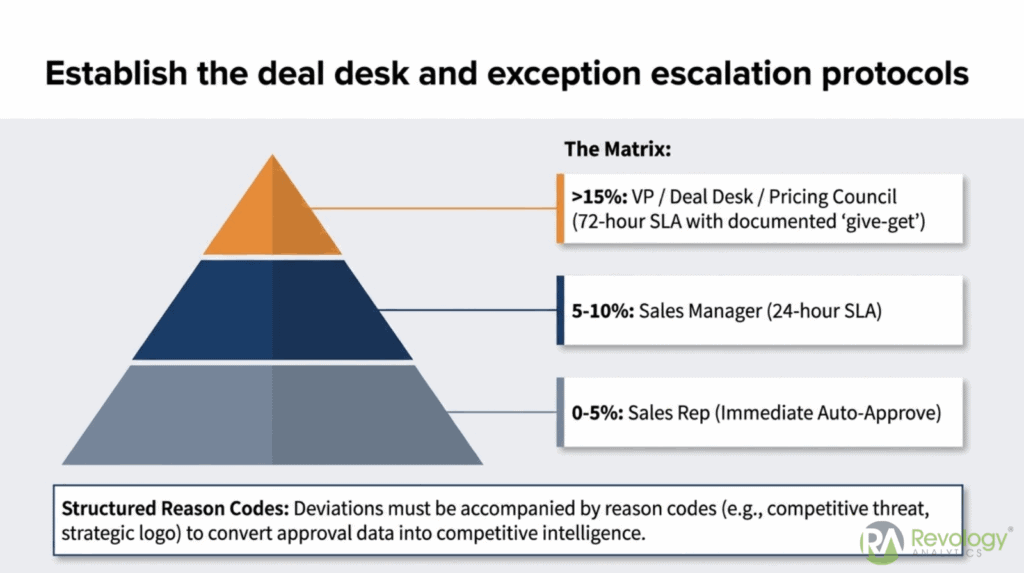
Replace ad-hoc discounting with sensitivity-based discount bands. Set target, stretch, and floor prices by segment. Require escalation for any discount below the floor. This structure reduces leakage while allowing sales representatives flexibility within defined limits.
Price Increase Planning: Who to Exempt, How to Phase, How to Message
Segment-level sensitivity data tells you exactly who absorbs an increase, who needs phased implementation, and who should receive a hold in exchange for volume commitments.
The Volume Hurdle Asymmetry
•A 15% price cut requires 43% volume growth to break even on gross profit.
•A 15% price increase maintains profitability even with a 23% volume loss.
This asymmetry is the strongest argument against reflexive discounting. The math supports holding or increasing prices in nearly every scenario where sensitive data justifies it.
Frequently Asked Questions
What Is the Meaning of Pricing Sensitivity?
Pricing sensitivity measures the degree to which a buyer’s purchase behavior changes in response to a price change. High sensitivity means small price changes produce large behavioral shifts; low sensitivity means prices can move without materially affecting demand.
What Is an Example of a Price-Sensitive Product?
Gasoline is a classic example: minimal brand differentiation, high transparency, and easy switching drive acute sensitivity. Grocery staples, commodity chemicals, and undifferentiated industrial inputs follow similar patterns.
What Is the Price Sensitivity Method?
The Van Westendorp Price Sensitivity Meter is the most widely referenced “price sensitivity method.” It uses four survey questions – too expensive, too cheap, expensive but acceptable, bargain – to map acceptable price ranges for a product or service.
How Do You Calculate Price Sensitivity?
The simplest calculation is arc elasticity: E = (% change in quantity demanded) ÷ (% change in price). For segment-level precision, econometric models estimate elasticity coefficients from transaction data with appropriate controls for confounders.
What Is Another Name for Price Sensitivity?
Price sensitivity is also referred to as price consciousness, price responsiveness, or demand elasticity, depending on the academic or practitioner context.
What Are the 5 C’s of Pricing?
The 5 C’s – Cost, Customer, Competition, Channel, and Context – provide a strategic framework for pricing decisions. Sensitivity analysis directly informs the Customer and Competition dimensions.
Diagnostic Checklist and Next Steps
Quick Self-Assessment: Data Readiness, Segmentation, Governance
Ask yourself these three questions:
1. Do you have at least 12 months of transaction data with price, volume, discount, and segment tags?
2. Can you articulate three to five customer segments with distinct price sensitivities, backed by data rather than intuition?
3. Is there a governance process that translates elasticity estimates into pricing guidelines with approval thresholds and exception escalation?
If you answered “no” to any of these, you have a specific, addressable gap, not a reason to delay.
What to Do If You Have Limited Price Variation or Small Samples
Limited price variation is common in B2B environments with annual contracts. Survey-based methods such as Van Westendorp, Gabor-Granger, and conjoint analysis supplement behavioral data when transaction history is limited. Even a well-designed study with 200 respondents can produce actionable segment-level WTP estimates.
When to Bring in Support and What to Expect from a Diagnostic
A pricing diagnostic typically takes four to six weeks and produces segment-level sensitivity estimates, a prioritized list of pricing actions, and a financial impact model quantifying revenue and margin opportunities. Organizations that complete structured sensitivity programs report recurring gross profit gains of 4 to 15 percent, with outcomes that compound annually.
Book a pricing and revenue management diagnostic call to identify where sensitivity-informed pricing can strengthen your margin architecture.