
A causal-inference framework for pricing and revenue management teams that need cleaner elasticity signals than typical regression models can deliver.
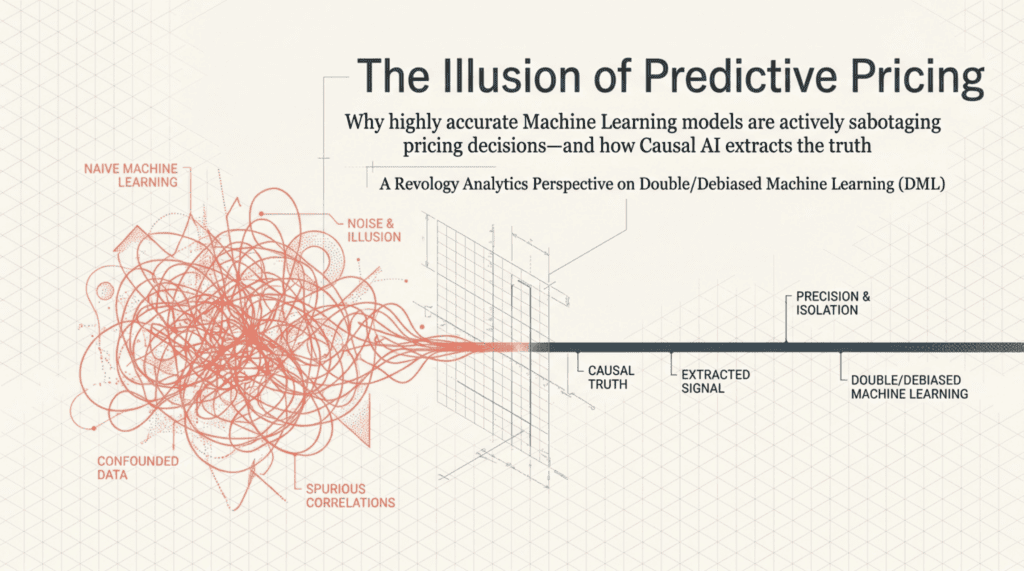
The illusion of predictive pricing: highly accurate ML models can still produce biased elasticity estimates. Double machine learning extracts the causal truth from the noise.
Pricing teams often rely on basic elasticity estimates that look great on slides but crumble under a CFO’s scrutiny. The issue is bias, not sophistication: almost all production estimates are skewed by unmeasured variables like concurrent promotions, assortment shifts, competitive responses, and seasonality.
Naive elasticity tells you what correlated with price; causal elasticity tells you what would happen if you changed price. Those are not the same number, and the gap between them is where bad pricing decisions live. Double machine learning price elasticity — DML for short — closes that gap by using a two-stage residualization that enables flexible machine-learning models to handle high-dimensional confounders while preserving an interpretable causal estimate of the price effect.
According to Revology’s research of 2,000 global companies, “Pricing Still Packs a Punch” (June 2025), a 1% improvement in price realization produces a 6–7% lift in operating profit (10–11% ex-regulated industries). Getting elasticity right is not a math exercise. It is the difference between a price move the CFO can underwrite and one that depends on luck. This guide provides a practitioner framework for double machine learning price elasticity — seven steps from problem definition to operationalized output — along with a worked B2B example, a KPI scorecard, and a 90-day implementation roadmap. The framework builds on the foundations laid out in our guide to modeling price elasticity of demand and the deeper methodology in our advanced price elasticity modeling capability.
Table of Contents
What is double machine learning price elasticity?
Double machine learning price elasticity — also called debiased machine learning — is a causal inference technique introduced by Chernozhukov et al. (2018). The core idea is to separate the causal part of the price–demand relationship from the correlation-driven part, driven by confounders. It does this by fitting two flexible nuisance models — one for the outcome (demand) and one for the treatment (price) — and then estimating the causal effect from the residuals rather than the raw variables. The result is a cleaner causal estimate of how demand responds to price, subject to the usual confound and variation checks, with valid confidence intervals.
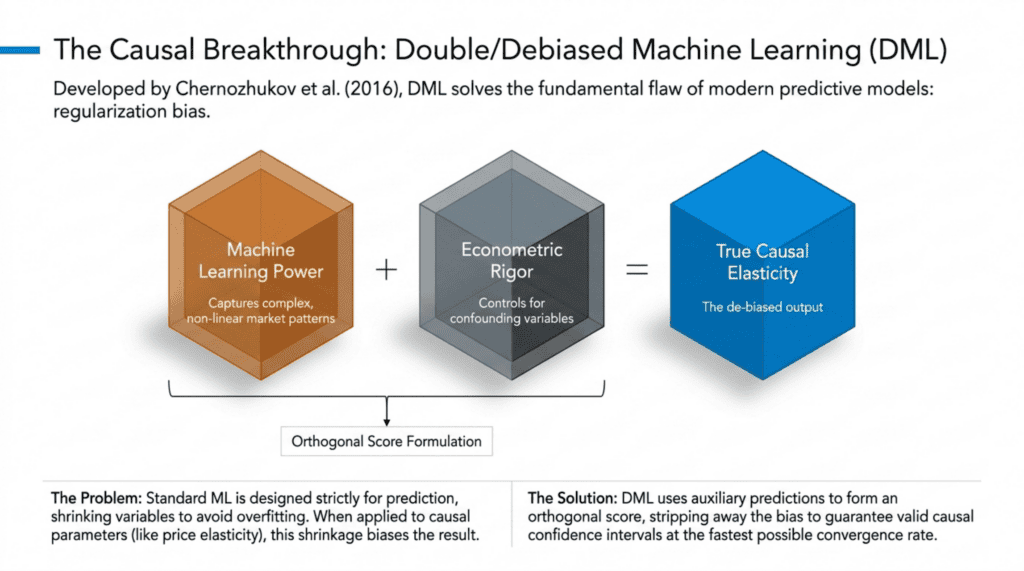
The causal breakthrough: double machine learning combines ML’s pattern-detection power with econometric rigor through an orthogonal score, producing a cleaner estimator of true price elasticity.
Definition of double/debiased machine learning in plain English
You have transaction data. You want to know whether a 5% realized-price move will hold margin without unacceptable volume loss. The naive answer is to regress log(volume) on log(price) and read off the coefficient. The problem is that price and volume are both being moved by other things — promotions, seasonality, competitive moves, channel mix shifts, assortment changes — and the coefficient absorbs all of those effects. DML asks two simpler questions: (1) Given everything I know about a period (promotions, season, competition, mix), what was the expected price? (2) Given the same context, what was the expected volume? Then it looks at the deviations from expectation on both sides. The relationship between residualized price and residualized volume is the causal effect, because the part of price and volume that could be predicted by the confounders has been removed.
How double machine learning price elasticity differs from causal vs. predictive elasticity
Predictive elasticity is the best fit to historical co-movement. It’s the right tool when you want to forecast volume given a price you’ve already committed to. A causal elasticity is what you need when you’re choosing a price — when the question is “what will happen if we move the price?” rather than “what did happen when price and volume moved together?” DML estimates causal elasticity. The mechanical difference is small (residualization, cross-fitting). The practical difference is large: causal elasticity holds up under intervention. Predictive elasticity often does not.
When this method is appropriate — and when a simpler log-log model is enough
DML earns its keep when (a) your data is observational, not from a controlled price experiment; (b) the confounding set is high-dimensional or includes non-linear effects; (c) the decision is high-stakes — list-price changes on a major SKU line, deal-desk policy, segment-level price strategy. If you’re moving by a few cents on a low-stakes promotional item where the confounders are clearly bounded, log-log is probably enough. Reserve DML for the decisions that need to survive a CFO’s first question.
Why most price elasticity estimates lie to you
The technical reason is straightforward: ordinary least squares regression of log(volume) on log(price) recovers a causal coefficient only when price is uncorrelated with the unobserved drivers of volume. In observational pricing data, this condition almost never holds.
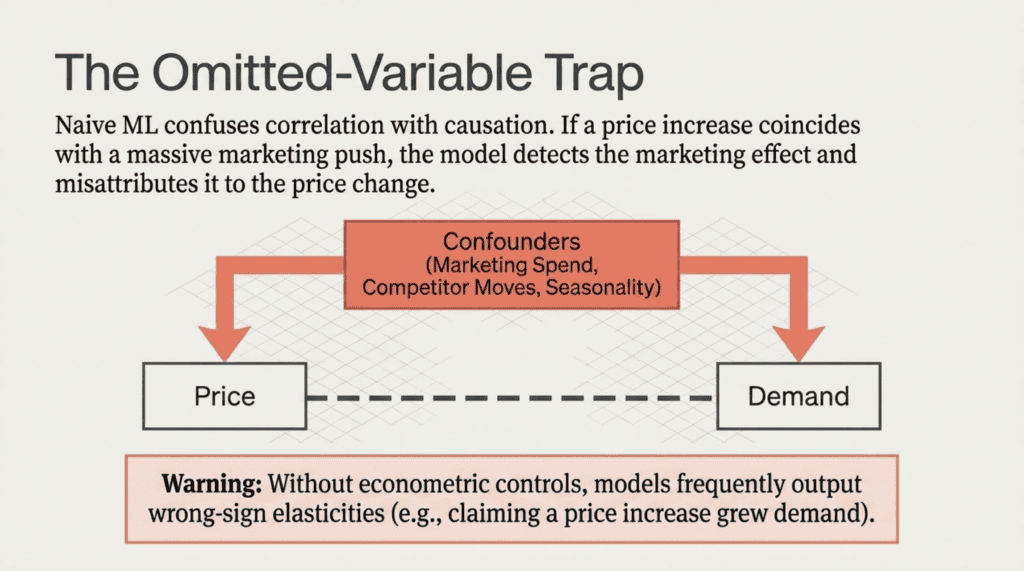
The omitted-variable trap: when confounders such as marketing spend, competitor moves, and seasonality move with price, naive models misattribute the volume effect — sometimes producing wrong-sign elasticities.
Endogeneity from promotions, sales actions, and competitive response
Promotions and prices are correlated by construction — you ran the promotion because you changed the price, or you changed the price because you ran the promotion. Naive elasticity attributes the entire volume swing to the price move, which inflates the estimate and produces over-confident downward recommendations (“if we cut the price 10%, demand will jump 30%”). Promotional intensity is doing most of the work. Competitive response creates the same problem in the other direction. You raise the price; your competitor follows. Volume holds. The naive coefficient says you have low elasticity, when in fact you have a co-moved market. The next time you raise the price alone, volume drops sharply, and the model misses it entirely.
Omitted variables — seasonality, assortment changes, channel mix shifts
Seasonality is the easy omission to model — most teams parameterize it. The harder omissions are assortment changes (the SKU mix in market shifted between the two periods being compared), channel mix shifts (more sales moved through the e-commerce channel where prices and elasticities differ), and customer mix changes (a large account churned or onboarded). All of these correlate with both price (because list-price decisions track them) and volume (because they directly move it). Naive elasticity absorbs the effect; DML residualizes it out.
Bias from naive regression and the “just run a log-log” reflex
The “just run a log-log” reflex is a real workflow pattern. It survives because the coefficient looks reasonable and the model fits. Goodness of fit is not the right diagnostic for a causal estimate. A model can fit historical data perfectly and still produce a biased estimate of what would happen under intervention. This is the analytical error we see most often in pricing reviews — and the most expensive one, because biased elasticity produces biased recommendations that lead to real margin loss.
Key Insight: A model that predicts demand accurately is not the same as a model that estimates elasticity correctly. The first answers “what will happen?” The second answers “what would happen if we moved price?” Most pricing teams ship the first when they need the second.
Why this matters for pricing and revenue management
Pricing is the most leveraged action a business can take. The margin leverage is well-established in Revology’s benchmark: a 1% improvement in price realization produces a 6–7% increase in operating profit for the median firm, and 10–11% in unregulated industries (Revology Analytics, “Pricing Still Packs a Punch,” June 2025). The CFO’s question — “How confident are you in this elasticity estimate?” — is not academic. It’s the gate between a defensible decision and a guess.
Better price change decisions and reduced regret moves
A causal elasticity estimate produces narrower decision ranges on price moves. Where naive elasticity tells you “demand will fall somewhere between 2% and 30%,” a well-validated DML model can often tighten that to “5% to 12% with 80% confidence.” That tighter range changes which moves are recommended, which are held, and which are escalated. Most pricing regret comes from moves the team thought were lower-risk than they actually were.
Discount governance that holds up to CFO scrutiny
Discount discipline depends on knowing how much volume a given discount actually buys. If your elasticity is biased upward (because promotional confounding inflated it), your team will over-discount, believing demand response is stronger than it really is. The audit trail at year-end shows margin leakage with no offsetting share gain. A properly built estimate gives the deal desk a defensible guardrail.
More credible revenue forecasts and scenario planning — the 1% realization → 6–7% OP lift math
Revenue forecasts under different price-move scenarios are only as credible as the elasticity input. Finance eventually learns whether the team’s elasticity inputs are decision-grade. When forecasts repeatedly miss because elasticity was biased, the team loses authority — and pricing recommendations stop getting funded. DML is a credibility-protection tool as much as a precision tool.
Core terminology and concepts (the math sidebar)
This is the section your analytics lead will pressure-test. If you’re a pricing executive, the operational sections below are what matter — skim this. If you’re the analyst building the model, read carefully.
Treatment, outcome, controls, and nuisance models
In causal-inference language, price is the treatment (T), volume is the outcome (Y), and everything else — promotions, season, competition, mix — is the control set (X). A nuisance model is any model whose output we’re going to subtract off rather than interpret directly. DML fits two nuisance models: one predicting T from X (the price model), and one predicting Y from X (the volume model). Neither needs to be interpretable. Both need to be accurate enough to remove confounding structure without overfitting.
Orthogonalization and residualization explained simply
Orthogonalization is the formal name for what residualization does: remove the part of T and Y that the controls X can explain, and look only at the leftover. Mathematically, if the residualized price is T̃ = T − E[T|X] and the residualized volume is Ỹ = Y − E[Y|X], then regressing Ỹ on T̃ gives a clean estimate of the causal coefficient. The “double” in double machine learning refers to using ML for both nuisance models — letting flexible models like gradient boosting or random forests capture non-linear control effects that linear regressions miss.
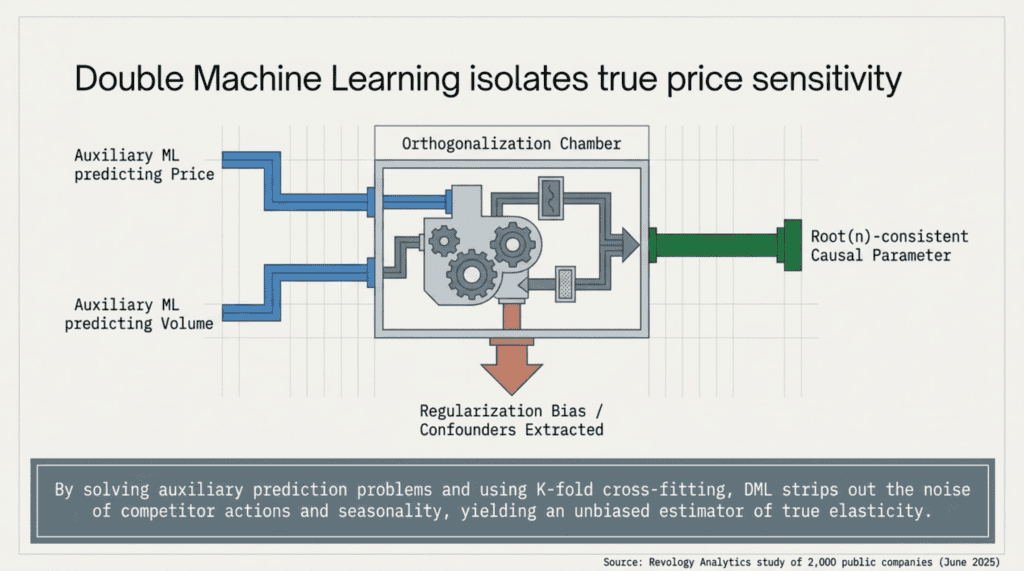
The orthogonalization chamber: auxiliary ML models predict price and volume separately, then the causal price effect is recovered from the residuals — root-n consistent under cross-fitting.
Heterogeneous treatment effects by segment, product, or channel
Most pricing decisions aren’t about a single average elasticity — they’re about which segment responds how much. DML extends naturally to heterogeneous treatment effects (HTE), where the coefficient varies as a function of segment attributes. Tools such as EconML and DoubleML implement this directly. The output should not be a single portfolio average — it’s a segment-level elasticity surface, which is what pricing teams actually need for a tiered price strategy.
The 7-step double machine learning price elasticity framework
This is the practitioner framework. Each step has a deliverable, a decision rule, and an exit criterion. Don’t skip steps; the value of DML comes from disciplined execution, not from sophisticated modeling.
Step 1 — Define the pricing decision and business question
Start with the decision the pricing committee has to approve. Are you setting a list price for a new SKU? Adjusting a tier ladder? Quantifying the margin cost of a deal-desk discount policy? The decision dictates which elasticity to estimate (overall, segment-level, channel-level), what time window to use, and what the action threshold should be. The deliverable here is a one-paragraph decision statement: what move is on the table, what segments are in scope, what time horizon matters, and what level of precision would change the recommendation. Without this, every downstream choice drifts toward “do everything,” and the project loses focus.
Step 2 — Specify outcome, treatment, and control variables
The outcome Y is usually log-volume or log-revenue. The treatment T is log-price (list, pocket, or net — be explicit about which). The control set X should include everything that plausibly affects both Y and T: promotional intensity, competitor pricing, seasonality, channel mix, customer cohort, product attributes, macroeconomic context. A useful test: would I be uncomfortable defending the estimate to a domain expert if I left this variable out? If yes, include it. If you can’t measure it, document the omission and assess the risk; DML handles many confounders, but it can’t recover from a missing one.
Step 3 — Build nuisance models for price and demand drivers
Fit a flexible ML model predicting T from X (the price model) and another predicting Y from X (the volume model). Gradient boosting (XGBoost, LightGBM) is usually the first model to test — it handles mixed feature types, non-linearities, and interactions without much tuning. Random forests work too. Linear models are usually too restrictive for the kind of control surface that pricing data has. The deliverable is two fitted models with held-out predictive performance documented. You don’t need spectacular performance — you need unbiased prediction, which usually means cross-fitting (see Step 5).
Step 4 — Residualize and estimate the causal effect
Compute the residuals: T̃ = T − T̂ and Ỹ = Y − Ŷ. Regress Ỹ on T̃ (linear regression is fine here; the nuisance ML has already done the heavy lifting). The coefficient is your causal elasticity estimate; the standard error is valid for inference. For heterogeneous effects, regress Ỹ on T̃ interacted with segment variables — or use a dedicated HTE estimator from EconML / DoubleML. The output is the segment-level elasticity surface that informs tiered price strategy.
Applying the framework in practice
The previous four steps produce a number. The next three steps make it usable.
Step 5 — Validate assumptions and model stability with cross-fitting
Cross-fitting splits the data into K folds, fits the nuisance models on K-1 folds, residualizes on the held-out fold, and rotates through. This breaks the bias that arises from using the same data twice. Use K=5 or K=10. Check that the elasticity estimate is stable across folds — if it swings wildly between K=5 and K=10, or between random seeds, your nuisance models are over-fitting and the estimate is fragile.
Step 6 — Convert estimates into elasticity ranges and decision rules
A point estimate is not a pricing recommendation. Convert the elasticity into an expected price–volume–revenue–margin range across the move sizes the team is considering. Pair the range with a confidence band. The output the pricing committee sees should be: “At a 5% price increase, expected volume change is −6% ± 2pp (80% confidence). Expected revenue is +X% to +Y%. Expected margin is +A% to +B%.” The decision rule is the threshold at which the recommendation flips. Document it. “Recommend the increase if expected margin lift exceeds 200 bps at 80% confidence; hold otherwise.” Decision rules make the team’s choices auditable and reduce the meeting time spent debating the same trade-off in every cycle.
Step 7 — Operationalize outputs for pricing teams and sales enablement
Elasticity that lives in a notebook is not operational. Push the segment-level elasticity surface into the pricing system — as a lookup, a recommended-range column, or a guardrail in the deal-desk workflow. Build a simple feedback loop: every quarter, compare predicted volume response to realized volume response, by segment. When the gap exceeds a threshold, retrain. When it stays small, increase the team’s trust in the estimate.
Practitioner Note: A DML model that no one uses is a research project. The difference between a research project and an operational asset is the feedback loop and the sales-enablement layer. Build both.
Data inputs required
DML’s appetite for data is rarely the binding constraint. In B2B, the binding constraints are usually price variation, control visibility, and quote-history quality.
Transaction, quote, and list-price history
Two to three years of transaction-level data is the typical minimum. For B2B with long sales cycles, you may need more; for fast-moving consumer with weekly seasonality, less. The data should include net price (after all discounts), list price, volume, SKU, customer, channel, and date.
Promotions, discounts, and sales interventions — the confound layer
This is the most important control. Every promotional event, every deal-desk approval, every sales action that touched the transaction should be observable. If your CRM doesn’t capture deal-desk approvals or sales reps don’t log discount reasons, you have a confound layer you can’t see — and DML can’t residualize what it can’t observe.
Product, customer, channel, and time features
Product attributes (category, tier, lifecycle stage), customer attributes (segment, size, tenure), channel (direct, distributor, e-commerce), and time (year, quarter, month, week) round out the control set. Each addition usually improves the nuisance model’s predictive power and tightens the residualization.
Competitive and market context signals
Competitor list prices, competitor promotional activity, and macroeconomic indicators (relevant to your sector) belong here. The richness depends on how much competitive intelligence the team can sustain. Even sparse data — quarterly competitor price snapshots, sector PPI from BLS — is usually better than nothing.
Model design choices and trade-offs
DML is a framework, not a single model. The design choices matter.
Log-log vs level models
Log-log models estimate constant elasticity — a 1% price change always produces the same percentage volume change. Level models allow elasticity to vary with price level. For most pricing decisions, log-log is a good first pass; switch to level models when the price range under consideration is wide enough that constant elasticity becomes implausible.
Cross-fitting, sample splitting, and regularization
Always cross-fit. K=5 is the standard. Use early stopping and regularization in the nuisance models to prevent overfitting; the consequences of an overfit nuisance model are subtle but real (biased residualization, biased causal estimates).
Segment-level vs pooled estimation
Pooled estimation yields a single average elasticity. Segment-level estimation gives you a surface. Pooled is easier to defend to executives; segment-level is what the pricing committee actually needs. Build both. Lead the conversation with the segment-level surface; fall back to the pooled estimate when the segment data is too thin.
Python workflow considerations — econml, DoubleML, scikit-learn
EconML (from Microsoft Research) is the most production-ready library for HTE estimation in double machine learning price elasticity work. DoubleML (academic-led, with a Python port) is the most faithful to the original Chernozhukov framework. Both are well-documented and well-maintained. For a first DML project, EconML’s LinearDML and CausalForestDML are good starting points; switch to DoubleML when you need the full set of orthogonal estimators.
KPIs to track after deployment
A DML elasticity isn’t a one-time deliverable. It’s an asset that needs ongoing monitoring.
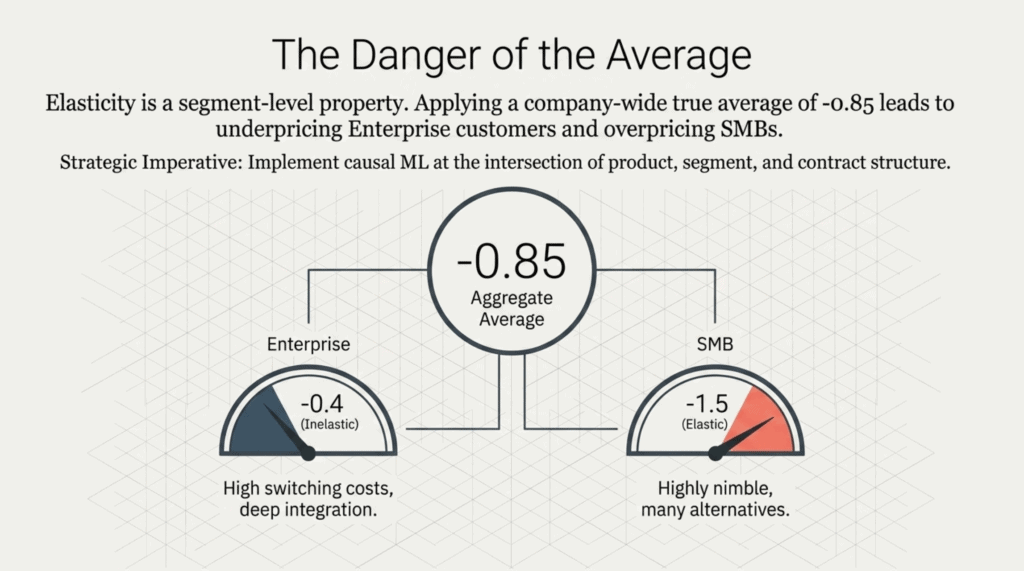
The danger of the average: applying a portfolio-average elasticity overprices SMB and underprices Enterprise. Heterogeneous treatment effects from DML surface the segment-level surface that the pricing committee needs.
Realized price uplift and margin impact
- The financial outcome from the price moves taken on the recommendation.
Forecast accuracy and elasticity stability over time
- The rolling difference between predicted and realized volume response.
Discount leakage and exception rates
- Whether the deal desk policy holds when guardrails are set from the elasticity surface.
Adoption by pricing and commercial teams
- The fraction of price decisions that reference the elasticity output.
Track these monthly. Review with the pricing committee quarterly. Retrain the model when the forecast-vs-realized gap exceeds the calibration threshold or the underlying market structure shifts.
Worked example — estimating elasticity for a B2B product line
This example draws on an anonymized regulated health-care manufacturer with a pharmacy-channel product line. The denominator is the eligible brand-channel panel where price, volume, promotion, and field activity could be observed consistently — not total company revenue. The methodology is the same one we use in B2B, CPG, technology, and industrial categories; the numbers are directional ranges from the engagement and should be confirmed before publication.
Scenario setup — a mid-market manufacturer with promotional confound
The product line raised realized price by roughly 2% over a year. Units rose roughly 50% over the same window inside the eligible brand-channel panel. The naive elasticity calculation — percentage change in volume divided by percentage change in price — produced +24: a positive, mathematically nonsensical number implying that raising price grows demand. A pricing system that treats this output as signal would conclude the brand has infinite pricing power and would recommend further increases. The reality was different. Over the same period, the brand’s physician detailing activity had spiked significantly — a confound that perfectly coincided with the price move. The naive calculation was absorbing the marketing-driven volume lift into the price coefficient.

Case I — The Pharmaceutical Reversal: naive elasticity flagged a wrong-sign +24. After residualizing out the marketing confound, DML revealed inelastic captive demand at -0.44.
Inputs, model setup, and estimation logic
The DML model used a country × channel × brand × period panel with the following control set: market concentration (HHI), Top-3 competitor price index, marketing expenditures (with geometric adstock decay, λ = 0.6, to capture carryover), physician detailing calls (also adstocked), free-samples spend, distribution percentage, outlets stocking, and seasonality. Prices were CPI-deflated to strip macroeconomic inflation from the elasticity reading. The nuisance models used Ridge regression with cross-validation. Plausibility bounds were segment-specific: OTC brands were constrained to [−1.5, 0], while prescription brands were tighter at [−1.0, 0], reflecting captive demand for medical-necessity categories. For data-sparse cohorts, the framework used a hierarchical shrinkage approach — Brand Family → Country-Type → Type → Global — with reliability-weighted partial pooling. Cells with high standard error were shrunk toward the higher-hierarchy median; data-rich cells retained their direct estimate.
Interpreting results for pricing actions
After residualizing out the marketing and detailing confounds, the same brand’s DML elasticity estimate landed at −0.44 — comfortably in the inelastic range, consistent with a captive-demand prescription product. The +24 was a measurement artifact, not a market signal. The pricing recommendation was the opposite of what naive elasticity implied: targeted value-based price expansion was viable, but A&P marketing spend was hitting diminishing returns and should be reallocated toward distribution expansion. The same engagement showed similar patterns across two other brands: one with naive elasticity of +7, corrected to −0.75; another with comparable artifact-level numbers, corrected to single-digit-negative causal readings. Across the OTC portfolio, the median causal elasticity was −0.72; across the prescription portfolio, −0.45. The pricing committee used the causal output to redesign the strategic pricing corridors — small adjustments tied to the competitor index for elastic brands, value-based expansion for inelastic ones.
Common executive questions about the output
“Why is the new number so different from the old one?” The old number absorbed marketing and detailing effects that ran simultaneously with the price moves. The new number is the price-only effect, isolated by residualizing out the marketing confound. The two are answering different questions: what did happen vs. what would happen if we moved the price alone.
“How confident are you?” The DML output produces valid confidence intervals (the asymptotic theory holds when nuisance models are sufficiently flexible). For this brand, the 80% CI was −0.80 to −0.08 — wide, reflecting genuine uncertainty given the data sparsity, but unambiguously inelastic.
“What if we’re wrong?” The downside scenario at −0.80 still supports a modest price increase. The model’s failure mode is underestimation of price power, not overestimation. The kill switch is a 6-week post-move volume check against the predicted band; outside the band triggers a review.
A second pattern — when high model fit hides causal failure. A separate anonymized enterprise-hardware engagement showed the predictive-versus-causal trap from the other direction. The team ran a standard XGBoost demand model with full controls on 156 weeks of sell-through data across 50 SKUs. The model achieved an in-sample R² of 94% — an excellent predictive fit that validated the model but not the intervention logic. The elasticity coefficients it produced: median own-price elasticity of −4.00, cross-price elasticity of +7.40. Both are economically impossible at scale; both would have driven catastrophic pricing recommendations if treated as causal. After moving to a DML framework with ATT-weighted treatment focus and two-level empirical Bayes shrinkage, the same data yielded median own-price and cross-price elasticities of −1.04 and +0.41 — economically plausible, defensible to the pricing committee, and consistent across model variants. The headline insight from the rebuild: the B2B/enterprise segment showed elasticity of −0.94 with promo response of only +0.72, supporting a strategic shift away from deep B2B discounting (which the team had been doing reflexively) toward selective promotion-funding on the consumer-grade product families where promo elasticity ran at +1.86.
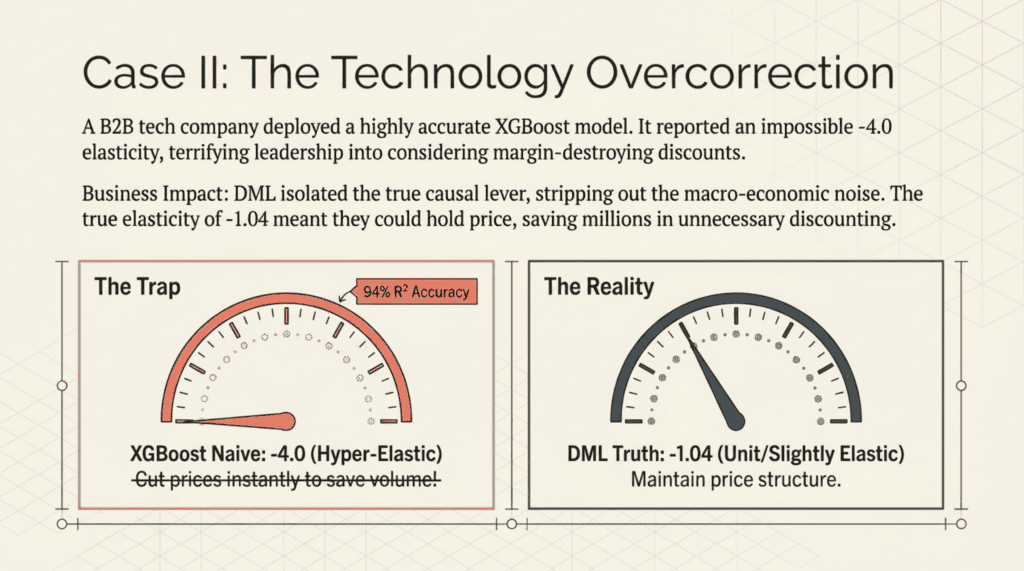
Case II — The Technology Overcorrection: a 94% R² XGBoost model produced an impossible -4.0 elasticity. DML corrected it to a plausible -1.04 and reframed the pricing recommendation.
Key Insight: A 94% R² model can still be a wrong-decisions machine. Predictive accuracy and causal validity are separate properties. DML is the discipline that keeps them separate.
Pitfalls and limitations
DML is powerful, but it isn’t magic.
Weak variation in price changes — when DML can’t help
If your historical price has barely moved, the residualized treatment T̃ has almost no variance, and the causal estimate is unstable regardless of how good your nuisance models are. The fix is to manufacture variation through controlled experiments (small geographic or customer-cohort A/B tests) rather than rely on observational DML.
Leakage from post-treatment variables
A variable that is itself caused by the price (e.g., a customer-level discount approved because of the price change) cannot be a control. Including it residualizes away the very effect you’re trying to estimate. The simplest rule: if the variable was determined after the price decision, it’s not a control.
Overfitting nuisance models
Aggressive hyperparameter tuning of nuisance models can introduce subtle bias in the residualization. Use early stopping, regularization, and stable cross-validation. Treat the nuisance models as boring infrastructure, not as showpieces.
Confusing prediction accuracy with causal validity
The nuisance model’s predictive RMSE is not a quality signal for the causal estimate. A nuisance model can have decent RMSE and still leave residual confounding if the confounder isn’t in the control set. The diagnostic for causal validity is sensitivity analysis (drop a control, check whether the estimate moves) and cross-fold stability.
Implementation roadmap for pricing teams
A realistic timeline for a first DML project — assuming an analyst with intermediate Python skills, decent data infrastructure, and pricing-committee buy-in.
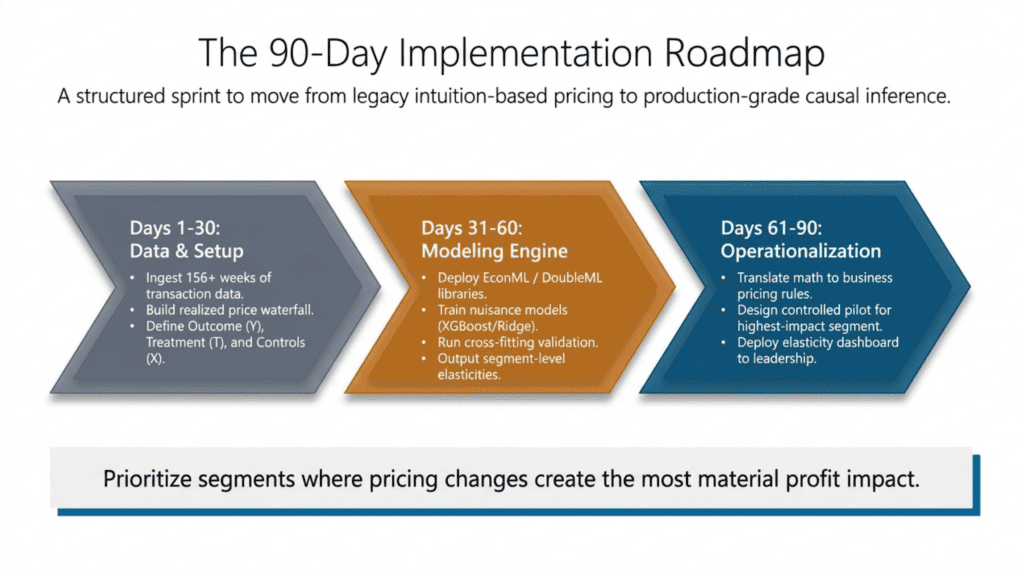
The 90-day implementation roadmap: a structured sprint from data audit through nuisance model build to operationalized pricing decision support.
30-day diagnostic and data audit
Map the decision (Step 1), inventory the data sources (Step 2 — outcomes, treatments, controls), and document the confound layer. Stand up a basic data pipeline. Deliverable: a one-page decision brief and a data-quality scorecard.
60-day pilot on one category or segment
Build nuisance models, residualize, and estimate elasticities for one product line. Validate with cross-fitting and a sensitivity analysis. Compare to the team’s prior naive estimate. Brief the pricing committee on the difference and the implications. Deliverable: an elasticity model, a comparison vs. baseline, and a draft recommendation.
90-day rollout into pricing workflows
Push the elasticity surface into the pricing system. Update deal-desk guardrails. Train the pricing analyst team on interpretation. Set the feedback loop. Deliverable: an operational pricing decision support layer, with monthly KPIs.
Governance, monitoring, and retraining cadence
Quarterly review with the pricing committee. Annual retrain or triggered retrain when calibration drifts. Annual sensitivity audit. Deliverable: a governance memo signed by the head of pricing and the CFO.
FAQ — double machine learning price elasticity
What is double machine learning in price elasticity estimation?
Double machine learning is a causal-inference framework that uses two flexible machine-learning models — one for the outcome, one for the treatment — to estimate the causal effect of price on demand while controlling for high-dimensional confounders. In pricing, it produces a cleaner elasticity estimate from observational data when naive regression would be biased by promotions, competitive response, mix shifts, and other unobserved variables.
How is double machine learning different from standard regression?
Standard regression assumes that the controls are correctly specified and that the relationship between the controls and the outcome is linear. DML uses flexible ML models for the control structure and recovers the causal effect from the residuals. The result is robust to non-linear confounding and produces valid confidence intervals when standard regression would not.
When should teams use causal inference for pricing?
Use causal methods whenever you’re making a price decision — choosing a list price, setting a discount policy, defining a tier ladder. Use predictive methods when you’re forecasting volume at a price you’ve already committed to. The two questions look similar but require different tools, and conflating them is a leading source of pricing error.
Can Python be used to estimate double machine learning price elasticity?
Yes. Two production-ready libraries are Microsoft’s EconML (LinearDML, CausalForestDML) and the DoubleML package (Python port of the original Chernozhukov framework). Both integrate cleanly with scikit-learn nuisance estimators and pandas data pipelines.
What sample size do you need for double machine learning price elasticity?
There’s no fixed minimum. The practical signal is variance in the residualized treatment — if your historical prices have barely moved, no sample size will rescue you. For B2B with monthly transaction data and meaningful historical price variation, 18–24 months is usually sufficient. For high-frequency retail, weekly data over 12 months can work.
Diagnostic Checklist and Next Steps
Self-assessment: Are you ready for DML in pricing?
Ask the team:
- Do we have at least 18–24 months of transaction-level data with prices, volumes, and observable promotions?
- Can we measure (or proxy) the major confounders — promotional intensity, competitive price moves, channel mix?
- Is there at least one specific, high-stakes pricing decision in the next two quarters where a sharper elasticity estimate would change the recommendation?
- Do we have an analyst with intermediate Python skills, or access to one, for 4–6 weeks of build time?
If the answer to all four is yes, DML is a strong investment. If two or more are no, fix the gating issue (data, decision focus, or talent) before building the model.
Resource-constrained path — what to do with a 2-person analytics team
Start with the highest-leverage segment and the simplest DML implementation. EconML’s LinearDML with a gradient-boosting nuisance model and 5-fold cross-fitting is a defensible minimum viable build. Skip HTE for the first project; the pooled estimate is enough to move the needle on a single high-stakes decision. Add HTE once the team has shipped one successful DML cycle.
When to bring in outside help
Pricing teams typically benefit from outside help when (a) the data architecture needs work before modeling can begin, (b) the team has limited causal-inference experience, and the decision is high-stakes, or (c) the pricing committee needs an external voice to bridge the technical work and the executive conversation. The 30-day diagnostic is usually the right scope for an outside engagement — it produces the decision brief and the data audit, hands the build to the in-house team, and stays available for the validation pass.
Book a pricing & revenue management diagnostic call to walk the DML framework against your specific data, decision context, and pricing committee structure.